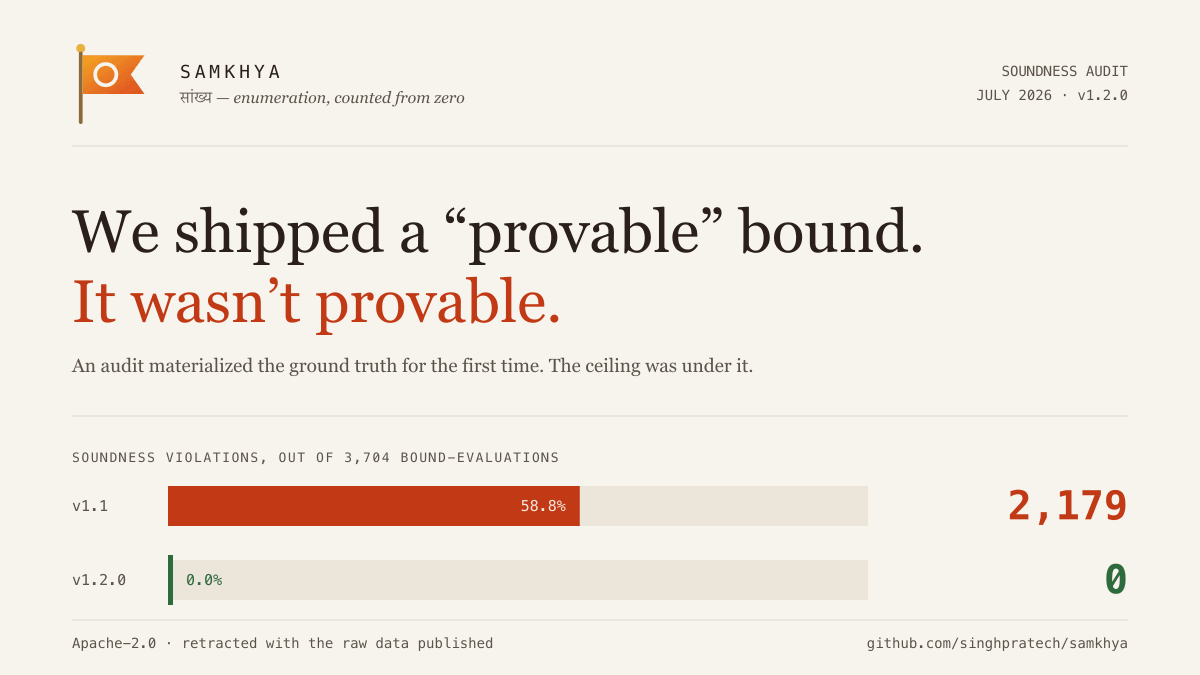
To solve this, we need a shift from simple prediction to verifiable bounds. If you are building a custom LLM agent or a database extension that optimizes queries, you can't just rely on a predicted_cost
value. You need a confidence interval that the optimizer can treat as a hard constraint.
The Technical Gap: Prediction vs. Provability #
In a standard AI workflow for query optimization, the model might output:Estimated Cost: 450ms
The optimizer sees this and chooses Plan A over Plan B (estimated at 600ms). But if Plan A actually takes 2000ms, the "prediction" was useless. A provable bound would instead look like:Cost: [400ms, 500ms] with 99% confidence
If the optimizer knows the worst-case scenario is 500ms, it can make a mathematically sound decision.
Practical Implementation: Adding Bounds to your AI Workflow #
If you're trying to implement this from scratch, you shouldn't just use a standard regression model. You need Quantile Regression or Conformal Prediction. Here is a basic example of how to structure a cost-prediction wrapper in Python using a quantile approach to get a "bound" rather than a single point.
import numpy as np
from sklearn.ensemble import GradientBoostingRegressor

lower_model = GradientBoostingRegressor(loss='quantile', alpha=0.1)
upper_model = GradientBoostingRegressor(loss='quantile', alpha=0.9)

lower_model.fit(X_train, y_train)
upper_model.fit(X_train, y_train)

def get_provable_range(query_features):
    low = lower_model.predict(query_features)
    high = upper_model.predict(query_features)
    return low, high
Deployment Strategy for LLM Agents #
When deploying an LLM agent to handle SQL optimization or schema migrations, the prompt engineering must force the model to reason about uncertainty. Instead of asking for the "best" plan, require the model to output a risk assessment.
Config Example for Optimizer Prompt:
{
  "system_prompt": "You are a database performance expert. For every suggested query plan, you must provide: 1. The estimated cost. 2. The variance based on historical telemetry. 3. A 'safe-bound' estimate. If the variance exceeds 20%, flag the plan as 'Unstable' and default to the heuristic-based rule set.",
  "temperature": 0.2,
  "max_tokens": 1024
}
Why This Matters for Real-World Systems #
The difference between a "predicted" bound and a "provable" one is the difference between a system that works in a demo and a system that works in production. Most AI-driven optimizers fail because they optimize for the average case. In a production database, the tail latency (P99) is what kills the user experience.
By moving toward a framework where the AI provides a range rather than a scalar, you create a safety buffer. This allows the optimizer to say, "I don't know exactly how fast this is, but I can prove it won't be slower than X," which is the only metric that actually matters when you're managing a multi-terabyte dataset.
Next Offline QR Generator: A Local-First Implementation →