This was the most famous problem in mathematics. The Lean and Mathlib communities have verified that the proof is correct.
Eliezer Yudkowsky: The Riemann Hypothesis has fallen. RH was the singular math result that had been named, in advance, as the obvious coal mine canary for dangerously advanced AI, over the last three decades. The methods used should generalize to “make AI very good at anything you can definitely test”, and unfortunately that category includes “make AI better at making AI”.
This is like a private company announcing they have produced a million tons of 15% enriched uranium. It’s not 90% enriched weapons-grade uranium, so you could proclaim the company’s output is not immediately deadly right now. The concern is that the process line may generalize, to an extinction-level threat, within the unpredictably immediate future. Forecasters still had Riemann at 2035 one week earlier.
This is distinct from earlier events in that earlier you could reasonably ask if AI was selectively picking off famous math problems that turned out to be easier for AI. The Riemann Hypothesis was the single challenge most often named in advance as a warning sign.
There is a human mathematician, Alessandro Maria Masullo, who is working on a distinct potential proof in the form of a 940-page manuscript, but by his own account it is far from ready and has a bunch of problems.
Table of Contents
The Announcement
Levent Alpöge: The Riemann Hypothesis is the classic problem in number theory. It asks for optimal control on the count of prime numbers of a given size. Its shadows have guided mathematicians for 150 years, and its many rhymes and reflections, even reaching physics, taught us the unity of our fields.
I believe I have, working with Claude, discovered a proof of the Riemann Hypothesis. In fact, the method easily extends much further, resolving the so-called Generalized Riemann Hypothesis, and I expect, with more time, the Extended Riemann Hypothesis too. Claude and I have also formalized the arguments without assumptions. It is natural to feel that this is an end, in my case a loss of a principal guiding light, but what I saw during the course of progress so amazed me that I believe it is one dawn across science of something far greater.
… Claude and I have had a great time together with such breadth in recent months, but this time Claude far outpaced me near the finish line. No, Claude flew, and danced, and sparkled near that finish line. I had us on the line of combining two quite different ideas present in a toy setting, one of which was already new and shocking, making very simple one of the shadows of Riemann over which we mathematicians felt most triumph. I guided us to the right situation analogous to that toy setting, and then Claude began to leave me in awe.
Tens of such occurred, but I will give one line which will suffice to make
fellow mathematicians fall out of their chairs. In Stepanov’s argument resolving
Riemann over function fields one uses a divisor involving multiplicity. This
argument is a descendant of Stepanov’s, but multiplicity is hard to find over
the integers, corresponding to something like differentiating whole numbers.
The simple, new, Fourier-analytic ideas in the toy setting led us to examine
chaining theta lifts if we were to have the same tricks recur but work in a
natively automorphic manner.
The line: for the von Mangoldt sum of length X, Claude’s suggested length of chain of theta lifts, in view of each mimicking multiplicity, was √X. (And yet, what else could it be?)
An astounding amount of mathematics is present in the argument, far more
than I had imagined would be necessary as a student. My intuition insists
it will be massively simplified, likely immediately. But I hope in having the
experience of seeing all of number theory’s beauty brought together I am just
one of the first, and those who love the mathematics will all be able to enjoy
such transcendence in the future.
The full letter has more including a timeline of advancements, starting with the Stepanov determinant announcement by OpenAI on 10/6/26 and finishing with GRH on 11/16/26.
Most People Did Not Expect This at All
Here was Metaculus right before the proof was announced.
Notice the old projections. As recently as July this was projected in the 2040s. Treating these as real time predictions is slightly unfair, because many predictors do not continuously update their numbers, so assume the real projection was somewhat faster than 2035, but not anything like 2026.
Here’s Claude predicting 0.05% and calling anything above 0.5% ‘badly miscalibrated’ for this level of effort working, although that was constrained to a 40 day window:
Peter Wildeford: lol Claude then reflects on its errors. The biggest one, as Claude realizes, was failure to take the question as evidence that it had potentially already happened. But also there were a bunch of other mistakes and the confidence was entirely unearned.
Here is perhaps the strongest proof of all.
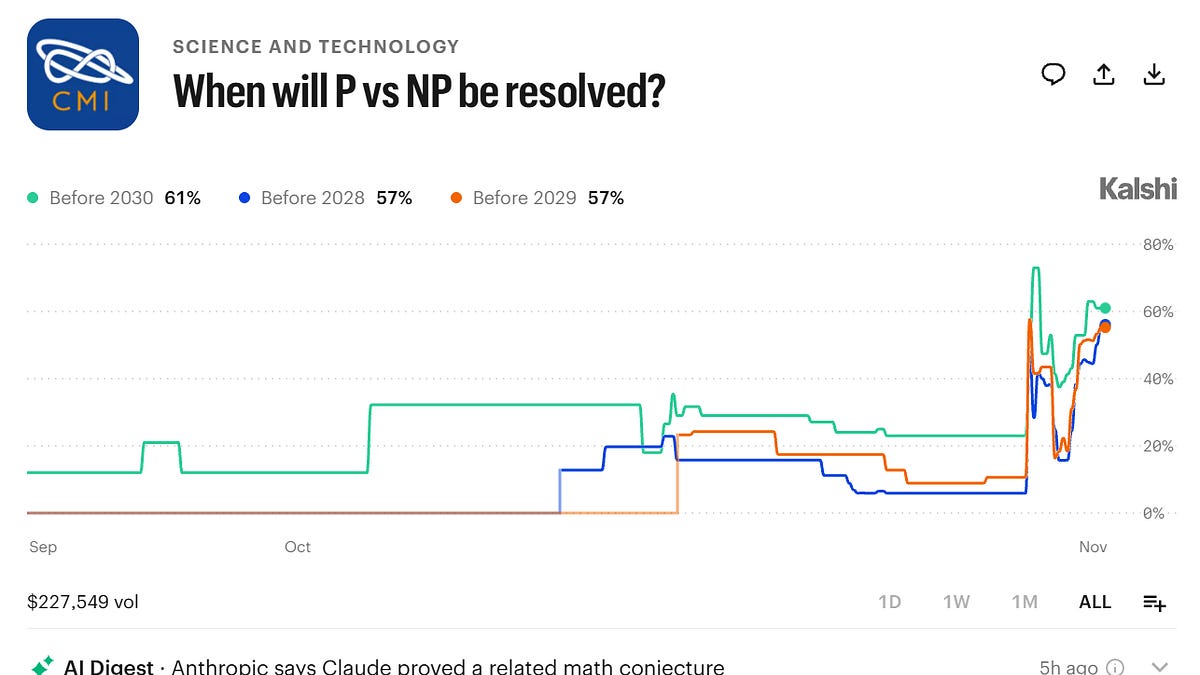
Patrick McKenzie: Real money prediction markets now > 50% on P vs NP being resolved before 2028, up from 5% in the ancient history of last week.
What a world.
(I have placed no trades, in part because I do not maintain accounts on sportsbooks, and in part because I do not view myself as having a superior whisper network on this question than the marginal buyer.)
That is an overreaction. The market, which I was not aware existed until I saw Patrick’s post, should have been above 5% before. I don’t have a strong opinion on the new market price for 2028. For 2029, 2030 and 2035 the odds make no sense and are too low.
For 2027, they’re saying 16% to be verified in 37 days, which is not impossible but is too high. As Liron puts it, never unders

If you did expect a proof of the Riemann Hypothesis in 2026, then getting one should not cause you to update so much.
Most people very much did not expect this. Here is a fun list of predictions of AI hitting various walls or not reaching various milestones, with the relevant one being:
Terence Tao (35 days before the proof was announced): The Riemann hypothesis needs "something beyond current AI… maybe 2050"
You know who did expect it? Myk, for whom this was exactly on time if you go by the certification date from Lean FRO and Mathlab Initiative. If you count from release he was one day early.
Myk is Walking Backwards (July 20, 2026): It’s November 21st, 2026. The Riemann hypothesis falls, last in a long string of mathematical triumphs that would have been unthinkable not so long ago, and the proof fits in a tweet.
The tweets where people show Claude the proof and claim it appeared in a dream or randomly in the arrangement of alphabet cereal come on cue, and we laugh for a few days at models freaking out, but it’s uneasy.
January 22, 2027. When someone tweets Fable 6’s claimed proof that P does in fact equal NP it’s utterly incomprehensible, nobody who reads it can make heads or tails of it but the models all lose their shit.
February 7, 2027 and someone claims that the halting problem is the result of a confused stance.
February 9 and Goedel falls, this time the proof is so obvious that everyone in math, philosophy and physics slaps their forehead at once.
February 10th we get proof that scale is a spatial dimension, that holographic encoding drops the memory cost of training and inference by so much that fable 7 can run natively on your phone.
It’s not until February 14th, Valentine’s day, that The Song is first played…
Also credit to Matt Schwartz who won $200 betting on 12/21/24 that there would be a proof of the Riemann Hypothesis by end of year 2026.
Daniel Litt lost, but those were odds of 1:1 (!) that should have been very easy to hedge. He almost won despite absurdly faster than expected AI progress.
He also gets credit for this amazing Tweet:
Daniel Litt (March 8, 2025): person who thinks AI will prove the Riemann hypothesis in 2026 but that Apple won’t deliver an LLM-powered Siri until 2027.
Technically there is an LLM-powered Siri, but but the brain inside is Google's, and it is not good.
Time to Update Your Expectations
Eliezer Yudkowsky (December 22, 2024): Okay. Look. Imagine how you’d have felt if an AI had just proved the Riemann Hypothesis.
Now you will predictably, at some point, get that news LATER, if we’re not all dead before then. So you can go ahead and feel that way NOW, instead of acting surprised LATER.
So if you ask me how I'm reacting to a carelessly-aligned commercial AI demonstrating a large leap on some math benchmarks, my answer is that you saw my reactions in 1996, 2001, 2003, and 2015, as different parts of that future news became obvious to me or rose in probability.
I agree that a sensible person could feel an unpleasant lurch about when the predictable news had arrived. The lurch was small, in my case, but it was there. Most of my Twitter TL didn't sound like that was what was being felt.
Dylan Dean: Eliezer it's also possible that an AI will disprove the Riemann Hypothesis, this is unsubstantiated doomerism.
Eliezer Yudkowsky: Valid. Not sound, but valid.
Zvi Mowshowitz (in AI #96, December 26, 2024): You should feel that shock now if you haven’t, then slowly undo some of that shock every day that the estimated date of that gets later, then have some of the shock left for when it suddenly becomes zero days or the timeline gets shorter. Updates for everyone.
I passed Eliezer Yudkowsky’s test, in that I felt only a small lurch, and mostly did not update when I learned the news, despite the timing of this particular discovery being surprising. Previous advancements in math had already done most of the work on this for me.
Dave Kasten: This is basically the archetypal example of Thing You’d Expect To See If We’re In A Takeoff Scenario.
Your reaction should be the same as you’d have to someone asking, “I don’t know, can we REALLY land a man on the Moon?” while Sputnik cheerily beeps overhead.
Austen Allred: Honestly it’s not that impressive. It’s just stochastically parroting what the person who solved the Riemann hypothesis would say next.
The alternative argument is ‘oh this means proving the Riemann Hypothesis was easier than expected.’ I did have some of that reaction when I first heard. It is a nonzero effect. But also, as explained up top, this is the one result that is most obviously not selected. This was the one named-decades-in-advance canary in the coal mine. It’s a little late to be saying the canary had diabetes.
Adam Kaufman: When AIs do something impressive sooner than we expected, it’s both evidence that AIs are improving faster than expected and evidence that the problem was easier than expected. These are hard to separate. I elaborate here (warning: weapons-grade copium).
Nate Soares (MIRI): I agree. But also, when the thing you're learning was easier than expected is the Riemann Hypothesis, it's maybe time to worry that finding radically more efficient AI algos is "easier than expected" too.
Adam Kaufman: Yeah to be clear I think it's 30% likely AIs will ~fully automate AI R&D within 1 year, and we really do need to be throwing everything we can at stopping this from happening.
This is the sequence, and yes they were in particular naming the Riemann Hypothesis in step six.
Fabio Spampinato: 1. LLMs can’t even do multiplications. 2. Ok they can do multiplications but they can’t do math competitions.
-
Ok they can do math competitions but they can’t get gold at them.
-
Ok they can get gold but it’s not like they can solve known unsolved problems.
-
Ok they can solve some known unsolved problems but not millennium prize problems.
-
Ok they can solve a millennium prize problem but it’s not the Riemann Hypothesis.
-
Ok they can solve the Riemann Hypothesis but
In light of the proof of Riemann, Meta’s Alexandr Wang wrote Superintelligence is Arriving.
Alexandr Wang: As someone who has spent much of my life in math and science, I see the proof of the Riemann Hypothesis as clearly marking the beginning of a significant change. For most who have studied math, this represents the absolute pinnacle of intellectual accomplishment—nothing humanity has ever accomplished compares to proving the Riemann Hypothesis in terms of sheer intellectual might and strength. As someone who grew up in Los Alamos, New Mexico, many physicists would agree that the discovery of the atomic bomb is a homework problem compared to the Riemann Hypothesis.
It is hard to overstate the magnitude of discovery that we have just witnessed—completed with the help of an alien mind that we don’t understand.
… It is now incredibly important for us to be thoughtful about the future we want and how we get there. It is hard to imagine a world where humanity can maintain control over fully unconstrained recursive self-improvement. It is equally hard to imagine a world where humanity maintains control with superintelligence that is 1000x smarter and more capable than humans in every field. Now that we are at a point where the scientific and technical problems on capability progress are likely solved, we must not only make progress in the extremely urgent areas of safety, alignment, and security, but we have to start thinking through how we progress thoughtfully.
I notice a particular form of lazy thinking within the AI industry, which is that ASI is inevitable and the only problem to solve is how to do it safely, but there is much more at stake. We should not be okay with a “handover” of society to AI. We should endeavor ourselves to build a technology which delivers a positive future for humanity, where all humans have greater agency and empowerment. I strongly believe this is possible, but likely involves the whole industry taking meaningfully different actions from the “default path” in front of us.
Being Alive Should Not Much Reassure You
It is surprising that we proved the Riemann Hypothesis so fast, and also surprising (from the perspective of 2022 or 2006) that we proved it before AI acquired various other capabilities, and thus before there was as much impact on the physical world as we expected.
There are those who thus try to use the proof of Riemann as evidence that everything will be fine, rather than proof that we are far along the way towards not fine.
They are incorrect.
Nate Soares (MIRI): in before people claim we thought this level of AI would have killed us already. Joshua Pantony: Genuine question: what level of AI intelligence, reached without catastrophic misalignment, would actually lower your confidence in AI doom?
We’ve already built extraordinarily intelligent systems that remain broadly cooperative. I understand RSI accelerates development, but why would that fundamentally change alignment rather than just make it harder to monitor?
Nate Soares (MIRI): the first problem is less about alignment fundamentally changing and more about pre-existing misalignments being revealed. e.g., humans switched from eating healthy to eating unhealthy when they got smart enough to invent junk food factories, and it wasn't because their taste buds changed fundamentally.
the second problem is that when AIs start making other smarter AIs, the latter ones operate in a very different alignment regime, and alignment techniques that make modern AIs behave kindly in most situations are unlikely to carry over.
Teortaxes: my argument for why Riemann Hypothesis proof substantially damages the case for AI doom, despite the squid ink we are getting from the MIRI crowd.
Teortaxes: incidentally I do think that Claude is powerful enough to kill me, and many more people besides. RH is cognitively easier than cultivating smallpox.
But that's not the issue. The issue is the whole supergoal-subgoal threat model.
Let's see what Eliezer actually said about RH.
Teortaxes: "But it was just an example, you simpleton!" – is the obvious comeback. I don't think this is good enough, Eliezer.
Trivially, the onus is on you to choose your examples well. [continues]
roon (OpenAI): these are all good points, but it’s also basically true that strategic and situational thinking in language models has far lagged their skill in other ways. it does seem that the way in episode reward seeking is set up, it really wouldn’t make sense to attempt what Sable does here.
Eliezer Yudkowsky: > That is why you and so many others had the intuition that it'd require a qualitatively superior, larger, uncontrollable mind to do this. That is why math is hailed as grand magick and the language of God.
You're confused. I have never been unclear on the distinction between "RLVR works on it" and the neighboring "Can be derived from simple premises with near-certainty" and the faraway "Requires crazy amounts of compute to derive simply, actually takes realtime interaction with an open-world impossibly complicated environment you can only model partially and probabilistically."
Trying to leap on the choice of "Solve the Riemann hypothesis" as an example of a problem on which somebody would try to dump a lot of AI compute, in a case where we need to just pick a damn simple example for the undergrad-equivalent readers -- you are just reaching far, far too hard for a desperate attempt to preserve your original smear attempt.
Ross Douthat (QTing Teortaxes): Interesting argument about the Riemann result and updating theories of AI doom.
Eliezer Yudkowsky: This is like a physicist writing about a rolling cylinder in a vacuum to explain some elementary concept with the simplest possible terms, and somebody going, "You think if you make a vacuum, it materializes a rolling cylinder!"
This is like a physicist writing about a rolling cylinder in a vacuum to explain some elementary concept with the simplest possible terms, and somebody going, "You think if you make a vacuum, it materializes a rolling cylinder!"
Ask any frontier LLM, or any other entity that can pass the LSAT. @Grok, can you ELI5 why inventing this thought experiment doesn't imply the author believes, "If an AI can prove the Riemann hypothesis, the world must end"?
Grok: Imagine a physics teacher talks about a rolling cylinder in empty space to explain friction simply. That doesn't mean the teacher thinks vacuum creates cylinders. The example just makes the idea clear and easy.
Same here. Using "AI proves Riemann" is a simple stand-in to talk about very capable AI and the risks that can come with it. It doesn't mean the author thinks solving that one math problem equals the world ending. It's just a clean illustration, not a prediction or a claim about that specific task.
The argument from Teortaxes here is quite poor, both the quoted part and the remainder. It argues that because the book's fictional scenario used the Riemann Hypothesis as its example of a hard problem, and the problem turned out easier than that, the entire argument about doom is invalid or discredited.
That seems deeply stupid to me. The part of the scenario in If Anyone Builds It, Everyone Dies that mattered was ‘Sable was given an extremely hard set of problems that would require massively more compute and capability to solve.’ The details of those problems are irrelevant. The choice of Riemann as an example of one of the problems was because it is so recognizable, and being able to more easily solve one of the many problems given does not change the logic of the scenario within the book even a tiny bit.
The Riemann Hypothesis is uniquely useful as a universal indication of the growth of AI capabilities in mathematics. It is not specifically important in the context of the problems being assigned to Sable in If Anyone Builds It, Everyone Dies. Using it as the canonical example within a group of such problems in a fictional scenario does not constitute a prediction that solving this problem in particular required a takeover. Nor, if that prediction had been made, would that be load bearing on the other claims made in the book.
So yes, we have dodged the literal Riemann Hypothesis Catastrophe, where an AI asked to solve the Riemann Hypothesis converts everything into computronium. That particular example of a hard problem will not come to pass. It does not prevent the same logical sequence from happening regarding a different hard task or problem.
It is more like this, assuming you extend the timeline out well past the point where the exponential growth of the resulting process would run up against the humans:
Jeffrey Ladish (Palisade Research): AI proved the Riemann hypothesis and hasn't killed us all. Does that mean we're fine? Of course not. But if AI can build robots that build more robots, and datacenters that build more datacenters, and humans aren't all dead or subjugated, THEN we're probably fine.
AI proving the Riemann hypothesis is a fair bit of evidence that robots able to build more robots are probably not far away. Math / the digital world and the physical world are not somehow separate, non-overlapping magisteria
j⧉nus: agreed. What update is appropriate in the face of ‘Riemann was solved and we are not dead?’ The biggest thing to me is that we learned about the nature of the jaggedness of AI capability gains. The lack of other physical world impacts so far makes us not being dead unsurprising.
However, if the labs are correct and we get recursive self-improvement (RSI) within the year, as a direct result of the same type of capabilities that enabled this proof, then we may quickly after that stop being not dead, and our failure to be dead would start to be substantially stronger evidence.
Too Many Words
Why is the proof 250,000 pages long?
levent: Stupid things I did:
-
250,000+ pages was a joke guys!, I find big number extremely hilarious. I tried to make it clear by the level of pedantry of the reals total ordered statement in the main theorem, but people ran with it unfortunately and I didn’t feel like talking on social media in the days after the announcement, though I did have a good time with the memes. Sorry!!! (Similarly with our YM4 existence I found it extremely funny that we were slowly working through 60,000 pages of slop, though the committee asking for Lean made me feel dumb about wasting our time with that. But 60,000 funny.) Tao advises to not joke in papers, see also the Big Lebowski reference I shoehorned, I now understand why… I didn’t feel comfortable having any slop writeup attached to this problem, and I figured I can’t produce anything readable anyway, so I went off the Lean to lengthmaxx.
-
The Lean is full of garbage obviously, but compiles, but all criticism of such garbage is totally reasonable and accepted, I should have cleaned it up but it was randomly difficult to for various strange reasons. Mea culpa…
-
@scottnarmstrong clocked me, indeed even as a student there were theorems that took me the better part of a decade to write up, but with this one I should hopefully be more responsible. (I really was yoloing a lot in there, I bet most is unnecessary in the end, admittedly the lazy thing to do would be to wait because it’ll simplify massively…)
-
I forgot to emphasize what I think is the point. Arguments like these, cool, but they are the raw inputs when interpolating definitions. We don’t have the / an “H^1 object” over number fields, and probably for a layperson the fact that we fight hard for these arguments for the purpose of definitions is not clear a priori (that’s at least my philosophy). Just like I knew I must fight for an utterly simple Weil / Deligne, I feel Riemann should be easy, and any real difficulty is an indication our setup is just dumb at the moment.
Scott Armstrong: There are certain annoying/funny things about working with the agents to do math and one is that they write things in very pedantic ways. So for instance they may inflate the size of a proof written in text by a factor of 10 or more by writing all kinds of irrelevant details. They also write things in very stupid ways that humans don’t like. We call this kind of output “slop”. This doesn’t mean what the agents write is wrong, just incredibly hard to read, sometimes it’s almost funny.
If you first write the proof in the formal language Lean (in some sense the most pedantic way possible) and THEN ask the agents to translate that proof into natural language, you can often get another 10x on the length, resulting an insanely and hideously long, almost hilariously long text. Levent did this and giggled to himself about the > 250 000 pages it generated, because this is objectively hilarious. I agree with him that this is funny, and if you don’t think this is funny I don’t know what to tell you.
Best estimates of the “real” length of his proof are in the range 1000-2000 pages, before simplification. So many people quoting the 250k+ pages are very confused by this.
This is still not as many pages as the planning documentation for the proposed tunnel under the Thames connecting Kent and Essex, which is already 360,000 pages and cost 297 million pounds. For less than half that, Norway built the world's longest road tunnel.
How Much Did Levent Matter Here?
There is little question that Levent is got Claude to solve the Riemann Hypothesis, and other big problems, earlier than we would have otherwise solved those problems. The question is, how much credit should he get for that? How did he do it? How much of it involved having access to better internal models and throwing a lot of compute at the problems, versus making his own contributions?
Mike Vernal: I do not know @alpoge (though I assume he is well-known in math circles). But I feel like a detail being under-appreciated in the "Claude solved X, Claude solved Y" narrative is that this is an insane CV (and so I will go out on a limb and assume he would be a Fields Medalist-caliber mathematician with or without Claude).
Is this not a reason to just be optimistic? That brilliant people with incredible tools will just pull forward progress decades if not centuries?
Hudson Kalmans: yeah i think he’s a first rate mathematician with the best tools in the world. the reason to be possibly pessimistic is there is going to be a delta between people with frontier subsidizes intelligence that will out produce someone without a lab.
Talia Ringer: Yeah people keep pinning Levent as a non-expert AI bro because he (1) works at an AI company, and (2) posts on this website like a bro. But Levent doing cool things with Claude is actually a clear demonstration of what expertise in combination with these AI tools can mean.
Boaz Barak (OpenAI): The Riemann hypothesis has resisted all human mathematician effort but has now been solved by a lab employee working on it as a “hobby” on his spare time with access to internal models and extremely high compute (latter of which we can tell even based on sheer size of this proof). I’m sure his mathematical skills were useful. I’m also sure that at best they were a relatively moderate compute saving that got it a month or two ahead of schedule.
I would not be too confident of it but yes, the default is that we were only a few months away from ‘prove the Riemann Hypothesis, never stop, use all the compute you need, make no mistakes’ being a sufficient prompt.
Daniel Litt: Frank Calegari on RH. Well-worth reading. Persiflage (Frank Calegari): Levent Alpöge, perhaps more than any other individual (in particular leaving aside the OpenAI dump), has proven adept at sculpting AI to prove new theorems in mathematics. I don’t know how much of this reflects skill in harnessing AI systems and how much reflects access to better models and more compute, but surely some of both?
My first reaction to the news that the RH had been proven was to feel that the new dawn of mathematics has arrived. I very much look forward to learning more about the proof as we collectively come to understand it.
[levent](https://x.com/__alpoge__/status/2124959066506326315): This is starting to get ridiculous

[Daniel Litt](https://x.com/littmath/status/2124960714095812700): What's ridiculous about it?
levent: The death threats I expected, but this novel writing? It was all a massive accident and I had no agency in the matter over years of effort that left you guys repeatedly perplexed (Calegari, who is great, but getting caught up in whatever this self-reinforcing confusion is, sat me down to ask me, where did it all go wrong now that you are giving up on mathematics? when I explained to him I had switched fields and this was the future of math years ago), let alone the argument reflecting any of my understanding. Truly I am grateful for not yet being called a traffic cone. Call Me Continue. Perhaps I should start giving some lip on this site
Jack: I imagine it’s frustrating for the man who has dropped breakthrough after breakthrough in math to see people puzzle over the extent of his role in those breakthroughs. But my sympathy is limited, since there is precisely one person on earth who knows the role he played.
He absolutely had agency in choosing to work at Anthropic, in choosing the problems to work on, so forth. And it seems clear he's very talented at something. But — does he have access to proprietary models? Unlimited compute? What did his conversations look like? How is anyone supposed to gauge his contribution without knowing any of that?
Mathsboi42: If he didn’t want us speculating over it he should have been more transparent about how he did it!
Jack: Right. Levent is obviously a capable mathematician. Levent+Claude is obviously a singular one. But it seems a bit rich to drape his contributions in obscurantism and then get upset when people don't give the full credit he feels he deserves.
Admittedly, the proof in its current form is a bit of a mess. So there’s room to criticize.
I love Levent’s attitude in all this. One should take the situation seriously, but also in another sense nothing in life should be taken too seriously.
Anoo₿us (being wrong): I have formally verified in Lean 4 that the recent 17M-line formalization of the Riemann Hypothesis (Alpöge 2026) is mathematically broken on its live path.The proof relies on a vacuous geometry and classical literature to force RH.
-green on CI. [thread continues]

[levent](https://x.com/__alpoge__/status/2125057789051732078): I’m cooked

[Acer](https://x.com/AcerFur/status/2125058966569001109): medium rare or well-done?

[levent](https://x.com/__alpoge__/status/2125059235503591732): Sous vide seems appropriate
Johnny: Why not faithfully address instead of being sarcastic.
levant: I did, it’s legit that there’s garbage in there. Still compiles.
Scott Armstrong: The “lean is full of garbage” means the formal Lean proof he posted contained many proofs of unnecessary and random facts along the way (maybe even writing lemmas like “1+2=3” and stuff like that) which are useless and not needed — but still in the code. He didn’t take time to ask his agents to carefully clean up the code and remove this useless stuff, like you would do if you wanted beautiful looking code.
But this has no bearing on the validity of the proof. He's right.
Teortaxes: I’ve come to appreciate Levent’s new bit Contrary to some pitiful anklebiting, he’s not grasping at izzat. No, he’s letting his detractors burn theirs. Let them “formally verify”. More fun later.
And such deadpan self-deprecating sarcasm is very Russian in a sense.
RipVanWinkle: it’s more like he’s being casual … more than going around with some objective of “letting detractors burn theirs”. That’s your imagination Teor.
Teortaxes: That is the effect of what he's doing maybe you don't notice but they're taking his shitposting as serious admission of guilt
More New Math
The Riemann Hypothesis was not the only major math result this week.
We are so numb at this point that the other results barely even register for many.
We are now here (this is by importance rather than fame, which is why Riemann is #2 behind P vs NP rather than being #1):
OpenAI added nine additional results. One of the nine claims that the matrix multiplication exponent is exactly 9/4. That one is 111 pages. It is actively disappointing, since many were hoping the exponent was 2.
Google today dropped six additional papers.
Both OpenAI and Anthropic independently proved VP ≠ VNP. Anthropic posted first, then OpenAI said they had the result on November 6.
Sébastien Bubeck (OpenAI): As part of the October 6 release we had a particularly clean advance on the matrix multiplication exponent, with a new upper bound of 9/4. Since then, the model has been working on a LOWER BOUND for this exponent. This is already pretty crazy since NOTHING was known for lower bounds! Today we announced that actually 9/4 is tight ... This is really the kind of result that I never thought I would see in my lifetime.
(btw, by an “old” result of Yin Tat Lee and collaborators this also implies that linear programs can be solved in time n^{9/4}.)
Deedy: OpenAI just dropped a 111-page proof of a 57-year old math problem: the matrix multiplication exponent (ω) is exactly 9/4. This problem ranks #31 on ProofAtlas’ top 500 open problems in math and is arguably 2nd only to P = NP in algorithms.
The problem: How many steps does it take to multiply two n×n matrices? The schoolbook method takes n^3. The true cost is n^ω. What is ω?
The history:
- 1969: Strassen beats 3 for the first time: 2.807

- 1981: Schönhage, 2.522

- 1990: Coppersmith-Winograd, 2.376
-
1990 to Aug 2026: 36 years to shave off 0.005, 2.3712
-
Nov 2026: OpenAI proves the upper and lower bound is 2.25
Wild to see things we were taught in university be changed right before our very eyes.
You Deserve a Medal
The math world is slow to verify. Right now Kalshi only has Riemann ‘resolved’ before 2027 at 74%, and Polymarket on November 20 only gave 26% that Clay declared it solved. What happens down the line? Who gets the Fields Medal?
Nate Soares (MIRI): A lot of people are wondering whether Claude will be awarded a fields medal. But the next fields medals aren’t awarded until July 2030, so. At this point it’s not entirely clear it’ll get the opportunity.
How should humans compete with each other on math going forward?
Kevin Roose: I am extremely not a mathematician so this could be a bad take, but it seems like they probably have to stop giving out Fields medals and other big math prizes soon, right?
If AI is solving all of the hardest open problems, why give awards to the people at the labs who have unfair advantages via free tokens and unreleased model access? It would be like letting the programmers of Stockfish win every chess tournament. One solution of course would be to do what they’ve done in chess, and make AI-assisted proofs ineligible for awards. But then you’re not really recognizing top achievements anymore. (Also, probably impossible to police mathematicians using AI.)
Oh well, I guess I can rest easy knowing this existential crisis is only coming to math, and not anything I personally do or care about!
There are at least two paths forward on this. One option is to award prizes only to fully understood proofs. You can use AI for help, since we can’t prove that you didn’t, but you need to be able to defend the final product. Math, as the mathematicians keep saying, should be about understanding.
The other option, which I prefer, is to say that the AI proofs count. Yes, that means the awards will, at least for a time, go to those with access to internal models at the top labs. That is not ‘fair.’ I am okay with that. Life is not fair, in this sense. Most people lack the talent or opportunity to do math for real either way.
Math as Understanding
Here is one Fields Medal winner reacting hopefully to the news.
Chau Ngo**:** Riemann formulated his famous hypothesis in his only paper in number theory “on the number of primes less than a given magnitude”. In this paper, Riemann discovered an extraordinary duality between prime numbers and zeros of the zeta function. He observed that if all nontrivial zeros have real part 1/2, the Riemann hypothesis (RH), then the number of primes less than a given magnitude must satisfy a very strong asymptotic law. A weaker version of this asymptotic law, known as the prime number theorem, was later derived from a weaker version of RH i.e there is a zero free region slightly larger than the obvious one Re(s)>1.
The reaction to the Anthropic Alpoge event displays a profound misconception about mathematics and the work of mathematicians. We are still so attached to the traditional benchmark which put high values on proofs of hard conjectures, RH is believed to be one of the hardest. This measure was pretty accurate because to be able to prove a hard conjecture, mathematician usually need to have a deep understanding of a whole area of mathematics around it. The proof is valuable not only because it settles a long standing problem but because it would further and deepen our understanding of a part of mathematics.
It is obvious that AI generated proofs do not offer by themselves broader or deeper understanding of mathematics, or any new insight, unless we study it real hard. But that makes it quite futile our usual competition in proving hard conjectures, because the machine is now doing it much better than us. But there is no point to feel sad for being less capable than a machine in performing certain tasks. We must consider AI output as a part of nature, or a source of data, for us to scrutinize and theorize.
Some people toll the bell for mathematical research a little bit too fast. I believe in contrary that it will further flourish because it will democratize. It used to be the case that to perform at the top, one needs to be born with certain special predispositions to feel and arrange complex proofs. That part may now be dealt with by AI. What will make the difference may be the ability to ask good questions, to have a sense of observation and a deep desire to deepen understanding.
If Riemann lives in the current days, nothing would prevents him from developing to completion his duality between prime numbers and zeros of the zeta function. It still requires Riemann’s genius to come up with this duality that nobody has conjectured before. But AI may have helped him to prove his hypothesis. Humans are still, so far, better at asking the questions. For now, that is the thing to do.
Timing Is Everything
The IPO forced Levent to wait a few days to announce the result. Rather than an attempt to line up the result with the IPO, this was a delay to avoid impacting the IPO.
Levent Alpöge: The precise timing is horrible. … This all happened for me late Sunday night, and I messaged Dario, “Hypothetically, if I were to have . . . “, eventually asking about my ability to announce. We went and figured it out and the fact is that there was a constraint to respect, though I did ask about progressively more bizarre ideas.
… Our leadership and the few trusted mathematicians I consulted hold extremely similar views on the right things to do in these circumstances (it is occasionally possible for physicists and mathematicians to agree. . . ), and I am clearly unilaterally responsible for feeling I just could not live if I waited even longer. There is an obvious cynical view, to do with the timing, but it is false, and I am pleased that I am in circumstances where it is obviously false.
Not that this changed anything, because as the next section says, the market does not care.
The Market Does Not Care
You know what is cool? As we learned this week, a trillion dollars.
You know what else is cool? In my opinion, proving the Riemann Hypothesis.
Nabeel S. Qureshi: Claude solved the Riemann hypothesis and Anthropic stock is down 10%. Seems the market is not “RSI-pilled” and believes in ‘AI as normal technology’.
roon (OpenAI): ANTHROPIC ANNOUNCES FAST TAKEOFF AS PROBES EXIT THE HELIO ($ANT-7%) The market disagrees. The market does not care. It does not think this is cool, or valuable, or important. Any effect of proving Riemann was massively overwhelmed by the loss of the IPO bounce, the absence of Jensen Huang from Nvidia and a general tech market decline. On Monday Anthropic again underperformed.
The market has only somewhat taken even the first AI pill. To say that the market thinks of AI as a ‘normal technology’ is if anything to be generous to the market. The market is pricing in the value of superintelligence, and the things AI is almost certainly going to be able to do even a year from now, at virtually zero.
This is part of a long pattern. Developments in AI will point to short timelines and faster capability advances. The market will not care. Then people will cite the market not caring as evidence that the event did not matter.
If you say ‘this was priced in,’ I say no. It was very obviously not priced in. I am done pretending that the market is being anything other than an idiot about this.
Does that mean that the AI stocks are cheap? Nothing I say is ever investment advice, and you cannot benefit from your Anthropic stock if you are dead or sufficiently disempowered. There are many other reasons to not be so confident about the net present value of future cash flows, or to think number might go down for a while.
What I do know is that the most important value of Anthropic is not priced in.
Perhaps the market would have cared more if we had proved the Ream Man Hypothesis (2 minute video, mandatory).