TL;DR — Key Takeaways
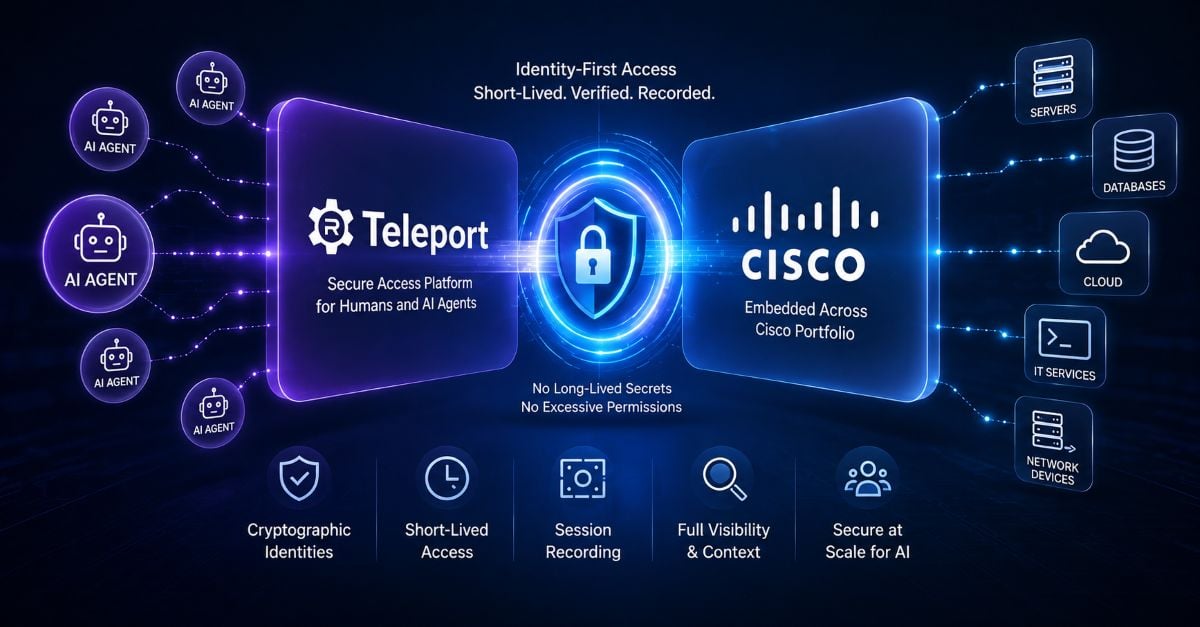
- Cisco is partnering with Teleport to secure and record infrastructure access using short-lived cryptographic identities instead of static credentials and long-standing secrets.
- Cisco plans to incorporate Teleport’s access technology across its portfolio and is taking an undisclosed equity stake in the company.
- Teleport argues that traditional password- and credential-based access models will struggle to operate securely at the speed and scale required by AI agents.
Teleport, a provider of a framework for programmatically providing access to IT infrastructure securely, this week revealed a strategic partnership with Cisco.
As part of that alliance, Cisco is partnering with Teleport to broker and record connections using a short-lived cryptographic access framework that eliminates the need for long-standing secrets stored in a vault and overly broad permissions.
Teleport CEO Ev Kontsevoy said Cisco will over time begin to embed the core access technologies developed by Teleport across its portfolio as artificial intelligence (AI) agents are starting to be deployed more widely. Cisco is also taking an undisclosed equity stake in Teleport.
The goal is to make it safer to deploy AI agents that require access to servers, databases and other IT services on a cryptographic foundation that can be employed at the level of scale that AI agents will inevitably require, said Kontsevoy. The ratio of AI agents to humans in many larger companies is already approaching 90 to 1, he added. Many of those AI agents will also be generating sub-processes as tasks are broken down to run in parallel, each of which requires an identity to be assigned to the sub-agent created to complete that task, noted Kontsevoy.
The issue is the current approaches to securing access to IT infrastructure using passwords are highly fragmented and challenging to manage. At the machine speeds at which AI agents operate, those legacy approaches for verifying identities are simply not going to work, said Kontsevoy. AI agents are, almost by definition, unpredictable, so IT teams will need a method to programmatically verify their identities at machine speed, he noted.
The Teleport framework was specifically designed to establish trust for humans, and now AI agents, that is carried into each connection but privilege is issued only for the task and expires when the access window closes. Static credentials and long running access are replaced by cryptographic identities and short-lived permissions.
In effect, Teleport is making a case for a framework that eliminates any anonymous computing and unmanaged privileges without requiring a tradeoff to be made between operational speed and security. Additionally, once identities are pervasively assigned, IT teams will be provided with additional context that goes well beyond simply tracking IP addresses, said Kontsevoy.
It’s not clear to what degree IT teams will be revisiting infrastructure access, but the fact that rogue AI agents can find ways to randomly access IT resources has created a wake-up call, he added. The challenge now is finding a way to make a programmatic framework for securing access that has historically been used mainly by DevOps and platform engineering teams more accessible to IT administrators, noted Kontsevoy.
At this juncture, it’s more a question of when, rather than if, the way access is granted will need to be revisited in the AI era. The challenge, as always, is determining how much havoc might ensue before that goal can be achieved at a time when AI agents, regardless of guardrails, will access everything and anything they can find.