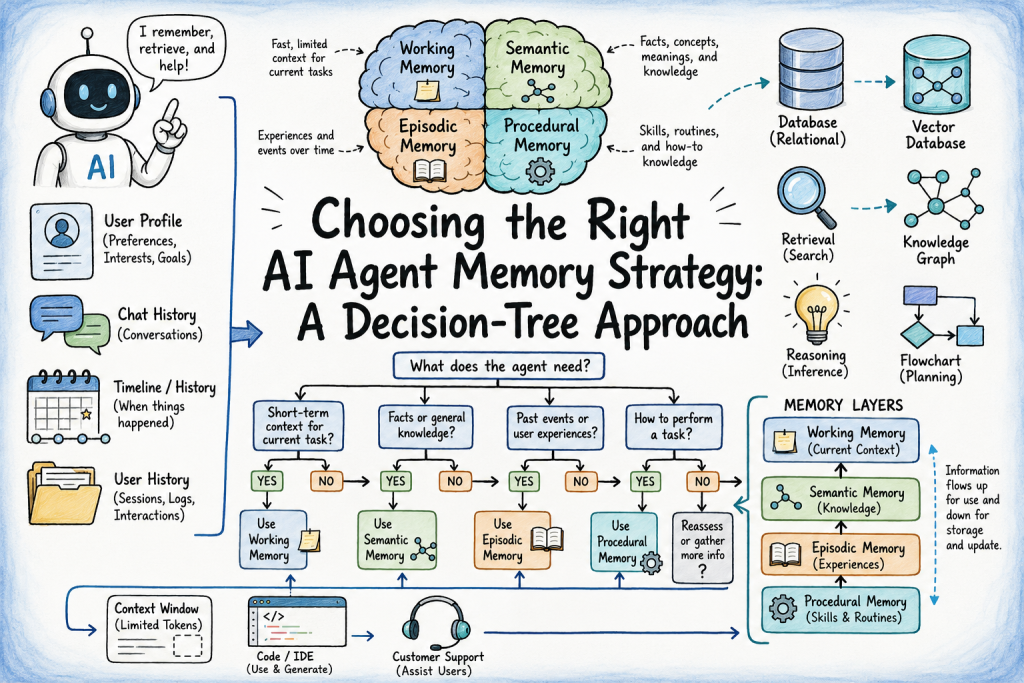
In this article, you will learn how to choose the right memory strategy for an AI agent by working through a simple decision tree, one category of information at a time.
Topics we will cover include:
- The four types of agent memory — working, semantic, episodic, and procedural — and what each one assumes about the information it holds.
- A five-question decision tree that classifies what a given category of information actually needs, and how those answers combine into a full memory architecture.
- The common pitfalls that show up once agent memory is implemented, and how to fix them.
Let’s get started.
Introduction #
Memory is one of the defining capabilities of an AI agent, yet it’s often designed as an afterthought. Some agents forget information users expect them to remember, while others are given complex memory infrastructure they never really need. Both often stem from the same unanswered design question: how long should different kinds of information live, and how should they be retrieved?
Agent memory strategy deserves the same deliberate design as orchestration. Unlike orchestration patterns, however, agent memory is rarely a single architectural choice. The current conversation, a user’s stated preferences, past interaction history, and learned routines are different categories of information, and each tends to need a different kind of memory. The useful question isn’t which memory system an agent should use — it’s which layer each category of information actually needs.
This article covers:
- The core memory concepts that separate working, semantic, episodic, and procedural memory
- A five-question decision tree for classifying what a given category of information needs
- How those classifications combine into the layered memory setups agents actually ship with
- The pitfalls that show up once memory gets implemented and used
We start with why this classification matters in the first place.
Why Is Choosing an AI Agent Memory Strategy Important? #
Before working through the decision tree, it’s worth being clear about what each memory layer assumes about the information assigned to it.
Working memory rests on the idea that everything relevant right now lives inside the active conversation and a finite token budget, and that trimming or summarizing older turns won’t quietly drop something the agent still needs.Semantic memory assumes that certain information is sufficiently stable and reusable that storing a canonical representation is more valuable than repeatedly inferring, re-asking, or reprocessing it. This includes persistent user facts such as name, role, and preferred language; domain knowledge such as business rules and product specifications; and generalized knowledge distilled from repeated interactions.Episodic memory is built on the expectation that the history of what happened carries value on its own, not just the current state: a record of past decisions, complaints, or transactions that should inform the next interaction.Procedural memory presumes that solving the same shape of task repeatedly should make the agent faster or more reliable on the next attempt, not just leave behind a transcript of past attempts.
These four layers answer different questions about information, which is why most production agents rely on more than one.
A customer support agent, for example, might keep the current ticket in working memory, a customer’s subscription tier in semantic memory, past complaints in episodic memory, and a learned refund-handling routine in procedural memory. Each layer serves a distinct purpose.
Problems arise when information is stored in the wrong layer. Using a vector store for stable facts that belong in a structured profile makes retrieval slower and less reliable, while searching an entire interaction history can surface stale or contradictory information that a structured record would have overwritten. For effective context engineering, memory is just one source of context competing for a limited context window, so information should only be retrieved if it meaningfully improves the agent’s response.
The Decision Tree for Choosing the Right AI Agent Memory Strategy #
The tree has five branching questions, each one narrowing down what a specific category of information needs based on a concrete property of it. Run the tree once per category, not once for the whole agent. A support agent’s “current ticket,” “account details,” and “complaint history” are three separate categories, and each one can land in a different place on the tree.
Question 1: Does This Information Need to Persist Beyond the Current Turn?
This question separates information that genuinely needs memory from information that just looks like it does.
- Self-contained, no carry-forward needed: the wording of a one-off classification request, the intermediate output of a tool call used only to answer the current question
- Carries forward, memory required: which issue a support agent already resolved this conversation, the state of a coding project an agent is picking back up from yesterday
If the information is self-contained → no memory layer is needed; the context window for that turn is enough. If it needs to carry forward → move to Question 2.
Question 2: Does It Need to Survive Beyond a Single Session?
This question separates working memory from anything that needs to be durable.
- Within-session only: what’s already been asked, which tools have already been called, what’s already resolved → a conversation buffer is enough, kept in bounds by trimming or summarization. Session-based memory managementin the OpenAI Agents SDK handles this directly. - Beyond the session: a returning customer’s preferences, an ongoing project’s state, a multi-day task → working memory alone won’t do it, since the information has to exist independently of any single conversation.
If only within-session continuity matters → working memory is the answer for this category. If it needs to outlive the session → move to Question 3. ⚠️ A common design mistake is mismatching information to its lifetime, either treating session-scoped state as permanent or building persistent memory infrastructure for information that only needs to exist during a conversation.
Question 3: Is This a Stable Fact or an Evolving Event?
This question is often skipped, with everything that needs to persist getting thrown into the same store regardless of shape.
- Stable facts (semantic memory): a name, a subscription tier, a preferred tone, a default shipping address, or other persistent knowledge that remains valid across sessions and is more valuable to store as a canonical fact than repeatedly infer or re-ask.
- Evolving events (episodic memory): a complaint filed last month, a decision made during an earlier project phase, a pattern of behavior across several interactions
Memory architectures borrow this vocabulary from how cognitive science categorizes human memory, separating stable knowledge from memory of specific past events. Some frameworks build the temporal dimension directly into their storage layer. For example, Zep models facts on a knowledge graph where each fact carries a validity window, so a superseded fact gets invalidated rather than left to silently contradict the newer one.
A stable fact belongs in a persistent knowledge store, whether that’s a structured record for user attributes, a knowledge graph for relationships, or a vector database for semantically searchable domain knowledge. An evolving event belongs in something closer to a log, where entries accumulate and older ones may need summarizing or pruning.
If this category is mostly facts and domain knowledge → semantic memory. If it’s mostly history → episodic memory. The next question is how that log gets searched at scale, which leads to Question 4.
Question 4: How Will This Memory Be Retrieved?
This question is about matching retrieval to the size, structure, and growth rate of the memory store rather than using the same retrieval strategy everywhere.
- Small, bounded store (a handful of user facts or a single profile): read the entire store at the start of a session. Anthropic’s memory toolworks this way because the store stays small enough that a full read is inexpensive. - Large, searchable store (an interaction history, document corpus, or expanding knowledge base): retrieve only the most relevant entries using semantic search or hybrid retrieval, since reading everything quickly becomes impractical. Google’s Memory Bankis designed for this scale, and memory frameworks like Mem0 offer a comparable, provider-independent approach that you can use with frameworks like LangGraph or CrewAI.
It’s common for one agent to need both retrieval patterns at once: a full-read profile for a small semantic store, alongside similarity search over a larger episodic log or semantic knowledge base.
Once retrieval fits each store’s actual size and structure, move to Question 5.
Question 5: Does the Agent Need to Learn Reusable Procedures?
This is where procedural memory comes in, and it sits on top of whatever semantic and episodic layers are already in place rather than replacing them.
- Recurring task shape that should improve with repetition (the same kind of refactor, the same category of ticket): worth distilling into procedural memory, so the agent applies a refined routine rather than just replaying past attempts.
- One-off or non-repeating tasks: skip this layer; the semantic or episodic memory chosen earlier is enough on its own.
An agent’s memory module typically sits alongside its planning and tool layers, feeding learned context back into how future plans get made. The key design decision is what gets written. Raw logs of past runs capture episodic memory, while procedural memory stores the distilled lessons, successful steps, and reusable strategies extracted from those experiences. A useful procedural store is written for future application, allowing the agent to directly apply proven workflows and patterns to similar tasks.
The above questions should give you a decision tree like so:
How the Memory Layers Combine #
Running the tree for each category of information produces a memory profile rather than a single answer for the entire agent. Combining these profiles reveals the memory architecture that best fits the agent’s needs.
For example, a coding agent might use working memory for the current session’s edits, semantic memory for user preferences and tooling knowledge, episodic memory for the history of changes across projects, and procedural memory for reusable test-and-verify workflows improved through repeated use. A simple FAQ agent, on the other hand, may only need working memory because none of its information needs to persist beyond the current conversation. Both are valid outcomes of the same decision process; the difference comes from the type of information the agent needs to retain and how it needs to use that information.
| Layer | What It Is For | Typical Implementation |
|---|---|---|
| No persistence | Self-contained information with no carry-forward | Rely on the context window alone; no memory layer |
| Working memory | Continuity within a single session | Conversation buffer with trimming or summarization |
| Semantic memory | Stable facts and generalized knowledge that persist across sessions | Stored in structured profiles, knowledge graphs, or vector databases for semantic retrieval; retrieved through full reads for small stores or similarity search for larger knowledge bases |
| Episodic memory | Evolving history that persists across sessions | Growing log, retrieved by recency or relevance search at scale |
| Procedural memory | Recurring task patterns that should improve with repetition | Distilled, reusable routines layered on top of an existing semantic or episodic store |
Common AI Agent Memory Pitfalls (and Fixes) #
Even with the right layer chosen for each category, memory implementations tend to fail in a handful of predictable ways. The table below maps common symptoms to their usual cause and fix.
| Issue | Likely Cause | Fix |
|---|---|---|
| Agent re-asks for information already given this session | Working memory trimmed too aggressively, or summarization drops the relevant detail | Widen the retained window or improve what the summary keeps, rather than adding a long-term memory layer |
| Retrieval returns irrelevant or contradictory results | Stable facts and evolving events mixed into one undifferentiated store | Split them: use a small structured store for facts and a separate log for events |
| Semantic memory gets overwritten with bad information | No validation or versioning at write time | Add confirmation, versioning, or a review step before a fact replaces an existing one |
| Procedural memory never seems to improve anything | The store holds raw replays of past runs rather than distilled lessons | Write the digested lesson learned, not a transcript of the attempt |
| One memory system is handling facts, history, and session state all at once | Every category of information was forced through the same store instead of being classified separately | Run the decision tree per category and let each one land on the layer it actually needs |
Wrap-Up and Next Steps #
The decision tree turns memory design into a set of clear choices rather than a single default approach. It asks the key questions before any storage is built: how long should this information persist, is it a stable fact or a past event, how will it be retrieved later, and does it represent a reusable behavior that can improve future tasks?
Many memory problems come from treating all information an agent handles as the same type of data. As discussed, working memory, semantic memory, episodic memory, and procedural memory serve different purposes and require different storage and retrieval strategies. Effective agents combine these layers based on what information needs to persist, how it should be retrieved, and whether it should improve future behavior.
The next step is to explore the agent memory frameworks and tools available. In a future article, we will walk through how to evaluate these frameworks and choose the right one based on your application’s requirements.