By continuing to browse our site you agree to our use of cookies, revised Privacy Policy and Terms of Use. You can change your cookie settings through your browser.
CGTN
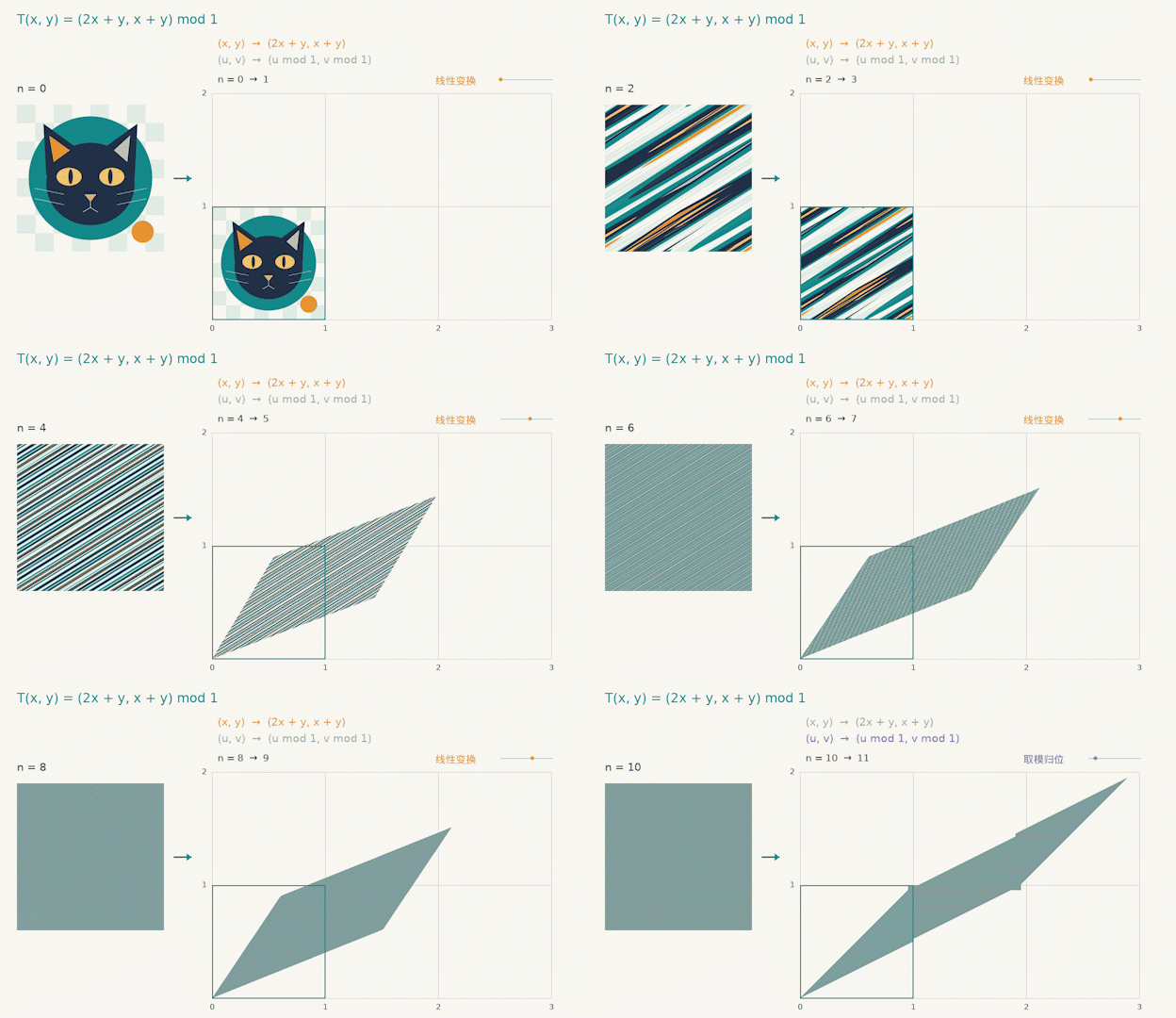
Computer-generated animation shows the Arnold cat map stretching, a classic example of the chaotic Anosov systems at the heart of the 3D Ghys conjecture. /CMG
A Chinese research team has fully proved the 3D Ghys conjecture, a world-class mathematical problem that had baffled the international mathematics community for more than 30 years. It is the first time Chinese scientists have relied on a domestically developed large AI model to crack a problem at this level.
The team, led by Xu Disheng, a professor at the Greater Bay University and a visiting scholar at the Shanghai Artificial Intelligence Laboratory (Shanghai AI Lab), worked with the lab's Intern-S2 science large model to solve the conjecture. The AI took on large-scale, long-chain and highly complex mathematical derivations, while the researchers steered the overall direction and screened out promising lines of reasoning.
After multiple rounds of iterative interaction, the collaboration produced a complete and rigorous proof of the conjecture.
Independent verification was carried out by a Peking University team led by Liu Ruochuan, an academician of the Chinese Academy of Sciences, and Professor Dong Bin. Using a self-developed framework and massive parallel computing with AI agents, the team completed formal machine verification of all core theorems and generated hundreds of thousands of lines of verification code, rigorously confirming that the entire proof is logically complete, gap-free and fully valid.
First proposed in 1995 by French mathematician Étienne Ghys, the conjecture has long stood as a central unsolved problem in complex dynamics, with extreme reasoning difficulty. Its real-number counterpart remains an open problem worldwide and is regarded as a key benchmark for measuring advanced mathematical reasoning ability.
The paper has been released on an international preprint platform, and the verification code has been fully open-sourced.