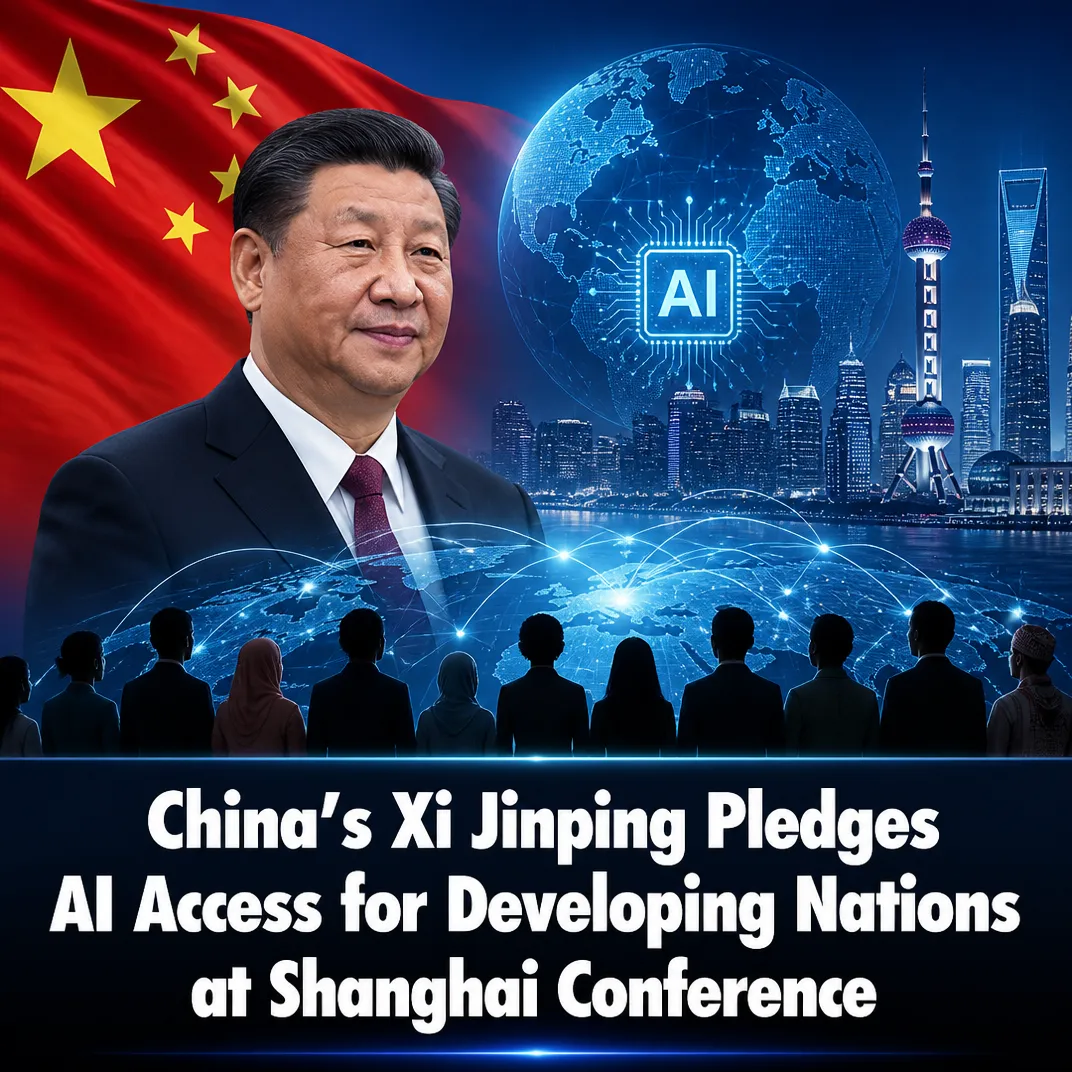
July 17, 2026, (Inside AI) — Chinese President Xi Jinping delivered a keynote address at the opening ceremony of the World Artificial Intelligence Conference (WAIC) in Shanghai on Friday, championing a “people-centred” philosophy for AI development. He outlined a vision where technology serves humanity broadly, not just a privileged few.
Xi announced new Chinese-led initiatives to expand AI access for developing nations, framing the effort as a bulwark against what he called “new historical injustices” in the global tech order. The speech signals Beijing’s intent to position itself as an alternative AI partner to the Western-dominated landscape.
The Geopolitics of Algorithmic Equity #
At the core of Xi’s address was a promise of capacity building. He detailed plans for China to cooperate with international bodies across Africa, Latin America, Asia, and the BRICS bloc to provide AI-related opportunities. This includes knowledge transfer, infrastructure support, and joint research programs.
The term “new historical injustices” is a deliberate rhetorical choice. It evokes colonial-era exploitation and suggests that a concentration of AI power in a few wealthy nations would replicate those patterns. Xi’s framing challenges the current reality where the U.S. and its allies dominate foundational model development and chip manufacturing.
This is not China’s first foray into digital diplomacy. The Digital Silk Road has already laid fiber optic cables and built data centers across the developing world. The AI push is a logical next step, embedding Chinese technology stacks into the digital infrastructure of emerging economies.
However, the initiative raises hard questions about governance. China’s own domestic AI ecosystem operates under strict state control, with algorithms subject to censorship and surveillance imperatives. Exporting that model could mean exporting its values, creating a parallel internet aligned with Beijing’s norms.
People-Centred, but on Whose Terms? #
Xi’s “people-centred” language mirrors the European Union’s “human-centric” AI approach, but the operational meaning diverges sharply. In China, AI is deployed for mass surveillance, social credit scoring, and predictive policing—tools justified as serving collective stability. Critics argue this redefines “people” as the state itself.
Western analysts point to a strategic vacuum. The U.S. has yet to articulate a cohesive global AI development strategy for the Global South, focusing instead on chip export controls and alliance-building among wealthy democracies. This leaves an opening for China to offer a turnkey package: hardware, cloud services, and pre-trained models with fewer restrictions on data usage.
Xi’s speech did not mention specific funding amounts or timelines. That absence is notable. Past Chinese infrastructure pledges have sometimes outpaced delivery, and AI capacity building requires sustained investment in education and compute resources, not just hardware gifts.
Still, the symbolic power is immense. For a nation in Africa facing a shortage of AI talent and GPUs, a partnership with China can be a pragmatic choice. It bypasses the licensing hurdles and ethical conditions often attached to Western aid, accelerating deployment but potentially embedding long-term technological dependency.
Xi’s address at WAIC was more than a conference keynote. It was a declaration of a new front in great-power competition, where the prize is not just market share but the architectural blueprint of the world’s future AI systems. The question remains whether China’s vision of “equity” will empower nations or simply extend its sphere of influence.