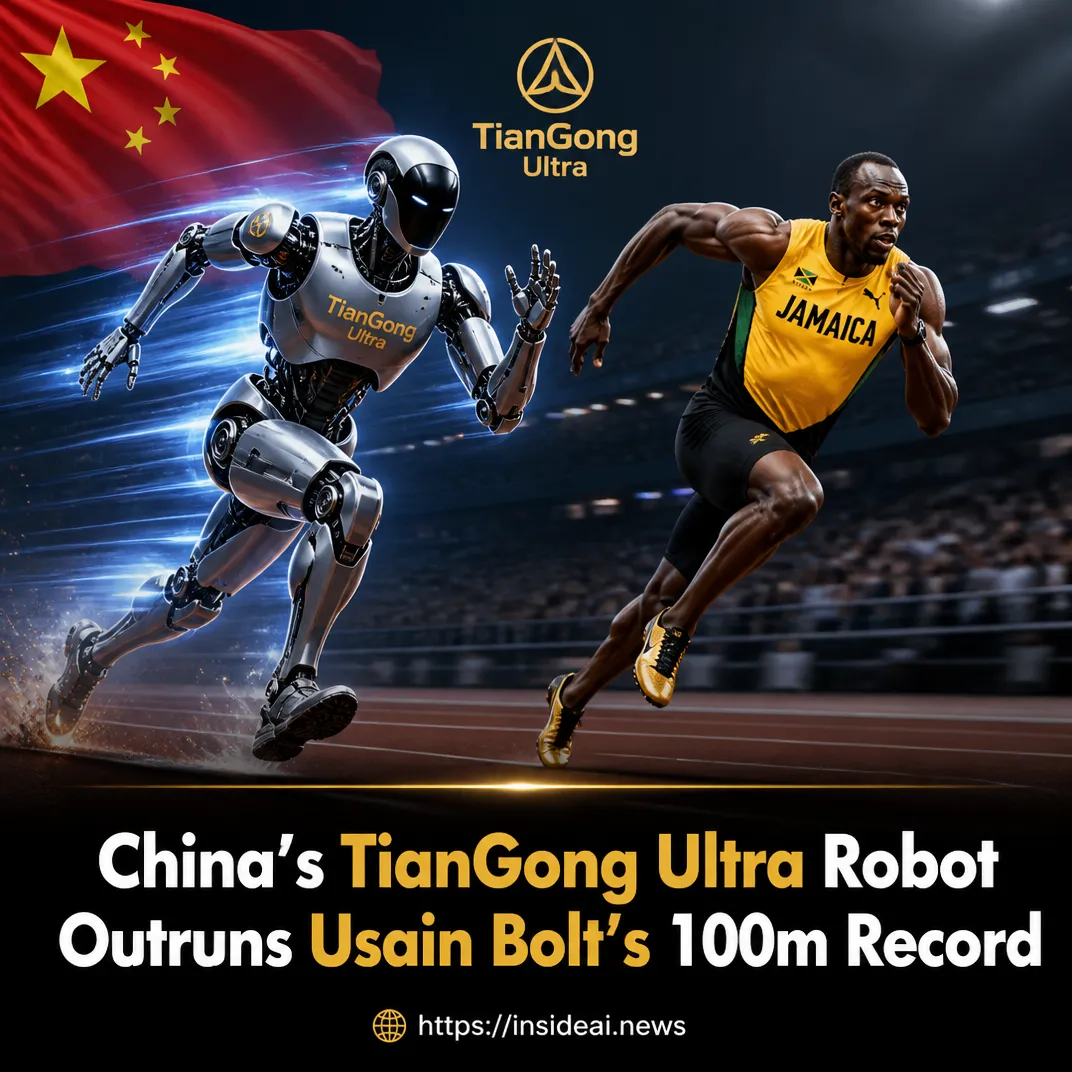
September 10, 2026, (Inside AI) — A Chinese humanoid robot sprinted 100 meters in 8.64 seconds at the World Humanoid Robot Games, beating Usain Bolt's human world record by nearly a full second. The machine, TianGong Ultra, achieved the feat after days of round-the-clock testing and repairs between races.
Jack Guo, who leads development of Ultra and a smaller model called Omni at the Beijing Humanoid Robot Innovation Centre, known as X-Humanoid, said the moment the robot passed 50 meters, he finally relaxed. A week later, the 34-year-old engineer is already chasing a harder goal: turning high performance into high reliability and high usability.
"We want to turn high performance into high reliability and high usability," Guo said in his first interview with foreign media.
The record run offers a rare window into China's growing lead in humanoid robotics. State-backed research, deep supply chains, and intense competition are accelerating advances in machine mobility. Yet Guo's next goal underscores a harder task facing the industry: turning dazzling demonstrations into useful workers.
Speed Alone Won't Put Robots to Work #
Ultra was not originally designed to win a race. It started as an experiment to push the boundaries of humanoid movement. Guo likens today's humanoids to the earliest cars. First make them controllable, then pair reliable bodies with smarter AI brains capable of handling complex tasks on their own.
The immediate challenge is making the robot body and motion-control system stable and reliable for everyday use. Developing the AI needed for more complex autonomous tasks will take longer. Making a robot run develops generalized mobility, improving its ability to cope with different terrain.
The smaller Omni has already shown what that can mean in practice. In an internal test this year, it climbed from the first floor to the 17th floor of X-Humanoid's headquarters. Guo expects smaller humanoids to find early roles in commercial services and light industry. Ultra could eventually perform outdoor inspection or emergency rescue.
One major challenge is braking. Ultra weighs 75 kilograms and at top speed can exceed 17 meters per second. At the Games, a crash mat sat beyond a short run-off area, leaving sprinting robots in the 100-meter races to slam into the barrier. Future versions could be lighter, brake harder, and adopt a safer posture, Guo said.
China's Robot Cluster Bets on Real-World Work #
X-Humanoid sits in Yizhuang, a high-tech development zone in Beijing's southeast and one of China's main robotics clusters. Long home to automakers, the district now boasts a robot sales centre and even a robot-themed restaurant, part of the capital's push to showcase the industry.
The first-floor showroom traces generations of TianGong robots, including one that still wears the vest from a winning half-marathon run last year. On the ninth floor, white Ultra and Omni humanoids stand suspended in metal frames. One wears a red "Champion TianGong" headband.
Established in November 2023, X-Humanoid is backed by state-owned and private investors including robotics firm UBTech, along with domestic tech giants Xiaomi and Baidu. It develops hardware, motion-control software, and AI for the wider industry while commercialising its own robots. X-Humanoid has not disclosed how many of its own robots it has sold or deployed commercially.
Its customers include universities, research institutes, and companies exploring industrial applications. At Foton Cummins' engine factory in Beijing, the company's robots have been trialled moving boxes. Its Tianyi 2.0 robot lifted 8 to 12 kilogram boxes onto shelves in what the factory described as an early-stage exploration.
Ultra arrived at the Games armed with three running strategies trained in simulation. One was battle-tested, two faster on paper but less proven. Each strategy is a trained motion-control system that continuously adjusts joints and balance, allowing the robot to sprint upright without an operator directing every step.
Ultra used a different program in each race, running 9.39 seconds in the preliminary, 8.86 in the semifinal, and 8.64 in the final. Between races, engineers returned to their test site to push faster programs harder and adjust navigation and running controls. Engineers pulled several all-nighters, sometimes testing into the following day before returning to the venue.
Pushed to their limits, robots stumbled, lost balance, and crashed, forcing teams to roll out backup machines while repair crews scrambled to fix the damaged ones. Earlier in development, the breakdowns were even more dramatic. "Legs broke, waists broke," Guo said.
Even on the morning of the final, the team was testing a newly trained running program. It worked repeatedly during trials, but not on the competition track. Differences between individual robots also created headaches, leaving Guo uneasy before the race.
Ultra's heavier legs limited early acceleration, but once it passed about 10 meters per second, it could keep building speed and reel in rivals. The team had shaved roughly half a second from its starting response by the semifinal, Guo estimated. From there, attention shifted to outright speed.
In the final, a faster reaction time and late acceleration allowed Ultra to pull off a more decisive overtake. Backstage, the team celebrated. At the closing ceremony, a row of TianGong humanoids donned red capes emblazoned with "Champion", some waving pom-poms.
"Finally, I could get a good night's sleep," Guo said.