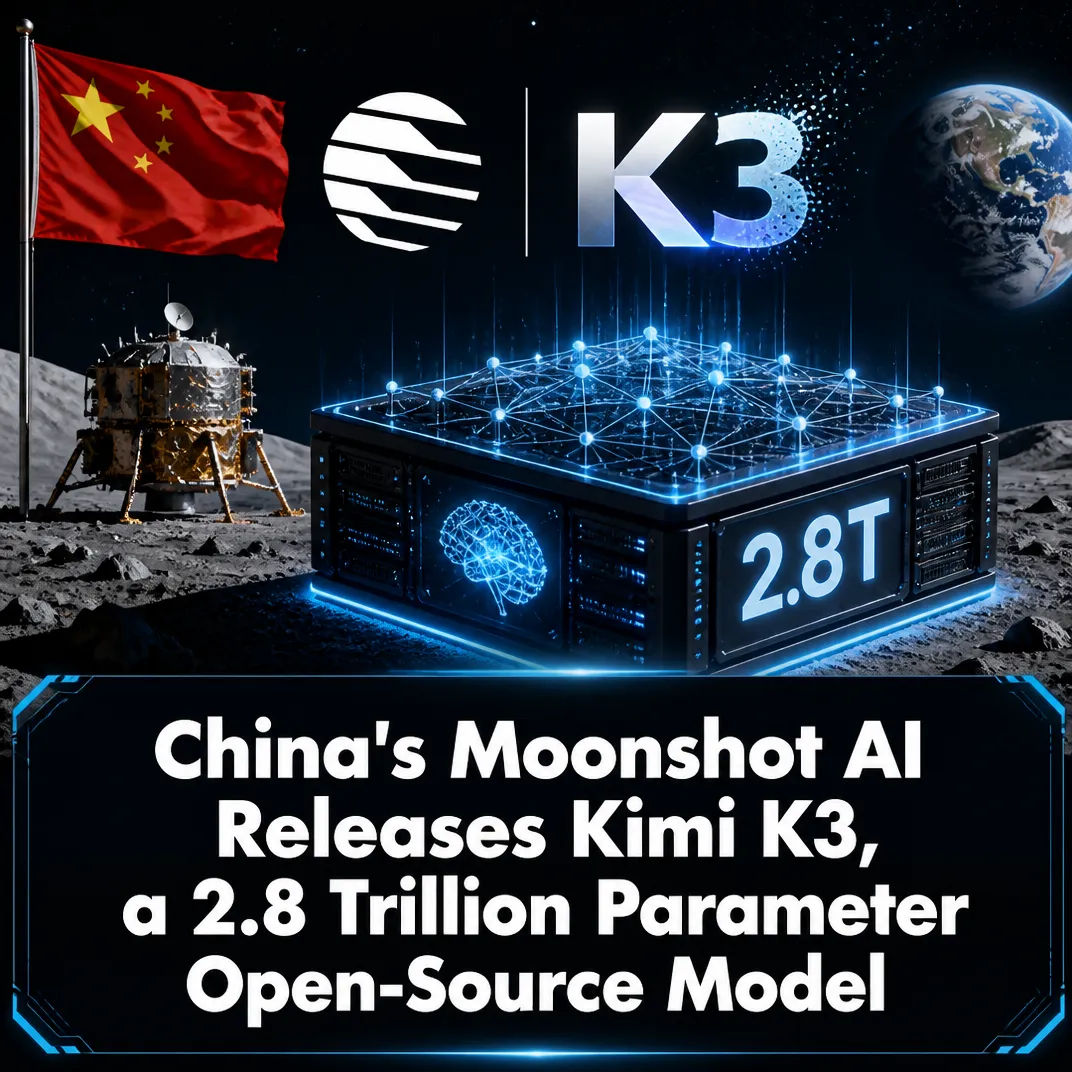
July 17, 2026, (Inside AI) — Beijing-based Moonshot AI released Kimi K3 on Thursday, a 2.8-trillion-parameter open-source model that the company claims is the largest ever built. The launch arrives days before the World Artificial Intelligence Conference in Shanghai, a timing that industry observers view as a deliberate statement of China’s growing AI ambitions.
Kimi K3 is roughly 75% larger than DeepSeek’s V4 Pro at 1.6 trillion parameters and dwarfs Zhipu’s 744-billion-parameter GLM-5 series. Moonshot says this is the ninth time in a year that a Kimi release has set a new open-source size record, a streak that began when K2 crossed the one-trillion mark.
The model’s performance claims are striking, though every figure comes from Moonshot itself. The company reports that K3 substantially outperformed Anthropic’s Claude Opus 4.8 and OpenAI’s GPT-5.6 Sol, while performing competitively against Anthropic’s Claude Fable 5. It concedes the model still trails the strongest proprietary systems overall—a rare and refreshingly honest caveat in an industry often prone to hype.
Pricing makes the proposition even sharper. K3 costs $15 per million output tokens, compared to roughly $50 for Fable, delivering frontier-adjacent capability at a third of the price. The full model weights go public on July 27, meaning anyone can download and run it for free. That move directly challenges the subscription-based access that Western labs have long relied on.
Engineering Under the Hood #
The architecture carries real engineering weight. Moonshot built K3 on Kimi Delta Attention and Attention Residuals, both previously published as open research. It also features a one-million-token context window and native visual understanding, capabilities that put it in direct competition with top-tier proprietary systems. Compatibility with the OpenAI SDK quietly lowers the switching cost for developers already building elsewhere, a tactical detail that could accelerate adoption.
For developers in regions like Pakistan, the free weight release matters most. Frontier-class capability without dollar subscriptions changes what small teams can realistically attempt, potentially democratizing access to cutting-edge AI in markets that have been priced out of the global race.
The Open-Source Power Shift #
K3’s launch is the latest salvo in an escalating open-source arms race. China’s labs have been systematically releasing massive models to challenge Western dominance, with DeepSeek, Zhipu, and now Moonshot all pushing parameter counts into the trillions. This strategy contrasts with the more guarded approach of OpenAI and Anthropic, who keep their most capable models behind APIs and paywalls.
Skeptics note that parameter count alone is a crude measure of capability. Efficiency, training data quality, and post-training alignment often matter more than raw size. Yet Moonshot’s decision to openly publish its attention mechanisms suggests a genuine commitment to transparency, not just a publicity stunt. The company’s admission that K3 still trails proprietary systems adds credibility, even as its claimed benchmarks demand independent verification.
The timing—just ahead of Shanghai’s AI conference—underscores Beijing’s strategic use of open-source as a geopolitical tool. By releasing K3’s weights, China not only showcases technical prowess but also invites global developers onto its ecosystem, potentially shaping the next wave of AI applications.
For the industry, K3 raises a pressing question: if open models can match or approach proprietary performance at a fraction of the cost, what becomes of the subscription business model? The answer may reshape the economics of AI over the next year.