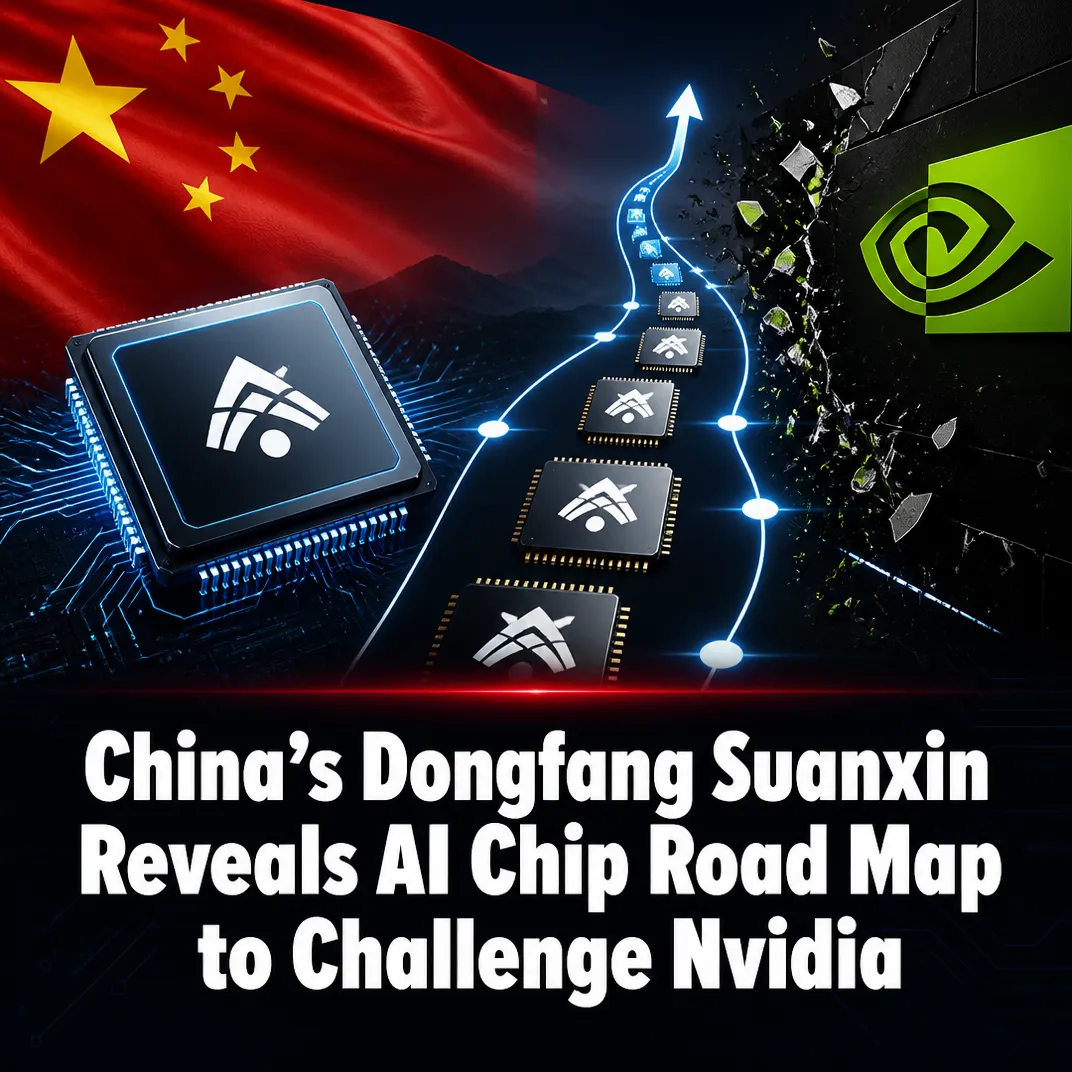
July 13, 2026, (Inside AI) — A Shanghai-based semiconductor start-up, Dongfang Suanxin, has unveiled an aggressive road map to challenge Nvidia's dominance in AI chips, leveraging novel architectures to bypass U.S. export controls.
The company, backed by Chinese state funds and domestic tech giants, announced its strategy on Monday, centered on software-defined computing and 3D-stacked near-memory architecture. These approaches aim to reduce dependence on advanced manufacturing and memory technologies restricted by Washington.
Dongfang Suanxin's flagship DF1000 processor, built on a 14-nanometre process, delivers 520 teraflops of BF16 performance—a critical metric for AI training. It boasts 6.4 terabytes per second of memory bandwidth and 900 gigabytes per second of scale-up bandwidth for inter-chip communication.
The chip is ready for mass production, with shipments expected by year-end. This timeline signals China's accelerating push for semiconductor self-sufficiency amid tightening U.S. sanctions.
Architectural Innovation as a Strategic Pivot #
Dongfang Suanxin's approach marks a departure from the traditional scaling race. Instead of chasing smaller process nodes, the company rethinks data flow. Software-defined computing dynamically reconfigures chip resources per workload, while 3D-stacked near-memory architecture vertically integrates memory layers closer to cores, slashing latency and energy use.
Founder Wei Shaojun captured the ethos at the launch:
"We have to forge a path of our own. That path cannot be about passively catching up within a framework set by others. We need independent architecture, original technology, a self-sustaining ecosystem and a secure, controllable supply chain."
This philosophy resonates with China's broader "dual circulation" strategy, prioritizing indigenous innovation. Yet, translating architectural novelty into a competitive ecosystem remains a monumental challenge. Nvidia's CUDA platform, with decades of developer lock-in, sets a high bar.
Industry analysts note that software-defined computing and near-memory processing are not new concepts—companies like Intel and AMD have explored similar paths. However, Dongfang Suanxin's focus on circumventing sanctions gives the effort geopolitical weight. The DF1000's 14nm node, while mature, may limit power efficiency compared to Nvidia's cutting-edge 4nm chips, but the company claims its architecture compensates through data locality.
Ecosystem and Market Realities #
Dongfang Suanxin's success hinges on building a software stack that rivals CUDA. Without robust tools, libraries, and developer support, hardware specs alone won't sway customers. The company has not disclosed detailed software plans, but Wei's emphasis on a "self-sustaining ecosystem" suggests investments in compilers and frameworks.
Competing viewpoints emerge from the broader landscape. Chinese tech giants like Huawei have already developed their own AI chips (Ascend series) and software (CANN), creating a fragmented domestic market. Dongfang Suanxin must differentiate itself or risk being overshadowed.
Meanwhile, U.S. sanctions continue to evolve. Recent rules have targeted even mature-node equipment, potentially impacting 14nm production. Dongfang Suanxin's supply chain claims of being "secure and controllable" may face scrutiny if key tools remain Western-dependent.
The start-up's state backing provides a cushion, but commercial viability demands performance parity with Nvidia's H100 or upcoming B100. Early benchmarks are absent, and real-world AI training workloads will be the true test.
In the broader context, Dongfang Suanxin's unveiling is part of a wave of Chinese chip efforts—from GPU start-ups like Biren Technology to established players like Alibaba's T-Head. Each aims to fill the void as Nvidia's advanced chips are blocked. Whether Dongfang Suanxin's architectural detour can deliver a viable alternative remains an open question, but the road map signals that China's AI ambitions are undeterred.