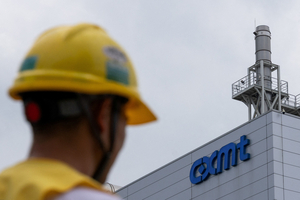
Chinese chipmaker reportedly tests memory with domestic AI firms but remains years behind Samsung Electronics and SK hynix
Chinese memory chipmaker CXMT has begun producing HBM3E in small quantities and testing it with domestic AI chip developers, according to The Information on Monday.
The step could increase competitive pressure on Samsung Electronics and SK hynix even as the Korean memory leaders remain ahead in cutting-edge HBM technology and mass production.
Alibaba Group’s chip unit T-Head and Beijing-based Cambricon Technologies are testing CXMT’s high-bandwidth memory with their processors, The Information reported, citing two people familiar with the matter. CXMT plans to expand production in 2027, and the Chinese chip designers could begin using the memory in products as early as next year if testing proceeds as planned.
CXMT, T-Head and Cambricon have not publicly confirmed the production or testing. The output volume, yield and detailed specifications of CXMT’s HBM3E also remain undisclosed.
The reported progress comes as Chinese AI chipmakers face tighter access to advanced foreign memory. The US added advanced HBM to its China export controls in December 2024, calling the technology critical to AI training and inference at scale. Chinese chipmakers also face restrictions on access to advanced semiconductor manufacturing equipment.
HBM stacks multiple DRAM dies to deliver much higher bandwidth than conventional memory and is used alongside processors in high-performance AI systems.
Mark Calderhead, an innovation center manager at Dutch chip equipment maker ASML, said CXMT’s reported HBM3E progress could help China reduce its reliance on foreign-controlled memory technology and represented an important step for its domestic semiconductor supply chain.
“It is a major step forward for China’s domestic chip supply chain,” Calderhead said.
He added that CXMT remains behind South Korean memory leaders, which have already moved beyond HBM3E into HBM4 production and HBM4E sampling.
SK hynix began mass-producing HBM3E in 2024, roughly two years before CXMT’s reported move into small-volume production.
By 2026, Samsung Electronics and SK hynix had moved into HBM4 production, and both had begun supplying HBM4E samples to customers by midyear. The companies have announced data-transfer speeds of up to 16 gigabits per second per pin for their HBM4E products.
The Information reported that CXMT continues to face low yields and remains an estimated three to five years behind leading HBM producers, citing people familiar with the company. CXMT has not disclosed whether its HBM3E has completed customer qualification.
CXMT is entering HBM from a growing position in conventional memory. Counterpoint Research estimated that the company held 7 percent of global DRAM revenue in the second quarter, ranking fourth behind Samsung Electronics, SK hynix and Micron. It also identified CXMT as the fastest-growing DRAM supplier during the quarter, helped by strong domestic demand and expanding capacity.
The company also raised 57.9 billion yuan ($8.6 billion) in its July Shanghai listing to fund technology upgrades, research and expanded production, giving CXMT additional resources as it pushes into HBM.
Neil Shah, vice president of research at Counterpoint, said CXMT’s expanding capacity and fresh capital improve its prospects, but cautioned that its HBM capability remains “unproven at scale.”
mjh@heraldcorp.com