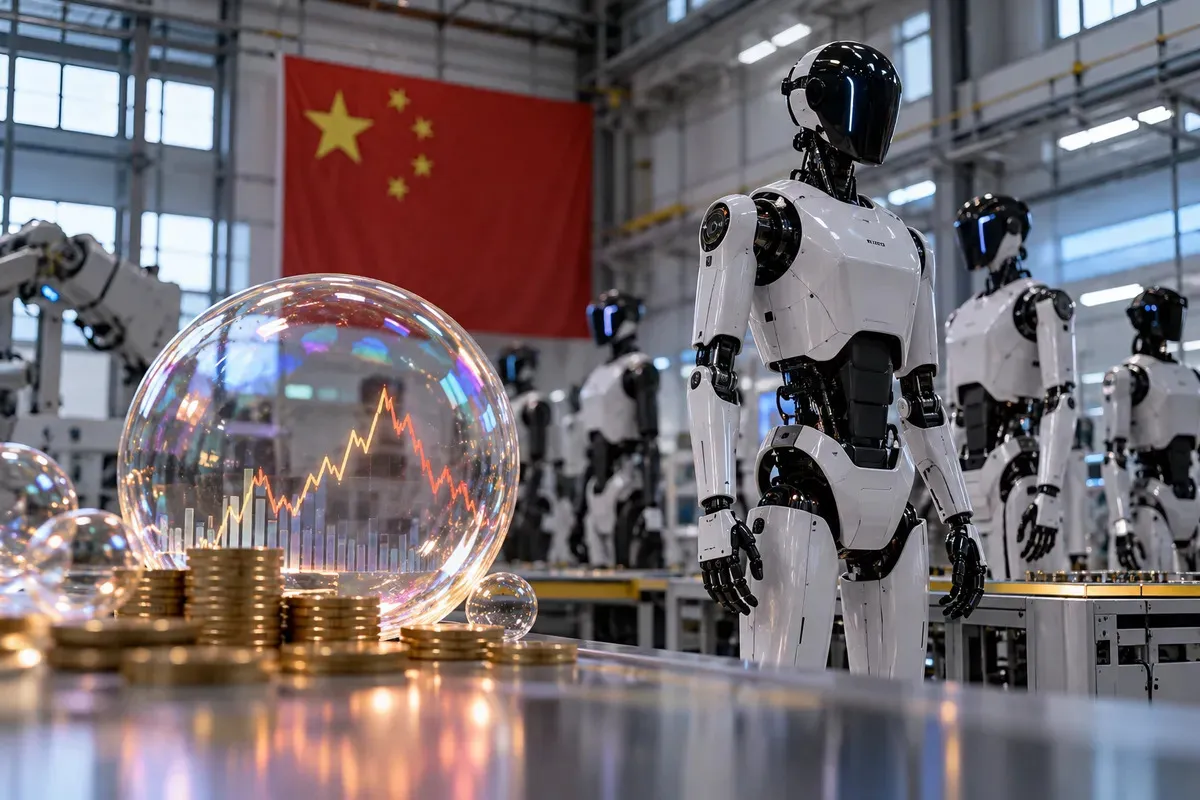
China has given humanoid robotics another high-level policy endorsement, but the more important signal for investors is the condition attached to that support.
On October 9, the Communist Party of China Central Committee and the State Council issued new guidance on developing what China calls “new quality productive forces.” The policy explicitly places humanoid robots among the intelligent products expected to benefit from the country’s AI Plus initiative and calls for more high-value industrial AI application scenarios. At the same time, official implementation guidance warns against repetitive construction, speculative projects, indiscriminate spending, and local governments rushing into the same emerging industries.
That combination matters more than another broad endorsement of robotics. Beijing is not withdrawing support from humanoids. It is signaling that support should increasingly produce measurable industrial value rather than simply more factories, funds, demonstration centers, or ambitious capacity targets.
The National Development and Reform Commission described AI commercialization and scaled application as a long-term, complex process. It specifically identified humanoid robots as one of the fields emerging as AI moves from laboratories into production and daily life. The same official explanation stressed that local development should reflect genuine industrial conditions and warned against wasteful duplication and projects driven primarily by policy fashion.
What this changes
For humanoid robotics investors, the policy strengthens two opposing forces at once. The supportive side is clear. Humanoids remain inside a nationally prioritized AI and advanced-manufacturing framework. The central guidance calls for AI deployment in traditional industries, industry-specific pilot bases, high-value application scenarios, continued investment in future industries, and development of underlying technology, computing and data infrastructure.
The discipline side is equally relevant. Officials are being told to avoid homogeneous industrial projects, blind investment and wasteful competition. Reuters independently characterized the guidance as an effort to support advanced technologies, including humanoid robots, while preventing investment bubbles and poorly coordinated expansion.
For company analysis, this makes announced production capacity less informative on its own. A new robot factory, local industrial fund or capacity target may still benefit from the policy environment, but it does not demonstrate demand. Named customers, paid activity, operating hours, repeat deployments, utilization, reliability and customer expansion remain stronger evidence of commercial progress. The guidance therefore favors a more selective interpretation of China’s humanoid buildout. Companies capable of connecting manufacturing capacity to real deployments may benefit from both national support and industry consolidation. Companies whose evidence consists mainly of funding, planned capacity, demonstration footage or policy alignment have not yet established the same commercial case.
What to watch next
The next useful evidence will be implementation rather than rhetoric: which provinces receive or establish industrial AI pilot bases, whether humanoid-specific procurement or subsidy criteria emerge, which companies receive material support, and whether those programs produce identifiable customer operations.
Most important will be evidence linking policy support to useful work. Unit production, financing and factory capacity should remain separate from delivery, operation, payment and repeat deployment. Until those links become visible, the October guidance is a confirmed policy signal, not proof that China’s humanoid sector has solved commercial adoption.
Sources:
- Xinhua, “中共中央 国务院关于发展新质生产力的意见” Source type: Tier 1, direct or official evidencehttps://www.news.cn/politics/zywj/20261009/f4bdabfe2bfa489fbeaf6d57bac21c22/c.html
- National Development and Reform Commission, “国家发展改革委有关负责同志就《关于发展新质生产力的意见》答记者问” Source type: Tier 1, direct or official evidencehttps://www.ndrc.gov.cn/xwdt/xwfb/202610/t20261009_1408037.html
- Reuters, “China vows to curb tech bubbles, keep AI risks in check” Source type: Tier 2, strong independent evidencehttps://www.reuters.com/world/asia-pacific/china-issues-guidelines-new-productive-forces-including-ai-2026-10-09/