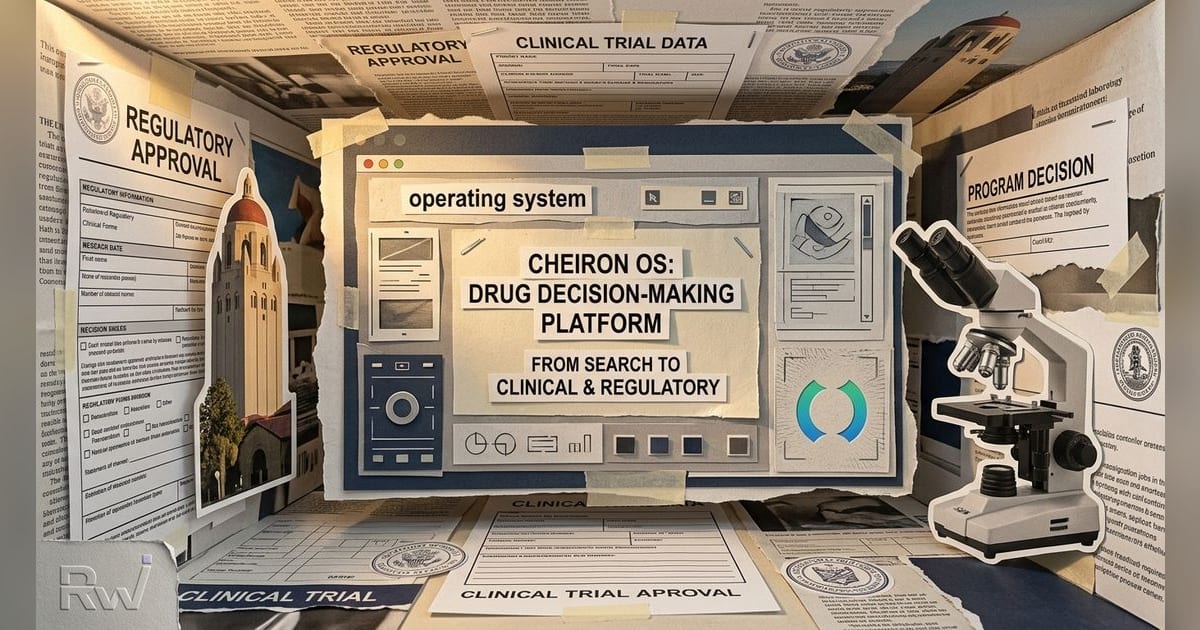
Minseok Bae, Jason Park and Harshit Gupta have raised an $8 million seed round for Cheiron, giving the young Stanford-linked founding group fresh capital to turn a biopharma research assistant into a system of record for drug development.
Menlo Ventures led the round, according to Cheiron's July 22nd announcement. Menlo partner Venky Ganesan will join Cheiron's board. Cheiron also named Robert Langer, the MIT Institute Professor and Moderna co-founder; former Pfizer chief medical officer Freda Lewis-Hall; Chai Discovery co-founder Josh Meier; former Starbucks chief executive Laxman Narasimhan; and former Apple AI chief John Giannandrea among its backers and strategic supporters. Cheiron did not disclose a valuation or the amounts invested by individual participants.
The financing follows a $4 million SAFE announced in August 2025. SK Networks led that financing, with participation from Cohere co-founder Aidan Gomez and Illia Polosukhin, a co-author of the transformer research paper "Attention Is All You Need." The two publicly announced financings total $12 million.
The investor roster gives Cheiron two forms of validation it needs. Menlo supplies enterprise software credibility and access to US customers. Langer, Lewis-Hall and other drug-development veterans lend domain standing to founders whose public biographies are weighted toward computer science rather than careers inside pharmaceutical research organizations.
Bae left Stanford, where he studied computer science, to build Cheiron. A PMWC biography describes him as a programming olympiad winner focused on applying generative AI to biopharma knowledge work. Cheiron lists Park as chief product officer and Gupta as chief technology officer on its founder page.
Moving beyond the answer engine
Cheiron's strategy has expanded since the product's initial release. Korean industry publication Korea Biomedical Review reported in December 2024 that Cheiron launched as an enterprise research assistant built around retrieval-augmented generation. The product searched academic databases and internal documents, then returned answers linked to source material.
Cheiron is now pitching a broader architecture. Bae wants Cheiron to represent the full state of a drug program, including evidence, assumptions, decisions, risks and commitments that accumulate across clinical development, regulatory work and competitive analysis.
Cheiron calls the core data layer its Life Sciences Knowledge Graph. According to Cheiron, the graph connects biomedical literature, clinical trials, regulatory material, patents and commercial information. Proposed uses include comparing a trial design with regulatory precedent, finding conflicts between published results and patent filings, and testing a biological hypothesis against available evidence.
That positioning moves Cheiron into a larger and harder software category. Search can help a scientist find an answer. A system of record must preserve context, permissions and decisions across functions, withstand review, and remain useful after source documents or assumptions change. Pharmaceutical customers will also expect traceability when an AI-generated output informs regulated work.
Cheiron's own description of the problem centers on the gaps between protocols, regulatory submissions, toxicology reports, manufacturing packages and meeting notes. Each document captures a moment in a program, while dependencies between those documents often remain in employees' memories. Cheiron wants its software to track those dependencies and show what needs to change when new evidence arrives.
The established alternatives already control parts of that workflow. Veeva Development Cloud covers clinical, regulatory, quality and safety operations. Benchling manages research data and laboratory workflows. Causaly applies AI and knowledge graphs to life-science research. Cheiron's opening is the connective layer across a drug program, where evidence from separate systems becomes a shared model for decisions.
Adoption claims carry an unclear clock
Cheiron says tens of thousands of biopharma professionals have adopted the product and that major drug developers have deployed it. Cheiron named South Korean pharmaceutical manufacturer Boryung as one customer. Cheiron has not published revenue, annual recurring revenue, pricing, paid-seat counts or a complete customer list.
The timeline behind the adoption claim is also unclear. Cheiron's July 22nd release says the usage was reached in "less than six months since launch." The August 2025 financing announcement said the Cheiron platform had launched in December 2024 and was being used by more than 60 organizations. Korea Biomedical Review also covered the December 2024 launch. Cheiron's latest release does not identify a subsequent product launch that would explain the six-month measurement period.
That discrepancy does not negate the reported usage, but it limits what can be inferred from the growth claim. "Tens of thousands" may include individual users across free, trial and enterprise access, while deployments at major developers could range from limited pilots to wider contracts. Cheiron has not provided the denominator needed to distinguish product reach from recurring enterprise revenue.
The prior financing announcement said all 10 of South Korea's largest pharmaceutical companies by revenue were using Cheiron for workflows such as paper and clinical-trial searches. It also described work with SK Biopharmaceuticals and Samil Pharmaceutical on Cheiron Write, a medical-writing product. The new pitch shifts the center of gravity from discrete research and drafting tasks toward the underlying representation of a drug program.
Menlo backs development execution
The round reflects investor interest in AI software for regulated professional work, with Cheiron applying the model to the expensive handoffs that occur after a drug candidate enters development. Much of biotech's recent AI spending has focused on target identification, protein design and molecule discovery. Cheiron is selling into the operational work that determines how evidence is reviewed, documented and carried into clinical and regulatory decisions.
That distinction shapes how Cheiron plans to spend the seed capital. Cheiron says the money will expand the Life Sciences Knowledge Graph, add capabilities across clinical, regulatory and strategic workflows, and support hiring in engineering, product and life sciences.
Cheiron is also formalizing a layer of domain oversight around its technical founders. Robert Langer's MIT biography documents work spanning drug delivery, biotechnology and company formation. Lewis-Hall and BG Rhee, a former Green Cross and GI Innovation chief executive, are joining Cheiron as advisers.
The advisers can help Cheiron translate technical claims into workflows that pharmaceutical executives will buy and regulated functions will accept. The harder test comes after the round: proving that a connected model of a drug program can remain accurate as evidence changes, integrate with entrenched software, and become important enough that customers treat Cheiron as infrastructure rather than another AI research interface.