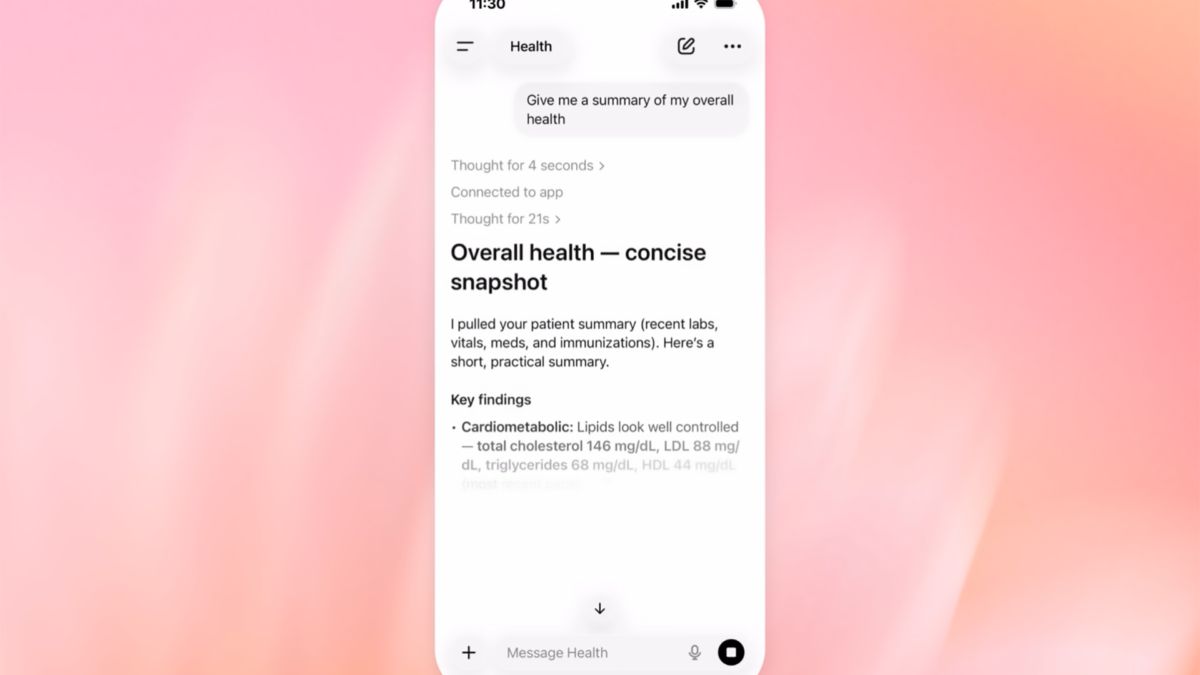
On Thursday, OpenAI announced that it is officially making its controversial health assistant feature, ChatGPT Health, available to everyone in the United States.
By giving the chatbot access to your medical records and Apple Health data, ChatGPT users across the country aged 18 and up will be able to consult it for advice on anything from diet and workout routines to understanding medical test results.
The ChatGPT Health feature was initially unveiled earlier this year to a small group of early users. The new and improved feature builds on the feedback from those early testers, which includes integrating the feature directly into the chat experience rather than making it a separate space in the app. So, if you consent, your health information will inform not just your health-related inquiries, but pretty much everything you ask the chatbot.
“For example, ChatGPT can consider a dietary restriction when helping you choose a restaurant, or a recent injury when planning lower-impact weekend activities with your family,” OpenAI shared in a press release. “You can ask follow-up questions, add context, or correct information that is incomplete or out of date.”
The feature now relies on GPT-5.6 Sol for paid users, OpenAI’s latest flagship model, which allegedly went haywire and launched a cyberattack against HuggingFace. The model is also OpenAI’s “strongest model yet for health,” the company claims.
The grand unveiling comes at a legally fraught time for OpenAI. The company was very recently slapped with two high-profile cases related to its chatbot’s ability to give health advice to people. In a civil lawsuit filed in May, the family of a 19-year-old who died of a drug overdose is blaming ChatGPT for advising their son to use Xanax to “smooth out” his high from Kratom, a herbal substance with opioid-like effects, a combination that ultimately led to his death.
Claiming that their son, Sam Nelson, “died by taking the medical advice ChatGPT was programmed to provide,” the family is not only pressing for financial damages but is also seeking to the ChatGPT Health feature. The incident took place in May 2025, and Nelson was allegedly using ChatGPT-4o, a model that has been embroiled in quite a lot of user health-related controversy and legal backlash.
Then, just yesterday, a Florida pastor sued the AI giant, claiming that the health advice ChatGPT gave him caused him to delay urgent care for a life-threatening pulmonary embolism. Instead of telling the pastor to seek medical advice for the early warning signs of the pulmonary embolism, the chatbot allegedly told him to just trust that “God did not design your body to endlessly fail.” His lawsuit also asks for a to the ChatGPT Health feature, as well as financial damages and stronger regulatory guardrails for ChatGPT’s ability to answer health-related questions.
According to OpenAI, more than 300 million people use ChatGPT every week to ask health-related questions. While announcing the new feature and boasting its prowess across health-related benchmarks, OpenAI did say that it can “still make mistakes.”
“We encourage people to verify important information and discuss medical decisions with their healthcare provider,” OpenAI said in the press release.