A new analysis says OpenAI's news and content partners get a separate, faster route into ChatGPT answers than everyone else. According to The Decoder's report on October 27, 2026, a generative engine optimization (GEO) researcher found that content from licensing partners reaches ChatGPT as pre-generated summaries, placed ahead of ordinary web results, while other pages arrive as raw text snippets.
This is an outside reverse-engineering result, not an OpenAI announcement. Below we lay out the claim, the numbers, what is confirmed from public records of OpenAI's publisher deals, and how you can test it on your own queries.
TL;DR: claimed vs verified #
| Claim | Source | Status |
|---|---|---|
| Partner content has a dedicated pipeline into ChatGPT | David Konitzny (Peec AI), via The Decoder | Reported by one analyst; not confirmed by OpenAI |
| Partner pages arrive as pre-generated summaries, not live fetches | Same | Reported; mechanism not publicly documented |
| Partner entries sit before other web results in the prompt | Same | Reported |
| 12 publishers across 43 domains | Same | His count; not independently checked |
| Summaries fill 70% of ranked positions 1 to 3, 23% of positions 7 to 10 (1,000 cases) | Same | His measurement; we could not reproduce it |
| OpenAI has licensing deals with major publishers | OpenAI announcements, press | Confirmed publicly for several partners |
| OpenAI promised partners more prominent placement (2024) | The Decoder background | Reported in earlier coverage |
What did the researcher find? #
The analysis was published on LinkedIn by David Konitzny, who works on GEO at the Berlin startup Peec AI, according to The Decoder. We have not been able to find a longer Peec AI write-up, so everything below rests on that post as summarized by the outlet.
As reported:
- Of three news engines configured in the system, only one, called "labrador," fills a field named "provider." That field is how he identified partner content.
- Partner content flows through "a dedicated pipeline that gives it priority over the rest of the web."
- ChatGPT does not fetch partner pages live. It receives pre-generated summaries, while ordinary pages come through as raw text snippets.
- In the prompt, partner entries come before all other web results.
- He counted 12 publishers with 43 domains.
- Across 1,000 cases in ranked lists, the summaries make up 70% of entries in positions 1 to 3 but 23% in positions 7 to 10.
The publishers named include Condé Nast, Hearst, Axel Springer, News Corp, Reuters and AP on the news side, and Allrecipes, Tom's Guide and Welt for recipes, product reviews and buying guides.
What is publicly confirmed about OpenAI's publisher deals? #
The existence of the deals is not in doubt. In December 2023 OpenAI and Axel Springer agreed that ChatGPT would show summaries of stories from titles such as Politico and Business Insider, as Law360 reported. Later, the Washington Post partnership had ChatGPT show summaries, quotes and links to Post articles in web searches, and OpenAI said it had similar agreements with more than 20 news publishers.
So "partner content appears as summaries with attribution" is consistent with what the deals described. What is new, and unconfirmed, is the claim about the technical path and the ranking effect. A summary pipeline is a plausible way to deliver the licensed experience, but that is our inference, not something OpenAI has documented.
The Decoder also notes that a study from Hamburg found Springer media appeared far more often in the web interface than through the API, and that even partners are not always cited correctly. We did not check that study directly.
How much weight should the 70% vs 23% figure carry? #
A hand moving one green card to the front of a fan of cards, showing how ChatGPT partner publishers may be ranked first
Treat it as a signal, not a law. Reasons for caution:
- Sampling. "1,000 cases" is a sample of queries chosen by the analyst. The mix of topics matters: news and recipe queries are where partners are strongest, so the overall effect on, say, developer documentation could be very different.
- Correlation with quality. Large publishers also tend to be authoritative and heavily linked. High placement of their content might partly reflect ordinary ranking signals, not only a priority lane. The numbers as reported do not separate those causes.
- Moving target. ChatGPT's search stack changes often. A pattern seen in one week may not hold in the next, and it may differ between the web interface and the API.
- Single source. We found no second independent replication at the time of writing.
None of that means the claim is wrong. It means it deserves a test before anyone rebuilds a content strategy around it.
Why does this matter for publishers, SEO and GEO? #
If the pattern holds, it has three consequences. For non-partner publishers, the route to being cited is narrower than "rank well on the web." Their pages still arrive, but as raw snippets and later in the prompt, which is a disadvantage when the model's answer leans on the first few sources.
For GEO practitioners, it shifts advice. A lot of optimization work assumes a level field where clear structure and quotable facts win. A paid or negotiated lane changes the economics: licensing becomes a distribution channel, not only a legal settlement. This sits alongside other moves we have covered, such as Meta's commercial terms on crawling publisher sites and CNN's multiyear partnership with Google.
For readers, it matters because the first sources shape the answer. If the first sources are all commercial partners, the answer may carry their framing and miss independent reporting. That is a media-diversity question regulators and publishers will likely raise.
It also lands in the middle of the copyright fight. Some publishers license, others sue: see USA Today's $250 million suit against OpenAI and Canadian publishers suing Anthropic. A priority lane for licensors is, in effect, a carrot sitting beside the stick of litigation.
How is this related to ChatGPT's ad business? #
OpenAI is also building advertising into ChatGPT. Our write-up of the ChatGPT ad stack describes a deliberate wall between ads and answers. The partner-content report concerns something else, organic source selection, but it raises a parallel trust question: which commercial relationships shape what appears in the answer, and are users told? Neither report establishes wrongdoing. Both show that the neutral "search engine" picture of a chatbot is incomplete. Anthropic took the opposite approach on ads, as we covered in the no-ads pledge in its IPO letter.
How can you check this yourself? #
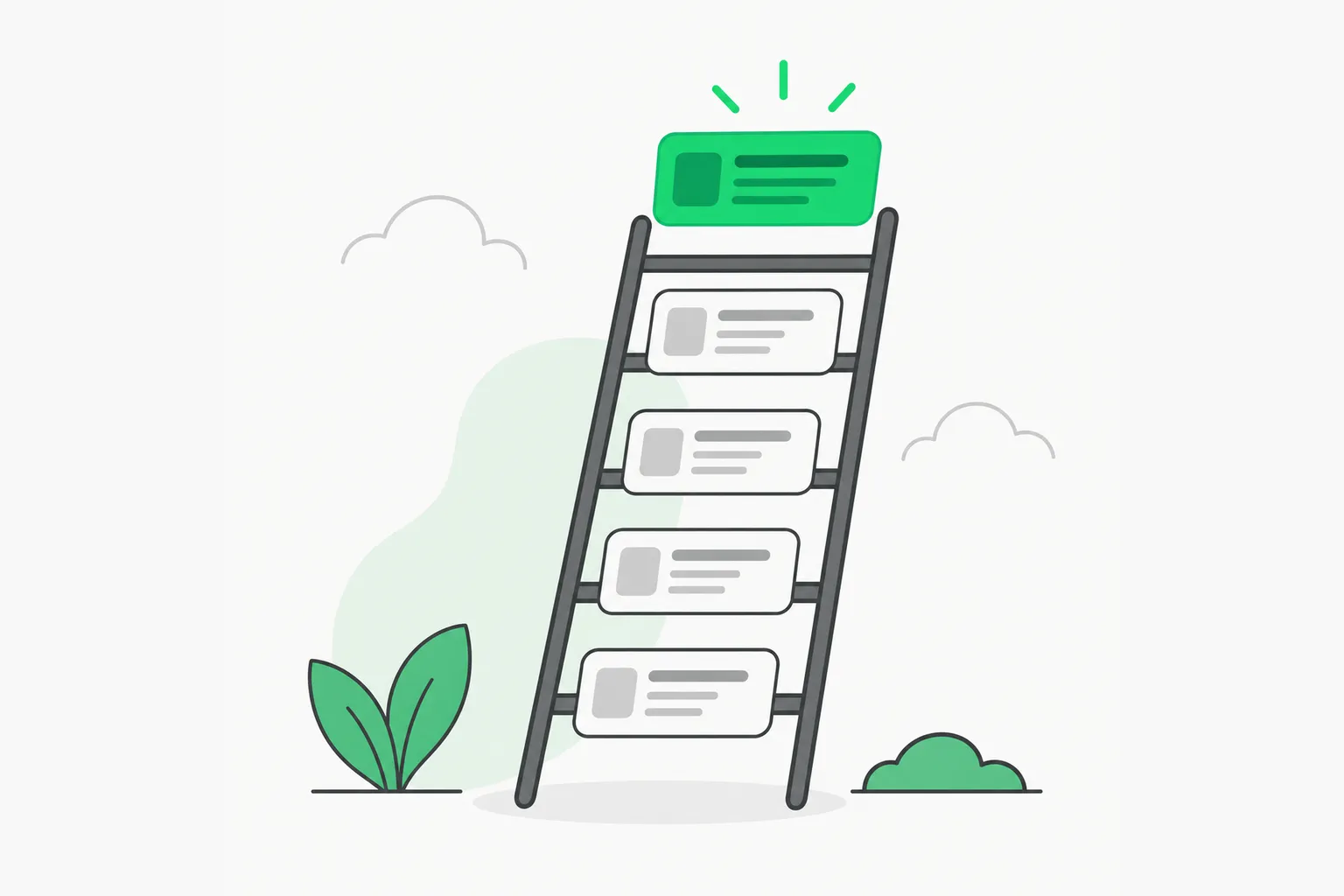
A stack of rounded cards with a green card near the top, a model for logging which sources ChatGPT cites first
You do not need special tooling to run a rough version of the test.
- Pick 20 to 30 queries in a topic where partners publish: breaking news, recipes, product reviews.
- Ask each in ChatGPT with search on, in a fresh chat, and record the cited sources in order.
- Mark each source as partner or non-partner using the public lists of announced deals.
- Compute the share of partner sources in positions 1 to 3 versus later positions.
- Repeat on a different day and with a logged-out session, to see how stable the pattern is.
- Repeat with a topic where partners are weak, such as niche technical documentation, as a control.
If you see something close to 70% versus 23% on news queries and nothing like it on the control topic, that supports the report. If you do not, that is useful too, and worth publishing.
What should site owners do now? #
- Do not panic or pivot. One analysis is not a policy change. Keep doing the basics: fast pages, clear answers near the top, original data, accurate bylines.
- Measure your own visibility in AI answers for your key queries, using the method above, so you have a baseline.
- Consider licensing only if it fits your business. Partner terms are private, and the benefit depends on what you publish and how much of your traffic AI answers already replace.
- Watch the crawl and robots rules of each AI provider, because these are the levers you control directly.
What is still unknown? #
- Whether OpenAI will confirm, deny or explain the pipeline.
- Whether the effect is a deliberate priority, a side effect of delivering summaries, or partly ordinary ranking.
- How stable it is across regions, languages and the API versus the web interface.
- Whether partners are labeled to users as such in the interface.
- What the partner terms say about placement.
We will update this post if OpenAI responds or a second team reproduces the numbers.
Related reading #
Figures are as reported on October 27, 2026 by The Decoder from a LinkedIn analysis, and have not been independently reproduced.