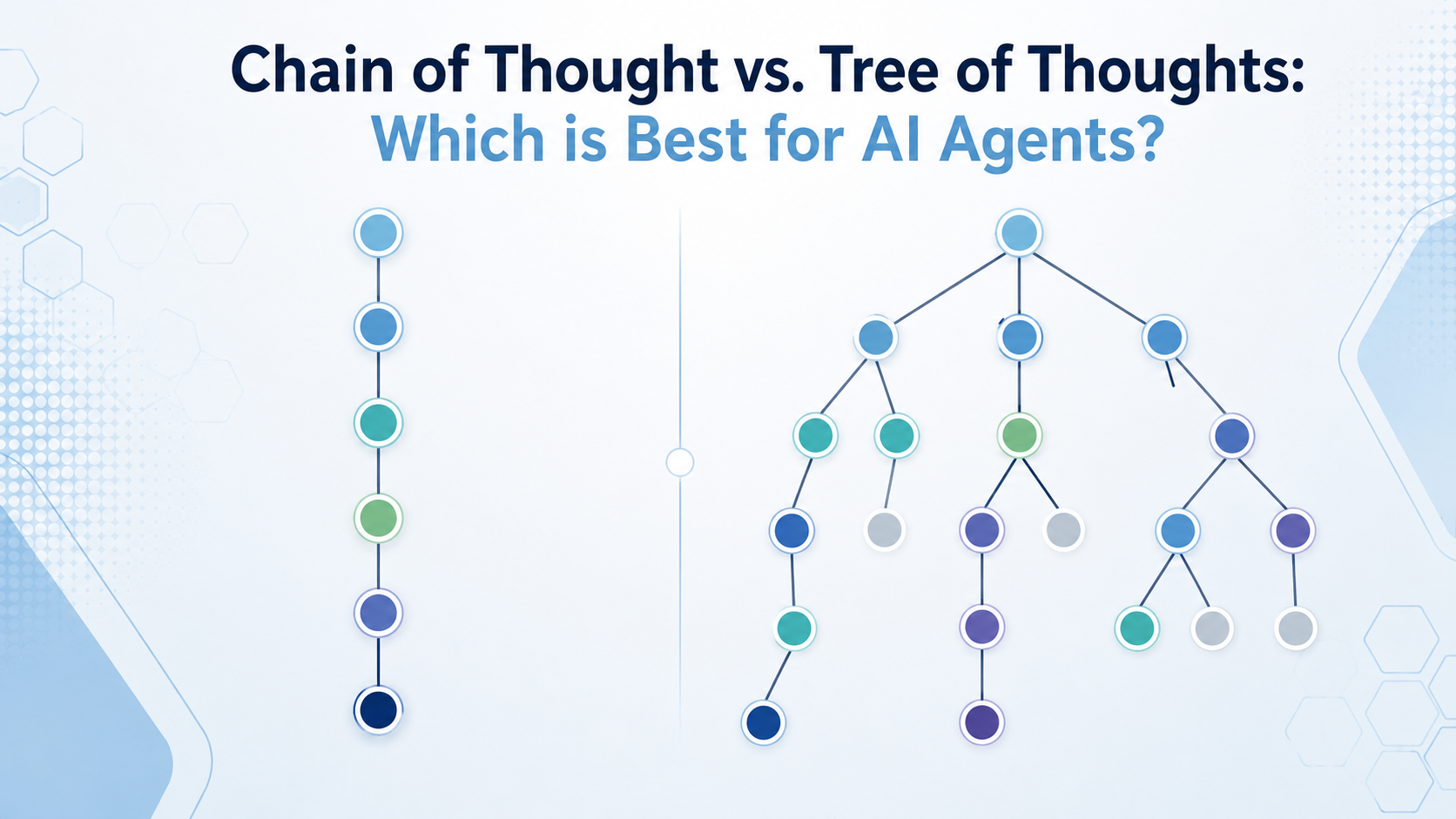
In this article, you will learn the key differences between Chain of Thought and Tree of Thoughts prompting, and how each reasoning framework is applied in AI agent systems.
Topics we will cover include:
- How Chain of Thought works as a linear reasoning technique and where its limitations lie.
- How Tree of Thoughts extends reasoning through branching, evaluation, and backtracking.
- How AI agents use both frameworks together, matching each to the complexity of the task at hand.
Introduction #
Large language models have a default behavior that works against complex reasoning. They are trained to predict the next most likely token given everything that came before, which means that, left to their own devices, they tend to leap directly from a question to an answer. For simple tasks, this works fine. For anything that requires multiple steps, careful logic, or planning ahead, it tends to fail in ways that look confident and coherent but are quietly wrong.
Two techniques have emerged to address this: Chain of Thought and Tree of Thoughts. Both are designed to force a model to reason before it concludes. They share that goal but pursue it in structurally different ways, with different costs, different strengths, and different failure modes.
For AI agents, the choice between these approaches is not cosmetic. It shapes what the agent can actually accomplish.
The Problem Both Techniques Solve #
To understand why these techniques exist, it helps to see clearly what happens without them.
Ask a language model a straightforward factual question and it will usually answer correctly. Ask it to solve a problem that requires holding several intermediate conclusions in mind, or that has a structure where early mistakes compound into later ones, and the model’s tendency to jump to a fluent-sounding answer becomes a liability. It will produce text that reads like careful reasoning but was not actually generated that way. The appearance of thought is not the same as thought.
Both Chain of Thought and Tree of Thoughts work by inserting intermediate steps between input and output. Instead of mapping directly from question to answer, the model generates a sequence of reasoning steps first. The final answer emerges from those steps rather than directly from the input. This simple change in structure produces measurable improvements on tasks involving mathematics, logic, and multi-step planning.
The techniques diverge in how those intermediate steps are organized, how many are generated, and what happens when a step turns out to be wrong.
Chain of Thought: Linear Reasoning #
Chain of Thought is the simpler of the two approaches. It asks the model to show its work: to generate a sequence of intermediate reasoning steps before arriving at a final answer.
In its most basic form, this can be triggered by something as minimal as appending the phrase “Let’s think step by step” to a prompt. The model, guided by that instruction, produces a chain of reasoning rather than an immediate conclusion. More structured implementations provide explicit step-by-step instructions or use examples to demonstrate the reasoning format expected.
The structure is linear. The model moves from the problem statement to step one, from step one to step two, and so on, until it arrives at an answer. Each step follows directly from the previous one. Think of a student working through an algebra problem on paper, writing each line of calculation in sequence. The approach is transparent, auditable, and easy to follow.
This linearity is also its core limitation. If the model makes an error at an early step, that error propagates forward. Every subsequent step is built on a flawed foundation, and the final answer inherits the mistake. The model does not go back. It does not evaluate whether step one was actually correct before proceeding to step two. Once a chain is started, it runs in one direction.
For a broad range of tasks, this does not matter much. Chain of Thought performs well on standard math problems, logical deductions, summarization tasks, and the kind of everyday reasoning that appears in most prompts. The single-path limitation is only a meaningful constraint when problems are genuinely ambiguous, when there are multiple plausible approaches worth exploring, or when the cost of an early error is high.
Tree of Thoughts: Branching and Backtracking #
Tree of Thoughts extends the Chain of Thought idea by making the reasoning process non-linear. Rather than generating one chain of steps and following it to a conclusion, the model generates multiple possible next steps at each point, evaluates how promising each one looks, and selects the most viable path to pursue further. If a path leads to a dead end, the system backtracks and tries a different branch.
The chess player analogy is useful here. A strong chess player does not just calculate the most obvious next move and commit to it. They consider multiple candidate moves, think through the implications of each, discard the ones that lead to bad positions, and pursue the one that looks most promising further. If deeper calculation reveals that the promising-looking move leads to a trap, they abandon it and revisit the alternatives. Tree of Thoughts applies this kind of deliberate search to language model reasoning.
At each step, the model is asked to generate several distinct continuations rather than just one. It then evaluates those continuations, either by scoring them directly or by reasoning about which ones are more likely to lead to a correct answer. A search algorithm — the same kind used in classical computer science problems — guides which branches to explore and in what order. The result is a structured exploration of a space of possible reasoning paths rather than a single committed trajectory.
This architecture allows the system to recover from mistakes in a way that Chain of Thought cannot. A branch that turns out to be wrong can be abandoned. A path that initially looked less promising can be revisited if the leading candidate fails. The model is not locked into a decision it made early in the process.
The cost is significant. Where a Chain of Thought response requires a single prompt and a single model response, a Tree of Thoughts process requires many. Generating multiple branches at each step, evaluating those branches, and continuing to explore the most promising ones involves calling the model repeatedly — sometimes dozens of times — for a single problem. The computational cost, in time, money, and token usage, scales with the complexity of the reasoning tree. For difficult problems, this can mean hundreds of model calls.
How AI Agents Use These Approaches #
The distinction between Chain of Thought and Tree of Thoughts becomes most consequential inside AI agent systems, where the reasoning framework chosen determines not just the quality of an answer but the quality of a sequence of actions.
An agent does not just respond to a prompt. It decides which tools to use, in what order, with what parameters. It interprets intermediate results and adjusts its approach. It takes actions in the world, and those actions have consequences that cannot be undone with a backspace. The reasoning process that governs these decisions shapes everything the agent can accomplish.
Chain of Thought is the default reasoning layer for most agent tasks. When an agent needs to decide which database to query, parse the intent behind a user request, or work through a multi-step calculation before choosing an action, Chain of Thought provides a structured, transparent reasoning process without significant overhead. It is fast, it is cheap, and it is sufficient for the vast majority of decisions an agent makes.
Tree of Thoughts is better suited to the harder class of problems where the right approach is genuinely uncertain in advance. A software engineering agent trying to implement a function that satisfies a set of constraints might generate three different implementation strategies, evaluate the trade-offs of each, implement the most promising one, test it, and fall back to the second candidate if the first fails. A strategic planning agent might explore several possible courses of action, simulate their consequences, and select the one that best satisfies the goal. These are tasks where committing to a single path without exploration carries real risk, and where the additional cost of Tree of Thoughts is justified by the difficulty of the problem.
In practice, well-designed agent systems use both. Chain of Thought handles routine decisions and straightforward reasoning tasks. Tree of Thoughts is reserved for the subset of problems where multiple approaches need to be considered and evaluated before committing, because the cost of getting it wrong is high or because the problem space is genuinely complex.
Choosing Between Them #
The decision between Chain of Thought and Tree of Thoughts reduces to three practical questions.
First, is the problem one where there is a clear, step-by-step path to a solution, or one where the right approach is genuinely uncertain? If the path is clear, Chain of Thought is almost always sufficient. If multiple strategies need to be explored and compared, Tree of Thoughts earns its cost.
Second, what are the consequences of an early mistake? In a summarization task, an error early in the reasoning chain is unlikely to produce a catastrophically wrong answer. In a planning task where early decisions constrain all subsequent ones, an uncorrected early error can be very costly. Higher stakes justify the self-correction capability that Tree of Thoughts provides.
Third, what are the resource constraints? Tree of Thoughts can be orders of magnitude more expensive than Chain of Thought for the same problem. In real systems, that difference is not abstract. It affects latency, cost, and the number of tasks an agent can handle in a given time window.
The right answer is almost never one framework exclusively. Chain of Thought is the workhorse: fast, reliable, and appropriate for most tasks. Tree of Thoughts is the specialist: slower, more expensive, but capable of tackling problems where linear reasoning reliably fails.
Key Takeaways #
Chain of Thought improves language model reasoning by generating intermediate steps in a linear sequence before arriving at a conclusion. It is simple to implement, fast, and effective for most tasks, but it cannot recover from errors made early in the reasoning chain. Tree of Thoughts extends this by exploring multiple reasoning branches at each step, evaluating them, and backtracking when a path fails. It is significantly more expensive but handles genuinely complex, ambiguous problems more reliably.
For AI agents, Chain of Thought governs routine decisions and straightforward reasoning tasks. Tree of Thoughts is reserved for problems where multiple strategies need to be explored before committing, and where the cost of an early mistake is high. Most production agent systems use both, matching the reasoning framework to the complexity of the task at hand.
Further Reading #
- **[Chain-of-Thought Prompting Elicits Reasoning in Large Language Models](https://arxiv.org/abs/2201.11903)** — Wei et al. (2022); the foundational Chain of Thought paper.
- **[Tree of Thoughts: Deliberate Problem Solving with Large Language Models](https://arxiv.org/abs/2305.10601)** — Yao et al. (2023); the Tree of Thoughts framework paper.
- **[Building Effective Agents](https://www.anthropic.com/research/building-effective-agents)** — Anthropic (2024); practical design patterns for agentic systems.
- **[Large Language Models are Zero-Shot Reasoners](https://arxiv.org/abs/2205.11916)** — Kojima et al. (2022); on the “Let’s think step by step” finding.
- LangChain — widely used framework implementing both Chain of Thought and Tree of Thoughts patterns.