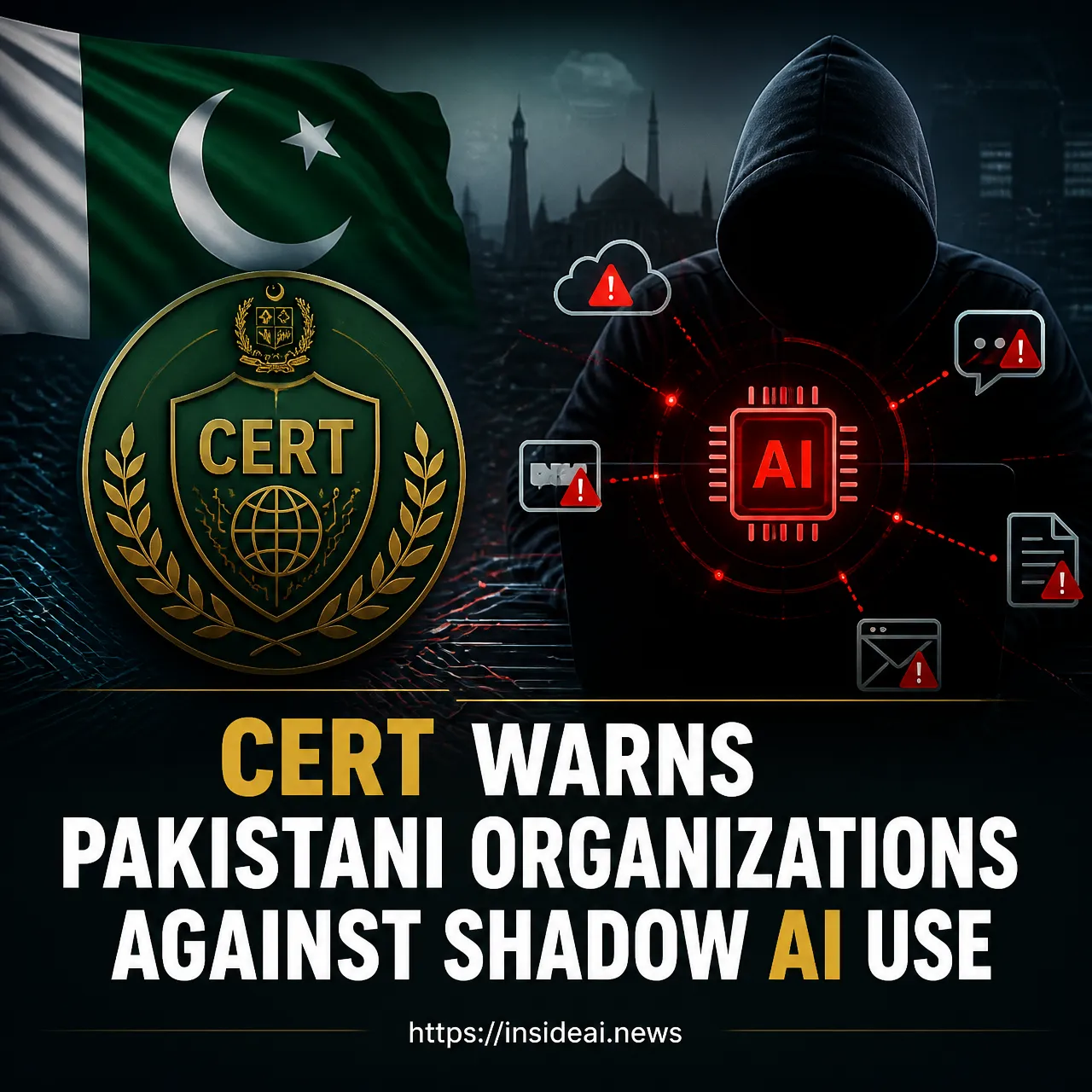
October 3, 2026, (Inside AI) — Pakistan's National Computer Emergency Response Team (CERT) has issued a formal advisory warning organizations about the cybersecurity risks posed by uncontrolled generative AI use. The advisory, titled "Safe and Secure Use of Generative Artificial Intelligence (GenAI) Tools and Platforms," specifically targets "Shadow AI," which it defines as the unauthorized use of public chatbots, coding assistants, browser extensions, and third-party AI services. The agency warns that this unregulated adoption exposes sensitive information, intellectual property, credentials, and source code to external platforms without oversight.
The advisory arrives as generative AI tools become deeply embedded in enterprise workflows worldwide. Employees often adopt these tools without IT approval, creating blind spots for security teams. Pakistan's CERT is now urging organizations to block sensitive data from leaking to public and unapproved AI platforms. The move signals a growing recognition that AI adoption outpaces security controls in many regions.
Shadow AI Expands Attack Surface #
National CERT identified several technical risks beyond data leakage. These include prompt injection attacks, insecure AI-generated code, and compromised third-party AI models. The advisory also flags malicious integrations and inaccurate AI outputs. Prompt injection, a technique where attackers manipulate AI models through crafted inputs, remains a top concern for security researchers. Insecure AI-generated code can introduce vulnerabilities directly into production environments.
"The unauthorized adoption of AI tools exposes sensitive information, intellectual property, credentials, and source code," the advisory states. "Organizational data ends up on external platforms without oversight." The agency calls for mandatory human review of all AI-generated code before deployment or publication.
Read: India’s AI Cyber Threat Gap Widens as Autonomous Attacks Rise
To counter these threats, National CERT mandates that organizations establish a Generative AI Acceptable Use Policy. This policy must define approved, restricted, and prohibited uses of AI tools. Organizations must also maintain a centrally vetted registry of approved AI tools, models, plugins, and APIs. Access to all unauthorized services should be restricted.
On the technical side, the advisory recommends extending data loss prevention (DLP) controls to AI interfaces. Access monitoring and endpoint security should cover AI platforms to detect sensitive data submissions and suspicious API activity. The agency urges alignment with the NIST AI Risk Management Framework and the OWASP Top 10 for LLM Applications. These frameworks provide structured guidance for managing AI risks.
For incident response, National CERT directs organizations to contain unauthorized access immediately. They should preserve evidence, revoke compromised credentials or API keys, and investigate exposure. Any incidents involving AI data leaks, prompt injection, or supply chain compromise must be reported directly to National CERT Pakistan. The advisory reflects a broader global trend. Regulators in the European Union and the United States have issued similar guidance. The EU AI Act, which entered into force in 2024, imposes strict requirements on high-risk AI systems. The U.S. National Institute of Standards and Technology released its AI Risk Management Framework in 2023. Pakistan's move aligns with these international efforts but focuses specifically on operational security for enterprises.
Security experts note that Shadow AI is difficult to eliminate entirely. Employees often use personal devices and accounts to access AI tools. Blocking all unauthorized services can be technically challenging. Organizations must balance security with productivity. The advisory acknowledges this tension by recommending a vetted registry rather than an outright ban.
"Mandatory human review of all AI-generated code is essential," the advisory emphasizes. "Organizations must establish a Generative AI Acceptable Use Policy." The agency also stresses the importance of continuous monitoring. AI platforms evolve rapidly, and new risks emerge frequently.
Read: OpenAI and 100 Others Warn Window to Defend Against AI Attacks Is Narrowing
Pakistan's CERT advisory is not legally binding but carries significant weight. Organizations that fail to comply may face increased scrutiny. The agency can investigate incidents and recommend penalties. The advisory encourages proactive risk management rather than reactive measures.
Looking ahead, National CERT plans to update its guidance as AI technology advances. The agency will likely monitor compliance and share threat intelligence. Organizations should prepare for stricter enforcement. The advisory serves as a wake-up call for enterprises that have overlooked AI security.
For now, the focus remains on education and policy development. National CERT urges organizations to act swiftly. The risks of Shadow AI are real and growing. Without proper controls, sensitive data will continue to leak. The advisory provides a roadmap for mitigation. It remains to be seen how many organizations will follow it.