The Technical Breakdown #
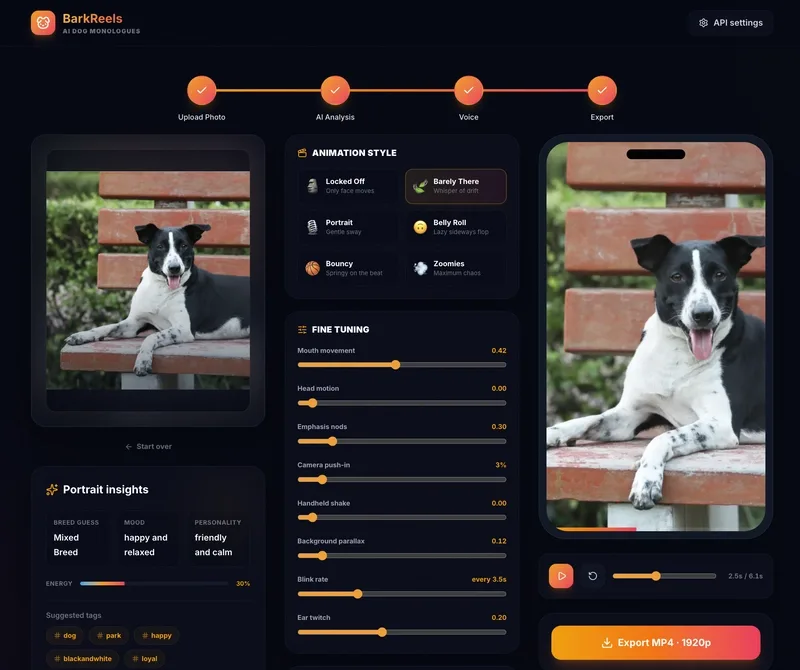
The tool basically turns a static photo into a puppet. Since it uses in-browser segmentation, the subject is isolated from the background, allowing for independent parallax movement and background swaps (you can even upload your own backdrop or use procedural ones like "Neon" or "Studio").
The animation system is surprisingly granular. You aren't just clicking "animate"; you're adjusting sliders for:
-
Mouth movement and emphasis nods
-
Blink rate and ear twitches
-
Camera push-ins and handheld shake There are different motion presets that vary the "chaos" level:
Locked Off: Only the face moves (the most realistic setting).Barely There/Portrait: Subtle drift and sway.Belly Roll/Bouncy: More aggressive movement.Zoomies: Maximum motion.
For the audio side, you can either let an LLM write a script based on the photo, type your own, or upload a voice recording. It then maps that audio to the lip-sync engine. It even handles "burned-in" subtitles with a color picker that samples tones directly from your photo so the captions match the dog's fur or collar.
Real-World Performance Tips #
After messing around with it, I realized the quality of the output depends entirely on the source image. This isn't a "magic" fix; it's a coordinate-based animation system. To get a clean result, you need to follow these rules:
Composition: Use a head-on portrait where the face fills the frame. If the dog is too far away, the muzzle is too small to deform naturally.Clarity: Ensure eyes, nose, and ears are clearly visible. These are the anchor points the rig uses to animate.Simplicity: Stick to one dog. If there are two, the segmentation usually merges them into one weird blob.Lighting: Avoid deep shadows or blur, otherwise the cutout edges look mushy.Obstructions: No sunglasses or toys covering the face, as anything overlapping an anchor point will warp.
My biggest takeaway was that "Locked Off" motion is actually the secret to making it look believable. When the head stays still and only the mouth moves to the audio, the brain is more likely to accept it as a real video rather than a puppeted photo.
If you want to try it, the live app is hosted at https://barkreels.vercel.app/
. It's a great example of how an AI workflow can be shifted to the edge to remove server latency.
Next Vega-Lite is the secret to getting LLMs to generate accurate →