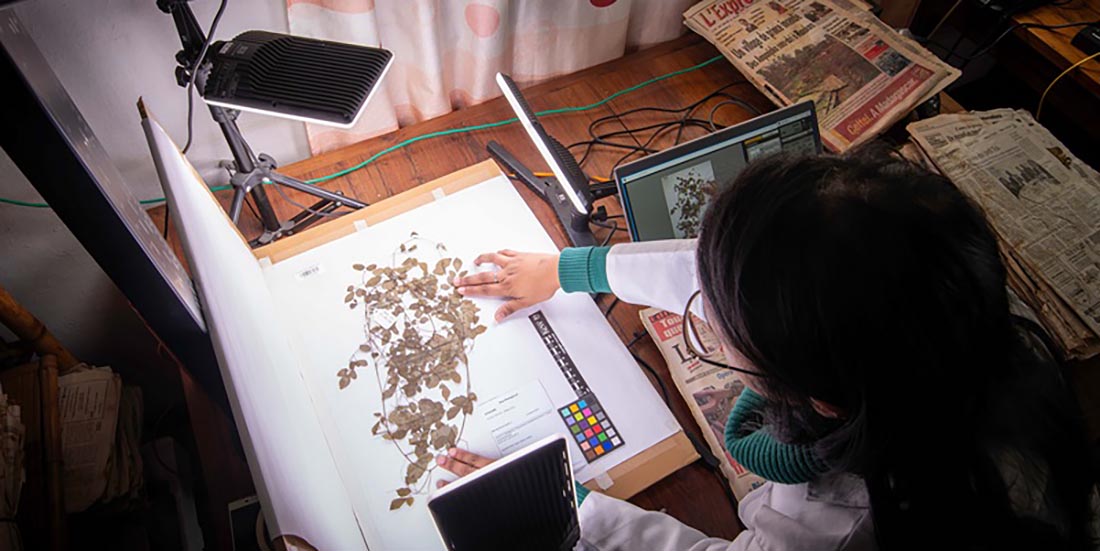
AI and eight million digitized old plant specimens reveal how the climate is changing nature in large parts of the world.
AI optimists will be warmed by a recent report on the state of the world’s plants and fungi by the Royal Botanic Gardens in Kew. The report examines the role that digitization and AI are playing in botany and nature management. Four hundred researchers in 40 countries contributed to the report, including scientists from NTNU.
James Speed, a professor of plant ecology at the NTNU University Museum in Trondheim, was one of the contributors to the report.
“For hundreds of years, naturalists have collected plants and fungi, pressed and dried them, so that they could be preserved for the future in herbariums around the world. In recent years, more and more specimens have been photographed and made available online,” explains Speed.
“More than 145 million plants and fungi preparations have been digitized worldwide, from over 170 institutions in 40 countries. This opens up completely new opportunities for research.”
**You might also like:**The museum treasures that never see the light of day
20 years of work completed in a single week #
David Williamson is a postdoctoral researcher in machine learning for natural history at the NTNU University Museum.
Williamson, along with Speed and botanists from the Trondheim herbarium, trained a machine learning model to recognize whether plants are in flower on digitized herbarium specimens. The model was used on eight million preserved specimens collected from all over the world; a total of 200,000 species.
“What’s so exciting is that we’re taking collections that have existed for centuries, combining them with machine learning and AI technologies that are barely five years old, and we can then answer big, important questions about nature,” says Williamson.
“Machines can’t do the work of biologists, but they can help experts analyse data sets that would previously have taken a lifetime,” says Williamson. “By way of comparison, the machine here took one week to do something that would have taken a human about 40,000 hours.”
To put that number in perspective, 40,000 hours equal about 20 working years.
Researchers surprised by changes in the tropics #
“These analyses showed that global flowering times have shifted by an average of 2.5 days per decade over the past century,” says Speed.
Flowering has shifted both earlier and later, and the differences are greatest in tropical areas.
The greatest temperature increases due to climate change tend to be in the far north, so we researchers were surprised to learn that the most dramatic flowering changes were in the tropics. Speed.
“In the tropics, flowering is more related to precipitation, and in a changing climate, the rainy season can come earlier, later – or not at all,” explains Speed.
When the flowering timeline changes, a mismatch can arise between flowering and pollinating insects. This can in turn have ripple effects, for example on insect-eating birds and food production.
“We are going to investigate these consequences in more detail in a new project, funded by The Research Council of Norway,” Speed says.
The effects of climate change on flowering time are only one of the questions that digital herbarium specimens can answer. The same methods can be used in the fight against species extinction.
Tools in the fight against extinction #
Millions of plants and fungi are still unknown to science. Fungi are the basis for almost all life on Earth, but more than 90 percent of species are still unmapped.
**Meanwhile, species extinction and climate change are accelerating, with the result being that some species are disappearing faster than scientists can map them. Just 1000 plant species have been officially declared extinct, but the actual number is likely to be much higher. **
AI and machine learning cannot solve these problems, but they can provide scientists with far-reaching mapping tools, which they have never had before.
By making millions of old herbarium specimens searchable and machine readable, it is now possible to map both species groups and parts of the world which we previously knew little about. Fieldwork can then be focussed where it is needed most.
Statistical models can also calculate the probability that a species is extinct, as opposed to undiscovered. AI can recognize unknown species in digitized collections and flag them for experts, speeding up the naming process.
**You might also like: **Why bees in Norway are struggling
Machines need people #
“I think the potential for AI is enormous, but it is still currently potential,” says Martin Cheek, a researcher and taxonomist at the Royal Botanic Gardens in Kew, and co-author of the State of the World’s Plants and Fungi report.
“It would be very useful to be able to name stuff reliably more rapidly. You’d still need taxonomists to check those names were accurate and that there were no mistakes. But with less time spent on identifying the more common 90% of species, we’d have more time to get on and describe the unknown species and to do things to conserve the threatened species.”
Before getting carried away by technological optimism, it is worth considering that less than 16 percent of the world’s herbarium specimens are digitally accessible. Futhermore, the biggest gaps are found in countries with rich biodiversity, where collections are understaffed and under documented, and not connected to global databases.
David Williamson concurs: “While AI is a useful tool for researchers, it doesn’t think for us. Our models are only as good as the data they are trained on. Experts need to be involved at every step – from asking the right research questions to validating the model design and interpreting the results.”
The NTNU postdoctoral researcher adds that new technologies underscore the critical importance of the work that humans are doing on museum collections.