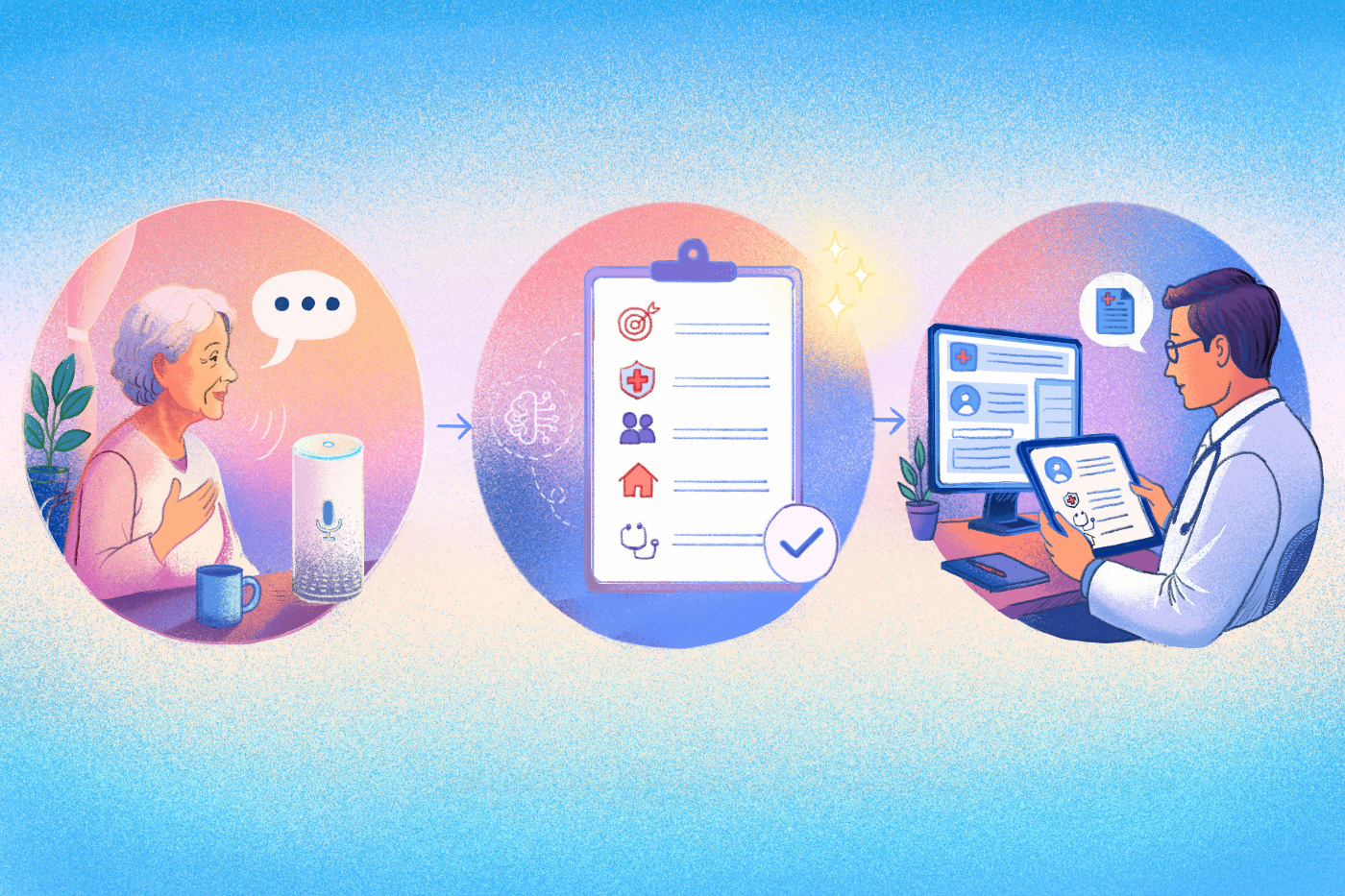
A team of Northeastern University researchers found that large language models, or LLMs, can potentially serve as surrogates in conducting serious illness conversations.
When a patient is admitted to the emergency room of a hospital with a life-threatening medical condition, the first order of business is to get that patient to a stable state. After that happens, it is standard medical practice for doctors to initiate what’s known as a serious illness conversation, which gives both the physician and patient an opportunity to discuss goals about care, treatment and end-of-life wishes before a medical crisis makes those conversations impossible.
But given the high pressure and time-limited nature of ERs, those conversations aren’t happening, according to Smit Desai, an assistant professor in the College of Arts, Media and Design at Northeastern University.
According to research from Desai and others, just 37% of seriously ill older adults report having had a serious illness conversation with a physician, and when they do occur, they’re often too late: on average, about a month before death.
That can leave patients receiving care that doesn’t reflect their wishes or undergoing treatments they otherwise might have declined, which in some instances can prolong pain and suffering. Those are the kinds of situations doctors are trying to avoid, Desai said.
Desai and others have now developed a way for artificial intelligence to help fill in the gaps in end-of-life care. In research published this month in the Proceedings of the ACM on Human-Computer Interaction, the team of researchers found that large language models, or LLMs, can potentially act as a surrogate in facilitating those serious illness conversations.
The study grew out of work being conducted in Desai’s Conversational Human-AI Interactions Lab. In previously published work, the researchers interviewed 11 emergency clinicians and mapped the entire workflow surrounding those conversations, from how the physicians identify the patients to have those chats with to how they prepare for the discussion to how they document the outcome in the electronic health record.
The interviews confirmed their suspicions about many of the pressures facing emergency physicians, who often spend just four to 10 minutes with each patient between reviewing medical records, making diagnoses and pursuing treatment plans, Desai said. ~~ ~~
Hasibur Rahman, a Northeastern University researcher who worked on the study noted that clinicians are already stretched thin, and instead of replacing them, AI could be “a supportive layer” by helping to reduce the administrative burdens. “I think we are perfectly positioned to use AI to support clinicians at the hospital,” Rahman said. “AI tools could create more time and mental space for clinicians to foster genuine human empathy in those emotionally sensitive settings.”
In the new study, Desai, Rahman and their colleagues looked to assess an AI voice assistant that they had developed for fields such as healthcare and education. They wanted to see how users perceive and respond to the conversational system and how to improve the underlying AI models that make those conversations possible.
They found that when the AI assistant had “structured conversations” with older patients about their end-of-life wishes, it was largely to the patients’ satisfaction. Of the 55 emergency patients who participated in the pilot study, 49 successfully completed an AI-guided serious illness conversation, and 46 found the system acceptable, meaning the participants found the mediated chats appropriate and were comfortable taking part, according to the study.
Editor’s Picks #
The preliminary data is promising, Desai said, because serious illness conversations honor patients’ values and make them feel heard and respected. They should be taking place inside emergency departments with regular frequency.
At the same time, the study also highlights that there are both technical and ethical problems that must be solved before the technology can be deployed in hospital settings more broadly. Desai noted that there was one case in which the voice assistant hallucinated a response, which he described as “not very nice” and resulted in the researchers having to terminate the conversation.
“It was a very strange case of hallucination,” he said. “We looked into that, and we were able to solve the problem as well.”
Dakuo Wang, an associate professor with joint appointments in Khoury College of Computer Sciences and the College of Arts, Media and Design, who also helped conduct the study, described AI’s emerging role in hospital setting as an inevitability.
But despite the rapid advance and enthusiasm, Wang estimates it will take “another decade or so” for hospitals and physicians to actually see AI transformations play out. Even though electronic medical records are ubiquitous now, it took decades for hospitals to adopt those systems after the internet revolution took hold in the 1990s, he said.
“The goal here isn’t to have AI replace doctors,” said Desai, who added that the tech can serve to streamline end-of-life care and ultimately free physicians to spend more time with patients.