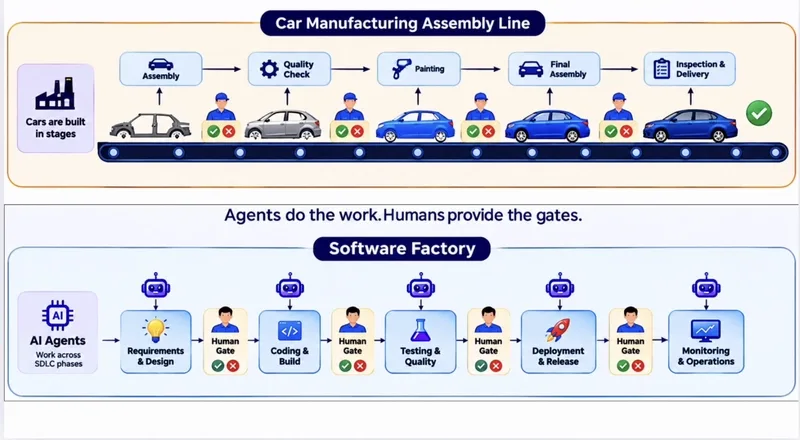
The idea is to stop treating AI as a fancy autocomplete and start treating the entire SDLC as a connected assembly line. In a real factory, a part doesn't just appear; it moves through specific stations (assembly, painting, QC) in a predictable order. An agentic workflow does the same for code. Instead of one giant prompt, you have specialized agents handling planning, implementation, testing, and deployment, with humans acting as the quality gates.
Building the Agentic Pipeline #
To move toward this model, you have to stop thinking about "chatting with an AI" and start thinking about orchestration. A real-world AI workflow for a software factory usually looks like this:
-
Context & Requirements: An agent gathers existing documentation and service context to define exactly what needs to happen.
-
Implementation Planning: Before a single line of code is written, an agent drafts a technical plan. This is where I usually step in to course-correct before the AI hallucinates a library that doesn't exist.
-
The Build: The agent executes the plan. This is the "coding" part we're all used to.
-
Automated Validation: The code is pushed to a CI pipeline where agents (or traditional tests) validate the change.
-
The Human Gate: A developer reviews the diff. The human doesn't do the grunt work; they provide the final "yes/no" based on security and architectural standards.
-
Deployment & Observability: The code hits production, but agents monitor the health signals. If a spike in 500 errors occurs, the system triggers an automated rollback or alerts the team.
The Evolution of Delivery #
We've basically moved from manual server configs in the 90s to Jenkins/DevOps automation, and now to this agentic layer. The difference is that while DevOps automated the process, agentic factories automate the decision-making within that process.
If you're trying to set this up from scratch, don't try to automate everything at once. Start by building a "testing agent" that writes the test cases for your features before you even write the feature code. That creates a safety net that allows you to lean harder on tools like Claude Code or Cursor without fearing a production meltdown. The goal isn't to remove the developer; it's to move the developer from being the "bricklayer" to being the "architect." You define the guardrails and the specs, and the agents handle the repetitive execution.
Next HolyClaude hit 2.4k stars and now I'm hosting it →