Member-only story
In Part 1, we covered the mental models behind single-agent systems, dissecting the ReAct (Reasoning + Acting) framework and learning how tool docstrings guide tool selection. #
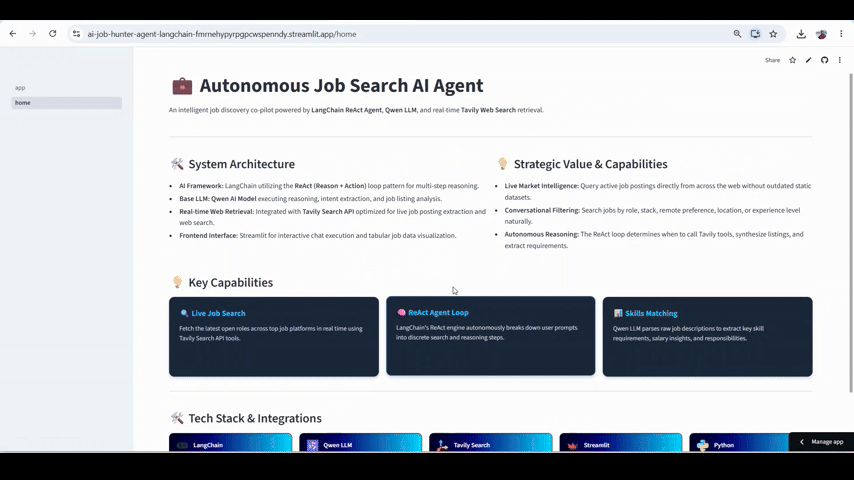
Now, in Part 2, we move from theoretical concepts to hands-on execution. We will build a production-ready AI Job Hunter Agent using Python, LangChain, Google Gemini, Tavily, and Streamlit.
1. The Architectural Pivot: Decoupling Retrieval #
A common pitfall with pure ReAct agents is giving the model open-ended, live web search access directly inside its execution loop. This often causes two major issues:
Token Inflation & High Latency: Repeated searching drains context limits and slows down response times.Non-Deterministic Loops: The LLM can get stuck tweaking query parameters without reaching a conclusion.
source & further reading
pub.towardsai.net — original article
How to Become an AI Engineer in 2026 and Earn $55K More in Big Tech
The Great Vector DB Consolidation: How MongoDB and Postgres Are Killing Pinecone
Anthropic’s Claude Certified Architect Exam (CCA-F): The Agent That Did Exactly What the Injected…