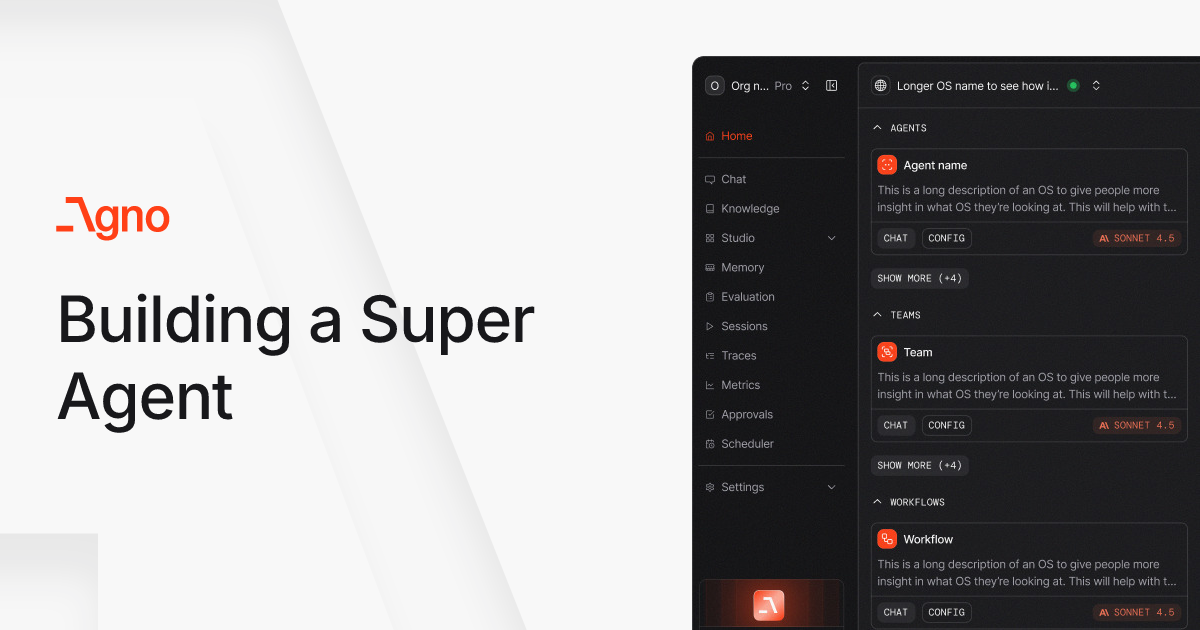
"Humans should manage outcomes while the system manages agents."
DeepSeek recently shared an article exploring the Super-agent design. It aligns closely with how we're seeing the agent experience evolve: a lot of coordination between agents can be handed off to a "manager agent". We've been testing with a similar design, and today I'll share some early thoughts on our version of the Super Agent.
First, the philosophy: humans should set goals and manage outcomes while the system manages agents. This is the same idea behind the self-driving company: as agents get more capable, humans spend less time on low-level orchestration and more on higher-level decisions and sign-off.
The idea behind a Super Agent is fairly simple. It understands your company, knows which agents are available, and can put them to work on its own. Those agents run in the background while you continue the conversation with your Super Agent. You can ask what's happening, change direction, or give it something else to do. It's the starting point for the self-driving company.
Super agent should identify work that needs doing and take it on itself. It watches a set of Sources (github, web, slack) and assigns work to agents on its own. The agents doing the work don't need to be Agno agents. Super Agent can hand a task to a coding agents like codex and claude code.
Super agent's goal is to take over the planning and coordination which falls on us today. We identify what needs to be done, start sessions, copy/paste context between them, check whether something finished, and ask another agent to review the work. Why can't a "manager agent" do that for us?
The first problem to solve is orchestration, and the second is figuring out what to orchestrate.
AgentOS handles orchestration, CompanyOS handles what needs to be orchestrated, and Super Agent brings them together.
Super Agent is a made of:
- Coding agents like claude code, codex + a bunch of workflows
- a company manager that organizes what needs to be done into Products, Projects and Tasks. This is the automated, self-driving part of Super Agent.
- a platform builder that can create agents and workflows on demand. This allows Super Agent to create purpose-built agents and workflows on the fly.
- a platform manager that helps Super Agent manage the platform.
- plus any number of other agents that exist in the platform.
Super Agent is always ON and has a view of what needs doing, which agents can do it, and how the work is progressing.
We have many of these pieces in place and are now connecting and testing the experience described below.
How Super Agent Works #
Super Agent starts with a trigger, which can be a message, an event, or a schedule.
- A message: someone asks it to do something through a chat interface like Slack, Telegram or WhatsApp. "Can you look into this issue?"
- An event: a GitHub issue is opened, a pull request gets a review, or a build fails.
- A schedule: it's time to prepare the morning brief or review documentation every Friday. Or review pending tasks every minute.
Once triggered, Super Agent figures out what needs doing and how to get it done.
Handle the request
When a request comes in, Super Agent first figures out what's needed. It could be a question that just needs an answer, feedback on work already in progress, or something that's already been taken care of.
There are a few ways it can respond:
Answer the question. "What's the status of the documentation update?" Super Agent checks the work and gives you an update. 2. Run an existing agent. "Prepare this week's customer report." If there's already an agent for that, Super Agent sends it the request and context. For code, that agent is usually Codex or Claude Code running in its own sandbox. 3. Organize a bigger piece of work. "Get our docs ready for the next release." Super Agent asks Company Manager to create a Project with Tasks for checking examples, updating API references, and writing the migration guide. Once accepted, those Tasks go into the queue for agents to execute. 4. Create an agent for the job. If the right agent doesn't exist, Super Agent asks Platform Builder to create one using the tools and resources available on the platform. That agent can then be used for this work and future requests. 5. Continue work already in progress. "The PR looks good, but add a test for the empty response." Super Agent connects the feedback to the existing Task and sends it back to the agent doing the work. 6. Leave it alone. The failed build passed on retry, the issue is a duplicate, or someone is already handling it. Sometimes there's nothing useful to do, and Super Agent should recognize that.
Work runs in the background while you continue the conversation. When something is ready for review or needs your attention, Super Agent brings it back to you. We want it to be able to continue, cancel, fork, or steer the agent sessions it manages.
Learns continuously
Super Agent uses Agno's Learning Machines to learn from its sessions. It remembers the people it works with and can carry useful lessons from one task into the next.
Learning Machines also support decision memory: what the agent decided, why, and what happened afterward. We haven't enabled that by default yet. We're experimenting with which types of memory are most useful for Super Agent.
Super Agent runs on AgentOS #
Super Agent brings together years of work on the infrastructure underneath it. AgentOS provides the durable runtime, session management, queue-based execution, scheduling, and tracing to understand what happened.
AgentOS also handles authentication and role-based access controls. You decide who can run agents, create them, or manage the platform. Super Agent works within those permissions.
AgentOS Studio lets Super Agent build agents, teams and workflows on demand. CompanyOS organizes the work into Products, Projects and Tasks.
AgentOS runs the work, Studio builds the agents, and CompanyOS organizes what needs doing.
A partner for the long tail of work #
I don't expect Super Agent to become my primary coding agent or daily driver. I do most of my development with Codex and expect to continue that. But there's plenty of work I'd happily hand over to Super Agent, and have it hand to Codex:
- After an SDK change, test the affected examples, fix what breaks, and update the documentation.
- Reproduce bugs reported in our slack channels, come back with a failing test and a proposed fix.
- Automatically review customer feedback and propose Projects for the problems that keep coming up.
I'd still review the results. I just wouldn't have to manage every session and follow-up myself.
There's still a lot of work to do, but the foundation is there and I wanted to share early thoughts on what we're building.
More soon,
Ashpreet