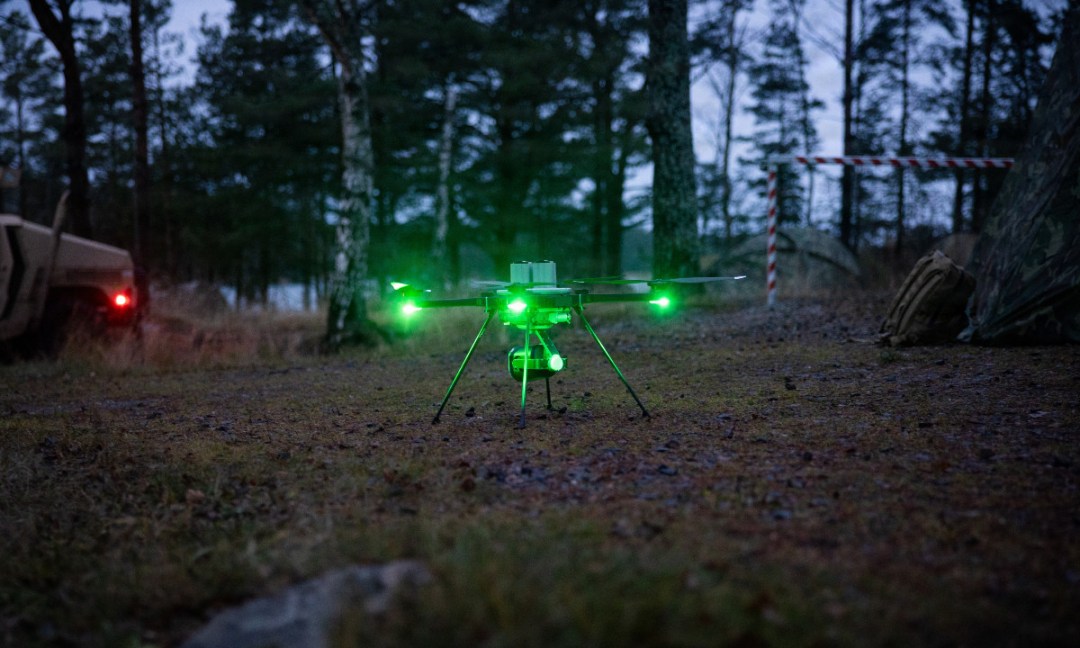
A force that cannot fly, fight, and defeat drones at the squad level is preparing for the last war. But proficiency alone is not enough. The decisive advantage now belongs to the force that can also outproduce and innovate faster than its adversary, fielding better drones more rapidly and scaling them in numbers that overwhelm. This reality was laid bare during NATO’s 2025 Exercise Hedgehog in Estonia, where a small Ukrainian-led team, using roughly thirty drones and an AI-powered battlefield management system, simulated the destruction of two NATO battalions in a single day, rendering an entire battle group combat-ineffective. The decisive question for the United States is no longer which drone to buy. Instead, we must ask how to build the frontline innovation ecosystem that enables success. This ecosystem requires authority and funding at the edge, a feedback loop measured in days, and an industrial base built for mass.
The Ukraine-Russia war offers a stark preview of that future. The mass, combined attacks Russia began employing in 2024 created a new challenge for air defense, as cheap, mass-produced strike platforms overwhelmed traditional defenses. As adversaries rapidly innovate and scale, the US Department of Defense faces a critical question. How can acquisition and industry partnerships be transformed for drone-centric conflict?
This article draws on seven months I spent in Ukraine, during which I engaged directly with operational units, the Ministry of Defence, the Ukrainian Defence Procurement Agency, and the domestic defense industry. That firsthand access offered an unfiltered view of how Ukraine designs, acquires, fields, and iterates drone capabilities at wartime speed, lessons the United States cannot afford to overlook.
By the Numbers
The numbers speak for themselves. In January 2026, Ukrainian Deputy Minister of Defence Serhii Boiev announced that Ukraine plans to produce more than seven million drones in 2026, roughly seventy times the United States’ annual output of combat drones. Ukraine deploys about nine thousand drones per day across the front, Ivan Pavlenko, chief of the electronic warfare directorate of Ukraine’s armed forces, confirmed in October 2025. In addition, Ukrainian drone manufacturers update their software and iterate on hardware designs three to four times a year.
By comparison, traditional US defense acquisition for major systems often take twelve years. Recent reforms such as the Adaptive Acquisition Framework, which has Urgent Capability Acquisition and Middle Tier Acquisition pathways, aim to shorten timelines to two to five years. Even so, that remains far too slow to keep pace with an adversary like Russia.
Procurement Pathways
A key enabler of Ukraine’s innovation is the ability of units to procure systems that best suit their missions, minimizing bureaucratic barriers and driving bottom-up adaptation. Fielding flows through six pathways, three of which matter most for US reform.
First, DOT-Chain Defence is a government-run marketplace where units request equipment and officials allocate resources based on need. The government certifies systems and manages contracts. It has dramatically accelerated the flow of critical capabilities to the front and shown how digitization and market mechanisms can strengthen defense in high-intensity conflict. The marketplace works on a simple principle: Units choose, the state supplies.
Second, the e-Points system lets units earn points for verified kills or neutralized targets and exchange them for drones or unmanned ground vehicles in the Brave1 Market, a platform uniting more than three thousand defense tech companies. The Brave1 Market functions as an “Amazon for the military,” allowing units to browse, compare, and directly procure new technologies.
Third, decentralized procurement gives combat brigades direct monthly allocations from the state budget, bypassing centralized bureaucracy and enabling faster, more tailored acquisitions. Ukrainian units procure through these channels, rapidly eliminating ineffective systems and accelerating development cycles.
The remaining three pathways round out the system. Centralized procurement, in which units receive standardized equipment packages tailored to their formation type, is the pathway most familiar to the Department of Defense, mirroring our own top-down model of issuing common equipment sets. International donations provide funds and equipment for urgent needs, with the United States alone providing roughly $65 billion in military and security assistance since 2022. Finally, charities and nongovernmental organizations such as Come Back Alive and the government-run crowdfunding platform United24, which has raised more than $3.6 billion, fill critical gaps in drones, communications, optics, and medical gear. What makes Ukraine’s approach powerful is not any single pathway but the combination, layering the familiar centralized model the US defense enterprise already knows with three faster, more decentralized channels it currently lacks.
Together, these pathways funnel capability to frontline units at unprecedented speed and with unprecedented autonomy. Rather than slow, top-down allocations, commanders get exactly the equipment suited to their sectors and the immediate threats they face, which is critical in a war where technology and countermeasures evolve weekly.
The Feedback Loop
Ukraine’s procurement system has evolved into a hybrid model that deliberately incorporates real-time feedback from the front lines, creating tight, data-driven loops among combat units, manufacturers, and government decision-makers. What works gets scaled quickly. What does not improve is dropped. The cost of getting it wrong is paid in lives.
The most striking example is also the simplest. Ukrainian manufacturers place QR codes directly on the drones they deliver. When soldiers encounter a problem, a scan connects them to the manufacturer’s support team around the clock, without an intermediary program office, contract modification, or an outsourced call center. That unfiltered data lets manufacturers resolve issues immediately. Frontline engagement and rapid iteration are not just useful in Ukraine; they are essential to a manufacturer’s commercial survival.
Other pathways reinforce the loop. In DOT-Chain Defence, units leave ratings and reviews visible to manufacturers. Highly rated or frequently ordered items earn larger production runs while poor performers are removed, and the Defence Procurement Agency uses the data to adjust contracts. The e-Points system adds a behavioral layer. High-performing units earn more resources, and the aggregated data reveals which systems and tactics are most lethal and survivable.
Across the force, frontline units have become de facto product testers. Brigade innovation teams modify drones and electronic warfare gear in the field, then route what they learn back to a dense network of domestic manufacturers, who push those changes into the next production run within days or weeks. There is no program manager, no lengthy contract modification, and no additional cost to the soldier for the upgrade. As a program manager, I find it difficult to advocate for removing ourselves from direct involvement in this process. However, I have realized that mandating our presence in the middle only slows the feedback loop.
The Electronic Battlefield
No discussion of drone warfare is complete without the electronic warfare and C-UAS (counter–unmanned aircraft system) dimension that determines whether drones succeed or fail. This war is as much a counterdrone arms race as a story of drone proliferation. Electronic warfare defeats a capability, a countermeasure emerges, better electronic warfare defeats it, and the cycle repeats within weeks. Both Ukrainian and Russian forces employ broad-spectrum jamming, GPS spoofing, and signal interception across the contact zone, creating one of the most contested electromagnetic environments in the history of warfare.
Ukrainian engineers have responded with remarkable ingenuity. A significant breakthrough is the fiber-optic drone, which connects to its operator through a physical cable rather than a radio signal, making it immune to jamming. As of April 2026, fiber-optic drones account for 32 percent of all strike drones used by Ukrainian forces. Developers have also turned to artificial intelligence, fielding AI-powered visual navigation systems such as the KrattWorks Ghost Dragon, which lets a drone complete its mission even when all radio and satellite links are disrupted.
The United States must prepare for both sides of this equation. On defense, the establishment of Joint Interagency Task Force 401 (JIATF 401) and updated C-UAS guidance released in January were necessary steps that expanded installation commanders’ defensive perimeters beyond the fence line under 10 US Code § 130i. The offensive electronic warfare fight, which enables our drones to penetrate adversary defenses while denying the enemy the ability to operate, remains an area that demands far greater investment, experimentation, and doctrine.
Challenges for US Acquisition
Despite recent reforms, the United States is not ready for modern warfare. Ukrainians proudly note they fielded fiber-optic drones first, then add that Russia outproduced them, flipping the dynamic from having the best equipment to having the most. Our defense industrial base is not structured to produce large numbers of expendable drones at the speed and scale now required. Most drones on today’s battlefield are single-use, expended like bullets. Yet our procurement system, with its lengthy contracts and focus on a handful of expensive, complex platforms, is fundamentally mismatched to mass drone warfare.
The Replicator Initiative, launched in August 2023, aimed to field thousands of attritable autonomous systems by August 2025, but delivered only hundreds. Meanwhile, Ukraine deploys around nine thousand drones every day. Even the Pentagon’s most ambitious effort has not come close to meeting today’s demands for autonomous systems.
Initiatives such as JIATF 401, the Army’s Global Tactical Edge Acquisition Directorate (G-TEAD) marketplace, and the service’s dedicated UAS website represent meaningful progress, each seeking to emulate Ukraine’s success by connecting frontline units with products. But these platforms remain small and slow to scale, largely because units lack the dedicated funding to drive demand, and their value depends on whether the joint force consolidates them rather than standing up competing portals. Even with consolidation, two problems remain: US manufacturers cannot produce at the scale needed, and units cannot purchase what is available without dedicated funding. You cannot buy what cannot be built, and you cannot buy what is built without money. The fatal flaw in our current system is expecting US industry to surge production capacity on standby. In a market economy, capacity follows contracts because no company will build the assembly lines of tomorrow on the mere hope of an order.
The temptation will be to copy what Ukraine has built. That would be a mistake. Neither side in the Ukraine-Russia war holds the technical edge for long, and any platform we lock in today could be obsolete before it reaches the field. Lifting Ukraine’s hardware or organizational charts wholesale would only import yesterday’s solutions to tomorrow’s fight. The question is not can we replicate this? It is how do we access it? The real foundation is the culture of rapid adaptation, a culture that pushes authority and funding to the edge, a feedback loop that turns frontline experience into design changes in days, and an industrial posture built for mass. That means partnerships, coproduction, and shared development, treating Ukraine not as a catalog to order from but as the drone warfare arsenal and academy it has already become.
Building the Future
The way to win the next fight is not to buy the best drone but to build the operating model that produces, fields, and improves drones faster than the enemy can adapt. Importantly, almost none of this requires new law. The authorities already exist in Other Transaction Authority, Commercial Solutions Openings, the rules governing commercial items of Federal Acquisition Regulation (FAR) Part 12, and government purchase cards. What is missing is funding, consolidation, increased purchase-card thresholds, and the willingness to make these the default rather than a workaround. There are four things that can be done now, using existing authorities, to build this operating model.
First, put money in the hands of the edge. Platforms like G-TEAD and JIATF 401 will remain empty storefronts until units have wallets of money to spend in them. The Department of Defense should establish unit drone funds—dedicated, recurring streams allocated directly to battalion, regiment, or wing commanders—mirroring the monthly allocations Ukrainian brigades use to buy exactly what their sectors demand. The fund should be allocated quarterly through a dedicated appropriation for attritable drones, counterdrone systems, and field modifications, insulated from a budgeting cycle that moves in years. Purchases should be limited to certified items, with thresholds below the bureaucratic friction line. The scaffolding already exists. Warranted unit-level buyers using government purchase cards under the micropurchase and simplified acquisition thresholds (FAR Part 13) is how the Army pushes buying authority to the tactical level today. The reforms required are establishing a defined drone category, raising thresholds, and empowering units to buy what they need.
Second, reward excellence with buying power. Ukraine’s e-Points system rewards combat performance with resources. We are not at war on our own soil, but we have a deep culture of competition that can serve as a peacetime proxy. The department should establish a warfighter incentive program. The Best Ranger Competition, the Marine Corps Marathon, the Best Sapper Competition, the Armed Forces Esports Championship, and gunnery tables should all become qualifying events, with top performers earning a substantial credit for their units, not a trophy, deposited directly into their unit drone funds. We should also set up a dedicated drone proficiency competition at every echelon, built around the standard this fight demands. The squad that can best operate, jam, spoof, and kill drones wins the funding to buy more, a virtuous cycle in which proficiency is rewarded with the very tools that build more proficiency. A portion of every reward should be tied to innovation, with the most effective homegrown modifications earning credits and being routed to industry for scaling. This deliberately grows a force of problem solvers, and we can run the loop before the first shot is fired.
Third, consolidate rather than proliferate. The department should designate a single joint drone marketplace as the authoritative storefront, the American analog to Brave1 and DOT-Chain Defence combined. Every attritable drone and counterdrone capability should flow through a single, certified, joint-accessible platform that enables browsing, comparison, rating, and direct purchase. The rating and review mechanism should be a core feature, and the certified-vendor list must be refreshed continuously, because a platform that is obsolete in months must be delisted just as quickly.
Fourth, close the feedback loop in days, not years. The QR code model is the most replicable single practice I observed, and it costs the government virtually nothing to implement. The department should require every fielded system to include a direct-to-manufacturer feedback link, mandate this requirement in all future government contracts, and prohibit manufacturers from upcharging the government for the service. To secure contracts, manufacturers must bear the cost of staffing a twenty-four-hour engineering response capability to action this data. This simple bridge closes the feedback loop in days rather than years, forcing industry to react to combat realities at the pace of the modern battlefield.
While most Army brigades already have dedicated innovation teams, these soldiers are too often hamstrung because strict configuration-control policies and statutory data-rights restrictions prevent them from modifying the program-of-record equipment they receive. We must resource these unit-level teams with 3D printers, soldering stations, and prototyping tools, while empowering operational commanders with the explicit authority to accept the tactical risk of these modifications on the battlefield. Once these frontline teams validate a physical improvement under the commander’s risk authority, we need a streamlined path to route those changes back to industry for mass production. The true bottleneck is our reluctance to change these restrictive policies, but we can overcome this by choosing to trust our commanders and rewiring our default settings to support rapid innovation. Two broader principles should guide the implementation of these four recommendations and the department’s larger effort to adapt to the realities of drone warfare.
Build for mass**.** Replicator delivered hundreds of drones while Ukraine is on track to field ten million this year, the clearest evidence that scale is now a warfighting requirement. We should pursue coproduction and shared development that buys access to the frontline innovation ecosystem and production know-how, license Ukrainian designs and processes for domestic manufacture, and distribute production across a broad base of small and mid-sized manufacturers that can iterate in weeks. We must secure the supply chain for the components that matter most, including motors, batteries, flight controllers, and the rare-earth and semiconductor inputs behind them, and establish warm production lines and prenegotiated surge contracts.
Change the culture. This is a problem of culture, not just process. We should empower tactical commanders to define their own sector-specific requirements within the certified marketplace, build a force structure that assumes constant change, and measure success not by the perfection of any single platform but by the speed of the loop—namely, how fast a lesson learned on the front becomes a fielded change. Let the numbers speak for themselves and put the power in the hands of the soldiers to select what works best and purchase more. No more listening to smooth sales pitches from manufacturers.
The temptation will be to buy drones. The imperative is to build a soldier-builder partnership. A warfighter incentive program that turns the units producing the top performers at the Best Ranger Competition or the Marine Corps Marathon into the best-equipped drone units in the force is more than a clever incentive. It is a peacetime engine for building the exact culture this war demands.
Overcoming the Hurdles of Peacetime Bureaucracy
Defenders of the current system will rightly argue that pushing this level of authority to the edge introduces significant risks in safety, configuration management, and cybersecurity. They will warn that allowing soldiers to modify proprietary hardware voids warranties and complicates depot-level maintenance. These concerns are perfectly valid for a military operating on predictable peacetime cycles.
However, the calculus of risk has been fundamentally altered by modern warfare. The tactical risk of an unauthorized battlefield modification pales in comparison to the strategic risk of sending our forces into combat with obsolete technology that gets them killed. This new framework is designed to manage these risks, not ignore them.
On safety and configuration, the certified marketplace is the guardrail. Units buy only vetted systems, and field modifications are routed back through the QR code pipeline to qualified engineers who can validate and scale the changes. In cybersecurity, a single, certified marketplace with a controlled software pipeline is vastly more secure than the current ad hoc proliferation of systems. Finally, concerns about licensing Ukrainian designs are well-known and can be addressed. The United States has established frameworks for coproducing sensitive systems with partners. Ukrainian drone manufacture F-Drones, whose combat-proven first-person-view and strike systems were developed and refined under fire, is establishing its first US production line in Ohio to supply the Pentagon’s Drone Dominance Program. The United States is localizing production of Ukrainian design under American oversight, standards, and contracts, demonstrating the precise model we should replicate and expand across attritable systems.
Every one of these risks is manageable. What is no longer manageable is the risk of fielding a force that cannot adapt at the speed of the fight.
Call to Action: Build the Acquisition System That Wins Wars
The Department of Defense and Congress face a clear choice. We can continue incremental reforms built for exquisite platforms in predictable conflicts, or we can construct a frontline innovation ecosystem that prevails in drone-centric conflict.
If we do not act, the consequences are real. In the next conflict, US forces will confront cheap, rapidly iterated drone swarms that outpace our low-volume production and multiyear replenishment cycles. Tactical units will lack dedicated funding and streamlined authority to meet local threats. Battlefield requirements will move through layered bureaucracies too slow to influence the next production run. Industry will receive no sustained demand signal sufficient to justify surge capacity. The result is a force that begins with apparent advantage and finds itself attrited and reactive while the enemy sets the tempo. That future is avoidable. Imagine a force in which every formation has recurring drone funds spent in a single authoritative joint marketplace of certified, rated systems. Feedback links directly to manufacturers, driving fixes in days rather than years. Unit innovation teams, equipped and authorized to accept tactical risk, validate improvements that move to scaled production within weeks. Excellence in drone operations and homegrown adaptation is rewarded with additional buying power through a warfighter incentive program.
We have the tools. We have the example. The only question is whether we will choose to build the acquisition system that matches the war already unfolding. The time to decide is now.
Colonel Rachael Hoagland is an Army acquisition corps officer with more than twenty-nine years of service. She most recently served in a dual-hatted role as Science and Technology Division chief and director of the Joint Capabilities Acquisition Cell, and she spent seven months in Ukraine working directly with operational units, the Ministry of Defence, the Defence Procurement Agency, and the domestic defense industry.
The views expressed are those of the author and do not reflect the official position of the United States Military Academy, Department of the Army, or Department of Defense.
Image credit: Sgt. Alfonso Livrieri, US Marine Corps