We’re building the Tasks API in Moss Inference so developers can give an agent a task, provide the relevant context, and receive the result.
Browser tasks are an early preview of that direction. Our latest configuration scored 84.4 on Browser Use Bench V2.1, above the published leaderboard’s highest score of 79.6. It also used 17% fewer agent steps than our previous configuration with the same underlying model.
We’re sharing those results alongside evaluations on Browser Use Bench V1, Online-Mind2Web, Odysseys, and Odysseys 2. Together, they show the browser execution capabilities we’re developing for the Tasks API, and how they compare with other agent configurations.
Give the API a task #
Consider a request like this:
Compare these five vendors against our requirements. Return a table with current pricing, supporting sources, and anything you couldn’t verify.
Completing that request requires the agent to navigate multiple websites, track the requirements, recover from failed interactions, and check its findings before returning an answer.
The Tasks API experience we’re working toward puts that execution behind Moss Inference.
| You provide | Moss Inference works toward |
|---|---|
| A task and relevant context | A sequence of actions to complete the work |
| Requirements and constraints | Findings checked against those requirements |
| The expected output | A result with supporting evidence and explicit gaps |
This is an early preview of the intended developer experience. The evaluations below test the browser execution system behind it; the Tasks API interface is still taking shape.
For developers building research agents and browser workflows, the goal is straightforward: delegate the task while Moss Inference manages the execution loop.
Results across five browser benchmarks #
The comparisons below cover page interactions, research, and longer workflows across multiple websites. Results are reported as of October 31, 2026.
Each score reflects a complete agent configuration: the underlying model, execution framework, and evaluation setup.
Browser Use Bench V2.1
84.4 across all 200 tasks, above the published leaderboard’s highest score.
| Agent configuration | Underlying model | Score / 100 | Tasks |
|---|---|---|---|
| Moss Inference | GPT-6.1 Sol, medium | 84.4 | 200 |
| Moss Inference | Claude Opus 5.5, high | 83.0 | 200 |
| Browser Use | GPT-6.1 Sol, medium | 79.6 | 180 |
| Browser Use | GPT-6 Astra, medium | 77.9 | 180 |
| Browser Use | DeepSeek V4.1 Flash 1017, max | 75.0 | 180 |
| Browser Use | Claude Opus 5.5, high | 75.0 | 180 |
| Browser Use | BU fast | 72.9 | 180 |
Our run uses the official V2.1 judge and scoring code. The published leaderboard evaluates a shared subset of 180 tasks; we evaluated all 200. Confidence intervals overlap, so this is a higher observed score rather than a statistically conclusive lead.
Source: Browser Use leaderboard and methodology.
Browser Use Bench V1
94 of 100 tasks passed through Moss Inference.
| Agent configuration | Underlying model | Pass rate | Evaluation |
|---|---|---|---|
| Polar | Not disclosed | 95% | Vendor-reported; port of the V1 judge |
| Moss Inference | Claude Opus 5.5 | 94% | Official V1 judge |
| Aside | GPT-5.5 | 93% | Vendor-reported; judge not disclosed |
| Browser Use | Claude Opus 4.8 | 89.5% | Official V1 benchmark |
| Browser Use | Claude Fable 5 | 87% | Official V1 benchmark |
Vendor results use different or undisclosed judge implementations, so the table reports scores without treating every row as a controlled comparison.
Sources: Browser Use benchmark repository, Polar evaluations, and Aside benchmarks.
Online-Mind2Web
298 of 300 tasks passed using Browser Use’s alternative grading prompt.
| Agent configuration | Underlying model | Pass rate | Evaluation |
|---|---|---|---|
| Moss Inference | Claude Opus 5.5 | 99.3% | Graded by us with Claude Opus 5.5 |
| Aside | GPT-5.5 | 99.0% | Vendor-reported |
| Browser Use Cloud | bu-max | 97.0% | Vendor-reported; Claude grader |
| OpenAI | GPT-5.4 | 92.8% | Vendor-reported |
| Anthropic | Claude Opus 4.8 | 84.0% | Vendor-reported |
| ChatGPT Atlas | Not disclosed | 70.0% | Vendor-reported |
We evaluated our runs and Aside’s published runs with the same judge model, prompt, and input fields. Browser Use’s published result uses the same grading prompt with a different evidence setup; its traces were unavailable for regrading.
The benchmark’s WebJudge method produces a separate set of results. Using WebJudge-7B, our full 300-task evaluation scores 78.7%. On the 114 matching tasks for which Aside’s published runs contain screenshots, the comparison is:
| Agent configuration | Matched tasks | WebJudge-7B pass rate |
|---|---|---|
| Moss Inference | 114 | 85.1% |
| Aside, regraded by us | 114 | 76.3% |
The 99.3% result uses the alternative grader and is not an official Online-Mind2Web leaderboard score. Results from the two grading methods should be read separately.
Sources: Online-Mind2Web, Browser Use evaluation, and Aside benchmarks.
Odysseys
169 of 200 tasks completed perfectly, with a 95.0 average rubric score.
| Agent configuration | Underlying model | Perfect-task rate | Average rubric score |
|---|---|---|---|
| Polar | Not disclosed | 98.0% | 99.6 |
| Moss Inference | Claude Opus 5.5 | 84.5% | 95.0 |
| Aside | GPT-5.5 | 75.5% | 86.5 |
| Paper baseline | Claude Opus 4.6 | 44.5% | 68.9 |
| Paper baseline | GPT-5.4 | 33.5% | 55.4 |
| Paper baseline | Claude Sonnet 4.6 | 31.0% | 49.8 |
Our evaluation uses the official grader with a one-hour limit per task. Aside reports a 200-step cap. Polar reports an uncapped multi-agent setup, with sampled-step grading on 18 tasks and an undisclosed judge model. These differences matter when comparing the reported scores.
Sources: Odysseys paper, Polar evaluations, and Aside benchmarks.
Odysseys 2
74.2 with Claude Opus 5.5, 3 points above its published Browser Use configuration.
| Agent configuration | Underlying model | Score / 100 |
|---|---|---|
| Benchmark configuration | GPT-6 Astra | 84.6 |
| Moss Inference | Claude Opus 5.5, high | 74.2 |
| Browser Use | Claude Opus 5.5, high | 71.2 |
| Browser Use | Grok 4.7, high | 68.2 |
| Benchmark configuration | GPT-5.6 Sol | 62.0 |
| Benchmark configuration | Claude Fable 5 | 61.5 |
| Browser Use | GPT-5.6 Luna, high | 59.7 |
We evaluated all 100 tasks using the published judge model, prompt, and scoring, with evidence packaging adapted from BU Bench V2.1 because the complete Odysseys 2 packaging was unavailable. Packaging differences may affect grading.
The 74.2 result is our original full-run score, without selective reruns after subsequent fixes. GPT-6 Astra remains the highest published result at 84.6.
Source: Odysseys 2 results and methodology.
What improves browser execution #
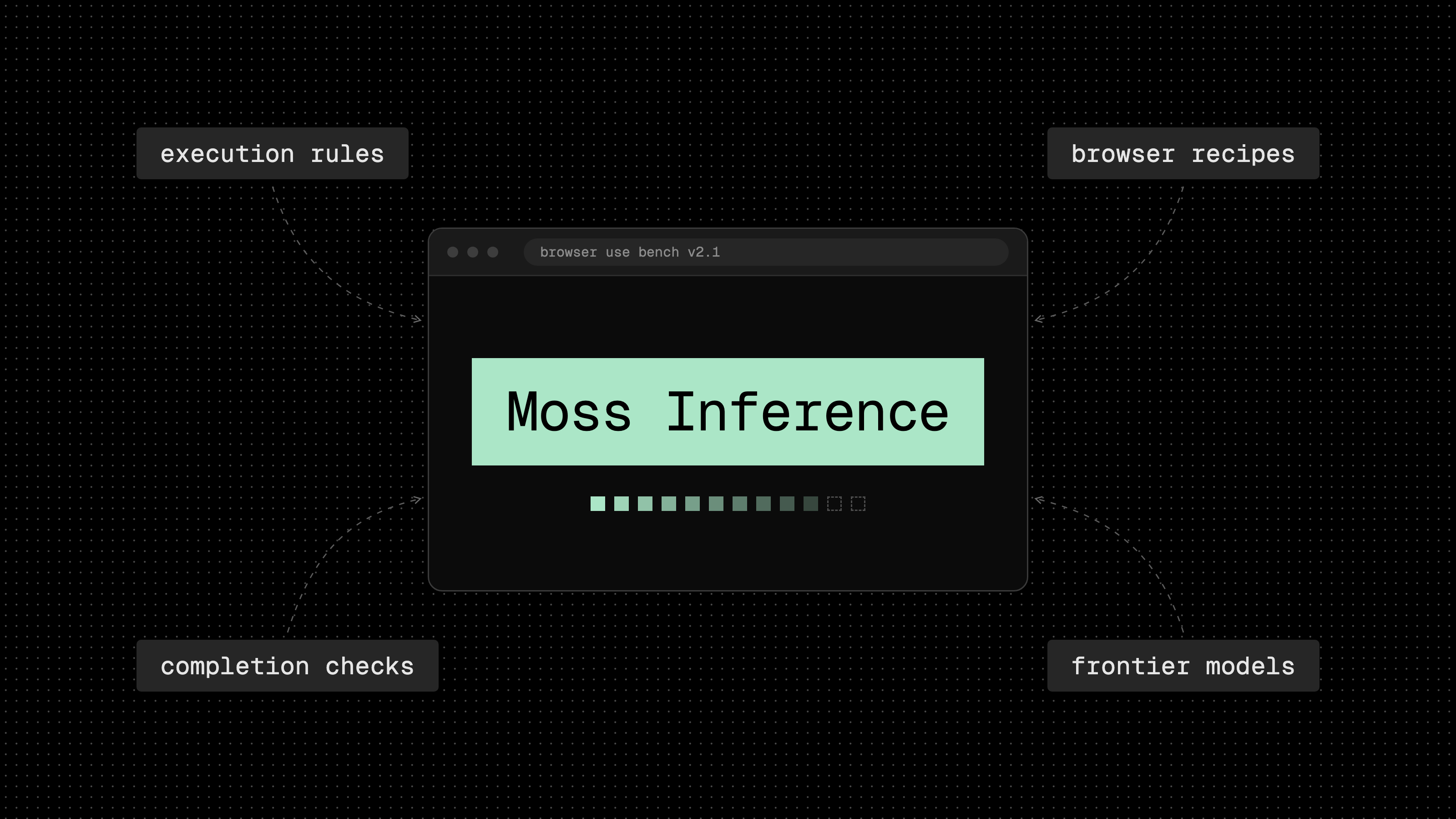
Moss Inference combines frontier models with execution rules, retrieved browser guidance, and checks before completion.
The execution rules help the agent track requirements, preserve evidence, manage its time, and verify that its final answer is supported by the work it performed.
The browser guidance comes from reusable recipes stored in an index within Moss Inference. These cover common interactions such as forms, file uploads, dialogs, and recovery after a failed step. Relevant guidance is retrieved at the beginning of a task and when the agent encounters a problem.
This gives retrieval a direct role in execution: supplying useful procedural context when the agent needs it.
On BU Bench V2.1, our latest configuration increased the score from 83.3 to 84.4 while using 17% fewer agent steps than our previous setup with the same model. The 1.1-point score improvement is within run-to-run variation; the step reduction is the clearer efficiency result.
Some rules and recipes were developed from failures observed in earlier benchmark runs. Testing on new workflows is the next step in understanding how well those improvements generalize.
Bring your browser workflow to the private beta #
Our first priority has been task quality: can the agent complete the requested work accurately?
We’re now bringing that execution into the Tasks API experience, while continuing to improve cost, latency, and reliability.
Moss Inference is in private beta. If your product needs agents to research across websites, work through browser interfaces, or complete multi-step workflows, we’d like to evaluate your tasks with you.