Via brightmachines.com
The robotics manufacturer's new human-in-the-loop assembly cell tackles the unglamorous but critical challenge of keeping digital traceability intact as AI server demand explodes
Building the AI future turns out to be a surprisingly manual process. For all the talk of autonomous systems and intelligent agents, somebody still has to physically bolt together the servers that run them. Bright Machines thinks it has a better way to handle that awkward reality.
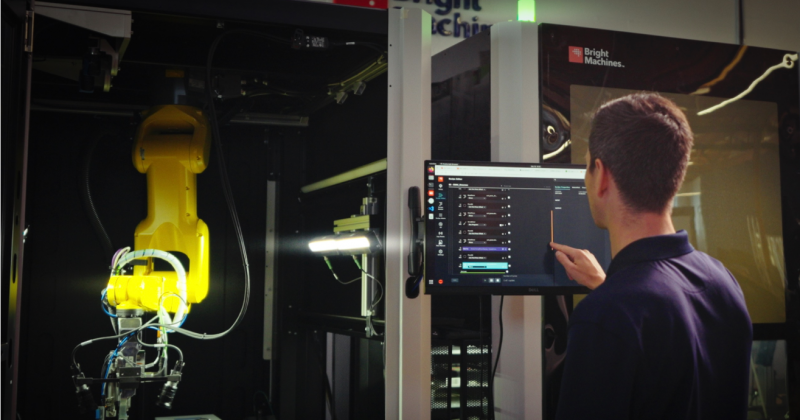
The San Francisco-based manufacturer just launched the Hybrid BRC, short for Bright Robotic Cell, an expansion of its Bright Factory platform. The system lets human operators step inside a sensor-monitored robotic cell to perform assembly tasks while maintaining a continuous digital record of every step in the production process.
Why manufacturing quality matters for the AI arms race #
Bright Machines’ previous robotic cell deployments have demonstrated the ability to process up to 50 servers per hour with a 98% first-pass yield. Those are impressive numbers for hardware manufacturing, where even small defect rates compound into massive costs at scale.
The Hybrid BRC tackles a specific pain point. Some assembly steps still require human dexterity, whether it’s routing a tricky cable or seating a component that doesn’t lend itself to robotic manipulation. The problem is that the moment a human touches the line, you typically lose the granular data trail that automated systems maintain. Bright Machines’ solution keeps sensor monitoring active even during manual steps, preserving traceability from the first screw to the shipping label.
The funding and partnerships behind the platform #
Bright Machines raised $126M in a Series C round in June 2024, pushing its total funding north of $400M. The capital is earmarked for expanding the Bright Factory platform and developing new tools like Bright Designer, which aims to automate aspects of server design itself.
NVIDIA has supported Bright Machines through both investment and technology collaboration, and Microsoft Azure integration extends the platform into the broader data center ecosystem, connecting manufacturing execution to cloud-based management and analytics.
What this means for the broader AI infrastructure trade #
The 98% first-pass yield figure is particularly telling. A 2% failure rate on thousands of high-value AI servers translates into significant rework costs, delayed deployments, and potentially unhappy customers who are already waiting months for hardware.
Bright Machines’ approach also highlights an underappreciated dynamic in the AI supply chain: the tension between automation and flexibility. Fully automated lines are fast but brittle. They struggle with the constant design changes that characterize a rapidly evolving hardware landscape, where new GPU architectures, cooling systems, and rack configurations arrive with each product cycle. The Hybrid BRC attempts to split the difference, keeping humans in the loop for tasks that require adaptability while maintaining the data integrity that automation provides.
Bright Machines isn’t a crypto company, and it isn’t pretending to be one. There are no tokens, no blockchain elements, and no Web3 buzzwords in its communications. But the physical infrastructure layer it operates in is shared territory, and the same data centers housing AI training clusters also power Bitcoin mining operations, Ethereum validators, and decentralized compute networks like Render and Akash.
Disclosure: This article was edited by Editorial Team. For more information on how we create and review content, see our