Book Review: Python for Algorithmic Trading Cookbook #
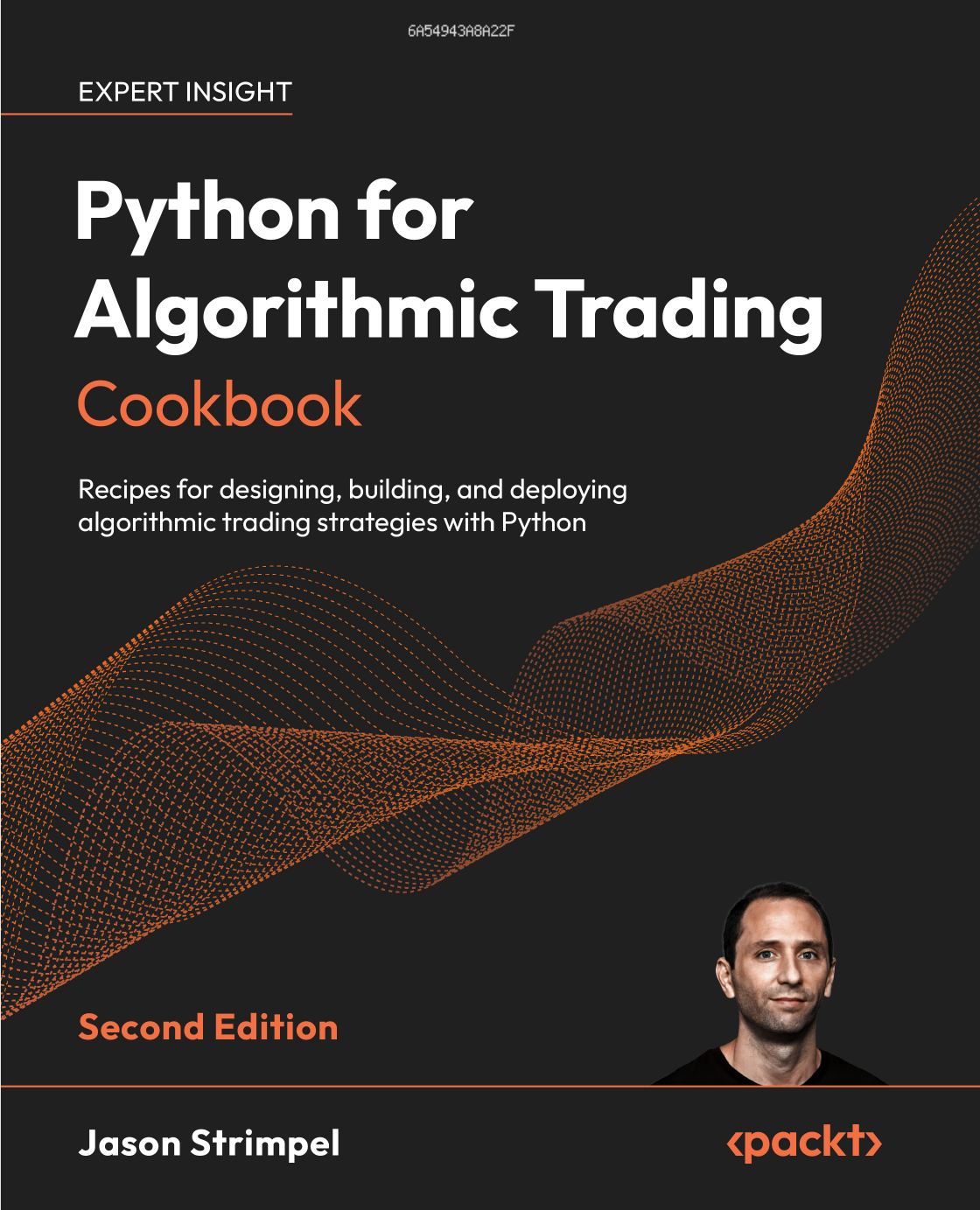
I was offered to read Python for Algorithmic Trading Cookbook by Jason Strimpel in exchange for an honest review. This book is a cookbook of 68 recipes that show you how to go from sourcing market data to placing orders through a broker, and it does it with professional tools. I liked the attention to lookahead bias and out-of-sample testing runs through the entire book. And it was especially interesting to see examples of using Interactive Brokers API, as I wanted to do something similar since a couple of months ago.
The overall structure
The book is organized as a pipeline from raw data to live orders:
- Data (Chapters 1-4): obtaining market data with the OpenBB Platform, transforming it with pandas and visualizing it with Matplotlib, Seaborn, and Plotly Dash.
- Research (Chapters 5-7): building a versioned research database with ArcticDB, automating market research with AI and agentic workflows, and engineering alpha factors with PCA, linear regression, and the Fama-French model.
- Backtesting and evaluation (Chapters 8-11): vectorized and event-driven backtesting, then measuring factor quality and portfolio risk.
- Execution (Chapters 12-14): building a modular trading application on the Interactive Brokers API and deploying live strategies.
- Acceleration (Chapter 15): moving the research stack onto the GPU with NVIDIA RAPIDS.
The recipes are written in a common pattern: explanation of why the technique matters, preparatory steps, detailed walkthrough and additional links to study later. They often provide examples of why the suggested ideas matter: for example, rolling beta is used because the constant-beta assumption in CAPM breaks in practice, and implied volatility surfaces have their place because their skew and term structure encode what the market expects.
What I liked
It is great that the book reaches the stage of live execution and doesn’t stop at backtest. Chapters 12 to 14 build a modular Interactive Brokers app across a set of small modules and then deploy three real strategies: a monthly factor portfolio, an options combo, and an intraday multi-asset mean-reversion strategy. Many years ago I traded on Forex manually and it was interesting to see how this can be automated nowadays.
Another good point is that the book applies rigorous validation. ArcticDB stores versioned datasets with time travel, so a backtest can read the data exactly as it existed on a given date, which is how you keep lookahead bias out. The walk-forward optimization recipe show that shuffling folds leaks the future into a timeseries backtest - a common mistake of people who don’t know about time-based validation. The factor-evaluation chapter measures the information coefficient, its decay across forward-return horizons, and factor turnover.
I also liked that it uses relevant libraries and programs. The data comes from the OpenBB Platform; the research database is ArcticDB; the backtesting and analytics run on the “Reloaded” ecosystem; and the final chapter accelerates the research stack on the GPU with NVIDIA RAPIDS.
The AI and agentic chapter builds a retrieval-augmented equity analyst over financial statements with LangChain, Chroma, and Claude, a couple of LlamaIndex agents that write and run their own Python in a sandbox, and a recipe that converts a strategy research paper into runnable code.
What could have been better
A few small things I would have wanted handled differently:
- Running everything end to end takes real infrastructure: an Interactive Brokers account, paid API keys for the AI chapter, and an NVIDIA GPU for the RAPIDS chapter.
- Some of the free data sources are fragile, and the book leans on yfinance in several recipes even while noting it is really meant for a handful of tickers.
Conclusion
This book is a good fit for Python developers and data people who are comfortable with pandas and want to move into systematic trading, and for active traders who want to industrialize their research instead of clicking around a charting tool. By the end you have a real backtesting and execution toolkit rather than a pile of indicator scripts.
The book teaches you the way of working: source clean data, store it so you cannot peek at the future, evaluate factors honestly, and then ship the code to a broker.
[blogpost](https://andlukyane.com/tag/blogpost)

[books](https://andlukyane.com/tag/books)

[python](https://andlukyane.com/tag/python)

[finance](https://andlukyane.com/tag/finance)