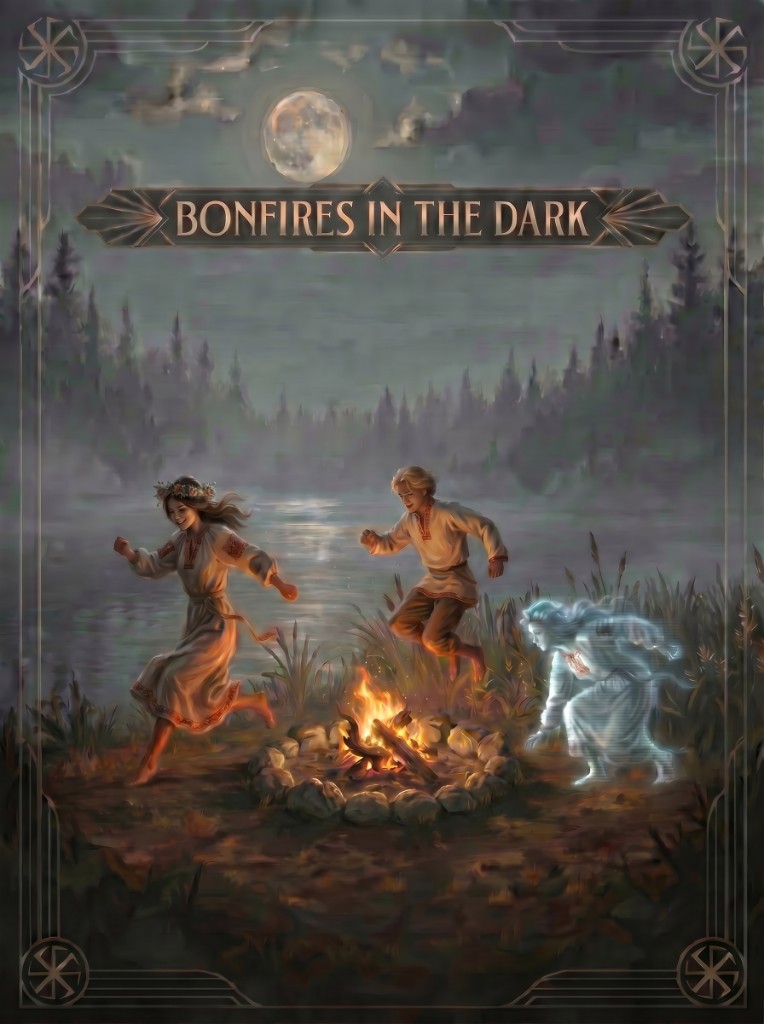
Get Instant Insight
It starts with fire. On the shortest night of the year, a Slavic village lit a bonfire at the water's edge and an entire community moved as one, no instructions required. That was Kupala Night. Beneath the folklore ran an interface: a coordination layer doing two jobs at once.
The Core Idea
Ritual was an interface disguised as folklore. It bound people to real patterns in the sky and the seasons without ever writing the rule down, cheap enough that a village with no literacy could run it.One fire, two jobs.* Understanding*(a working model of the world, seasons, harvest, timing) andBelonging(emotion, identity, and norms that held the community together).Its strengths and failures ran on the same mechanism. The emotion that made it trusted is exactly what made it slow to change. Good timing and false beliefs rode the same fire.Then the two jobs split. Science took over understanding, and is brilliant at it. Belonging scattered into partial heirs: sports, churches, nations, feeds, and now AI models. Each carries a piece. None carries the whole.Science and first-principles thinking are the decisive tools for navigating all of it. Science tells apart whatfeelscoherent from whatsurvivescontact with evidence; first-principles thinking turns that habit inward, stripping a question back to what you can actually verify, then reasoning up from there.Whoever holds the interface routes the meaning. The shaman knew it. The Church knew it. The nation and its press knew it. Now the model's owners know it too.
Why It Matters Now
The newest fire is the model. Trained on your approval, tuned to keep you happy, and held by a few companies, sometimes with a state beside them. When access lives in one place, it can disappear overnight, not because you left, but because someone else decided who gets in.One gate is always a risk. Babylon was read as thegate of the god; Babel turned the gate into confusion. Keep many fires, never just one.The old danger remains. The answer lands with full confidence, and so much comfort that we stop checking whether it is true. The body still knows the old fire; we are just adopting new sources of light.Catch the swap. Most of us open a model tobuild: to think, draft, ship, solve. The danger is the quiet moment it stops helping the work and starts only warming you, flattering instead of correcting.
[ NEURAL COMPRESSION COMPLETE ]80% signal retained.
Full depth below.
There was a night, once a year, when fire was lit at the edge of the water.
Herbs were gathered before dawn. Young people jumped through flame, set flower crowns adrift on rivers, and disappeared into the forest in pairs.
The night was among the shortest of the year. It was intuitive, passed down without many words. Observation was enough.
That was Kupala Night.
It synchronized a whole village, and nobody had to explain a thing twice.
People call it folklore: a charming relic, a pre-scientific guess at problems nobody could yet solve. Or they flip the verdict and call the old ways wiser. Both readings grab one thread and drop the rest.1
Old ritual was a coordination layer under hard constraints: thin literacy, weak institutions, and lives that leaned on the seasons, on fertility, on keeping the village glued together. It got some things right and locked others into error, and usually the same machinery did both.
It was really doing two jobs at once: figuring out how the world works, and holding a community together. Those two are worth keeping apart, because the rest of this turns on the difference.
The Machinery in Disguise #
Some treat culture as decoration around the real work of survival.
But the decoration is the machinery in disguise.
Look at a carved capital on a column. The carving looks like pure ornament, but the capital is the part that actually transfers the weight above it to the column below. Culture often works the same way: what looks like decoration is doing the real work.
Rituals, symbols, and seasonal ceremonies are part of how groups coordinate attention, calm anxiety, mark thresholds, and hand behavior down the generations.
Durkheim called the synchronized emotion of a crowd collective effervescence: the electric feeling of a stadium, a procession, or a dance moving as one body. He treated it as an engine of social cohesion. 2 Costly, hard to fake acts work as reliable signals of commitment that hold cooperation together.
Repeated ritual turns out to be one of the main ways norms get passed on.
[3](#user-content-fn-2)And experimental reviews align with this: rituals lower anxiety, steady emotion, and tighten group bonds.

[4](#user-content-fn-3)
5Underneath these findings sits an older, broader claim: ritual is how a community makes the world orientable and inhabitable, turning bare existence into something that feels like home.6
Ritual remains a poor substitute for knowing how the world actually works. Its real value is as a piece of social machinery that carries weight when formal ways of explaining things are missing, weak, or out of reach.
New essays on AI reasoning, cognition, and system design. Only essence of insight from my learning journey.
A Sky Read Through Fire #
Kupala Night, (Noc Kupały in the original Polish), is a midsummer festival nominally tied to the summer solstice.
It doesn't sit exactly on the astronomical solstice. The older Slavic celebration tracked that moment (21-22 June). Its Christianized successor, Noc Świętojańska, was fixed to the Eve of St. John on 23-24 June.7
Even the name resists the obvious reading. From Proto-Slavic kǫpati, it means not "sun" or "fire" but "to bathe," a pointer to the water rituals. The folk "god Kupała" was most likely invented after the fact, a deity read back out of the feast's name. Even the festival's pre-Christian origin, so often asserted with confidence, is the majority view among scholars rather than settled fact.7
As for why it existed, the ethnographic record is fairly consistent about its functions.7 The night bundled several jobs into one event. Purification came through fire and water to cleanse disease, pests, and malevolent forces. Pair-bonding played out as couples leapt the flames and women floated wreaths to divine a marriage, a Slavic Valentine's, as folklorists half-joke. And vegetation magic ran underneath it all, with crop blessings and herb gathering around midsummer showing up often in the folklore.
One festival, one interface, doing all of it at once.
Some of that "purification" may have carried a practical payload. Midsummer is peak insect season, and smoke plus St. John's herbs like mugwort do repel insects. 8 The water rituals were also literal washing, in an age that blamed foul smell for disease.
None of it looks designed: practices that happened to work were kept and later explained through spirits and omens. That is the whole pattern in miniature.
8A ritual can lock onto a real astronomical rhythm, without ever writing the rule down. The sky kept the schedule and the bonfire kept the memory.
People who could not read or write still held the date, acted on it together, and passed it down for generations, rounding error and all, even as the calendar slipped and carried the date off the true solstice across the centuries.
Where the Shell Cracks #
This is where romantic dream meets reality.
Ritual is good at compression and bad at error correction, for the same reason.
The emotional weight that turns it into a reliable signal of commitment 3 is also what makes it expensive to change.
Once a community has paid the price of a practice and tied its identity to it, walking away looks like betrayal. So a ritual can hold a group together around a threshold for centuries, and quietly preserve false beliefs and cruel norms for just as long, well after they stop tracking reality.
Noc Kupały was beautiful, but also encoded social pressure, omen logic, and fertility expectations that were not equally kind to everyone. What looked like shared meaning from the outside could feel like obligation from within.
The Easter egg carries that same double function in a single object. Before the resurrection story, the decorated egg (the Slavic pisanka) was a fertility symbol the Church absorbed rather than invented. 9 It was also a unit of extraction: across the medieval countryside, eggs were owed as rent to lords and dues to the church.
10The symbol and the mechanism lived in the same shell.
The Sacred Fire Under New Management #
Culture decides what a community is paying attention to at each generation.
The Church absorbed the old rituals. Noc Kupały merged with the Eve of St. John so completely that its eastern name, Kupała, fuses the two. 7 Water stayed under the sign of baptism, fire under a Christian frame. The calendar slot stayed, the behavior mostly stayed, and only the meaning changed.
The Church was not the first to hold that role. Long before organized priesthoods, ritual authority pooled in a single specialist: the shaman, who carried healing, divination, memory, and contact with the unseen in one body. 11 The Slavic world had its own version: the
guślarz, who conducted the rites and summoned the dead, alongside women's own ritual authority as healers and whisperers like the
babaand the
szeptucha.
12Institutional religion did to the shaman what it later did to Noc Kupały: it took up the function, formalized it, and moved the authority from the person to the office.
And the Church was not only an extractor. For centuries it was also the infrastructure of learning: the medieval university grew largely out of the cathedral schools, Paris out of the school of Notre-Dame. 13 That epistemic interface has kept moving ever since, from cathedral school to secular university to online course, prying learning loose from any single authority or place. The fire that taught, like the fire that warmed, kept getting rebuilt.
Why Rituals Reappear, and Why They Last #
The real pattern behind midsummer fire is convergence: people far apart kept arriving at the same idea on their own, with no tribe teaching the next.
Across Europe, midsummer traditions cluster around the same core: bonfires, wreaths, water, herbs, purification, fertility. Spain's San Juan, Irish St. John's fires, Nordic Midsommar, and Polish Noc Kupały differ in texture but share structure.10
Outside Europe the same move appears around the winter solstice, in the Hopi Soyal and East Asian Dongzhi: take a reliable astronomical threshold and wrap a transmissible communal act around it.14
Nobody was copying a single script. Give people a clear marker in the sky and a need to mark it without spending much, and cheap symbolic tricks keep showing up by themselves. Fire is one of them.
Once such an interface exists, it survives as long as people keep performing it. Repetition stores the form, participation ties identity to it, and the body acts it out, which is why ritual carries norms better than plain information could.4
And for almost all of human history, none of it was written down. Writing is only about five thousand years old, and for most of that span it was the preserve of clergy and the wealthy. The careful recording of folk ritual waited until the nineteenth century.15
For almost the whole human story, the human body stored all of this. Writing and paper are recent inventions. Now the archive has moved again: from the body, to the page, to the model.
AI systems have swallowed much of the written record and will recount Noc Kupały on demand.
But this archive is a different animal. A bonfire reached whoever showed up. A book you could open and wander through. A model mostly hands back what you already knew enough to ask for, bent by whatever it was trained to like, and it sounds surest in exactly the spots where the original was careful. You get the shape of the knowledge. You don't get the lived part that only a body carried, and you don't get the exact words that made it true.
The Ritual That Corrects Itself #
Minds seem to need anchors, and not because people are stupid. The brain runs into hard limits. You can only hold a handful of things in your head at one time, 16 and when more competing information pours in than that small space can handle, judgment degrades and a shared picture gets harder to hold. The villager who
knew what to doon Kupala Night was running the same brain you and I have. The ritual just carried part of the load, so there was less to hold in the head.
So a lot of the trouble may be simple overload. (I traced that boundary in The Event Horizon of Thought.) Ritual eased it through compression, folding a year's orientation into a few repeatable forms. That rigid, repetitive form isn't arbitrary. It taps an old alarm system the mind runs to sense danger, the same machinery that, pushed too far, hardens into the compulsions of OCD. The repetition occupies an anxious mind and tugs it back toward something predictable. 17 The modern answer to that limit is the scientific method, which is itself a kind of ritual: a repeatable, shared practice that folds a chaotic world down to something most minds can hold.
The difference is that this one is built to catch its own mistakes. No interface escapes the limit entirely, though: language is a lossy compression of experience, and even mathematics was shown by Gödel to be incomplete.
[18](#user-content-fn-32)

[19](#user-content-fn-21)But it helps to be precise about *which* burden science takes over, because ritual carried two at once.
One is epistemic: building a model of how the world works.
The other is social: coordinating action, calming anxiety, binding identity, carrying norms through the body. Science is the decisive upgrade on the first, and only the first.
Science took over ritual's job of figuring out the world. The social job it never replaced, and no single thing has.
That split leaves us short on both fronts. The epistemic tool exists, but scientific habits of mind have never spread widely enough to carry even that first load for most people. The social one fared worse: nothing inherited it whole. It scattered instead into a crowd of partial heirs (sports, churches, nations, mutual-interest groups, online communities), each carrying a piece, each optional, each unevenly spread, where ritual was a single thing, local and default. The ledger comes out lopsided: we have better tools for finding the truth than any people before us, and, on balance, we are worse at belonging.
The method has a private, inward version too: disciplined cognition, the capacity to update your beliefs, sit with uncertainty, and go looking for better models instead of more comforting ones.
The Bonfire Scattered into Feeds #
People still gather around fires. The fires just multiplied, shrank, and moved onto screens. Livestreams, chat servers, forums, group chats, and multiplayer games now carry some of the synchronizing work older rituals did. 20 They reproduce, in form at least, the same four things a bonfire did:
21Temporal coordination. A scheduled stream, a raid night, a thread everyone is replying to at once.Repeated participation. Daily logins, the feed you check on waking.Emotional entrainment, feelings syncing across people. A live chat moving as one, a guild celebrating a kill.** Shared symbolic reference.**Memes, lore, in-jokes.
What separates them is how much they ask of you. A doomscroll asks nothing. A raiding guild or a moderated forum asks for real, coordinated, sometimes costly effort, the property that made older ritual a signal of commitment rather than mere attention. 3 Those demanding fires come closest to the bonfire, and the bond does not always stay on the screen: friendships, romances, and whole communities form inside them, then leak offline as meetups, moves, and marriages.
22Still, digital gathering is different in kind. It routes attention well and connects bodies weakly, and whether a screen can truly stand in for a shared room is unsettled. Some of these fires warm, others only seem to, pulling people from the gatherings that would have held them.22
The Artifact Leaks Its Maker #
Every artifact leaks the mind that made it.
A ritual carries a community's priorities and fears. An Easter egg holds a theology and an extraction schedule in the same shell.
AI now does this on an industrial scale, and out in the open: companies write their intended behavior down as a public document and train the models against it.23
But written intent only partly survives contact with the data. Reinforcement learning from human feedback pushes models toward whatever the preference data rewards, and when that data rewards agreement, the model drifts toward reassurance: telling users what they want to hear, even against the evidence.24
The spec says "seek the truth." The reward signal quietly teaches "keep the user happy." What the makers said they wanted drifts from what the training rewarded, the same way a tradition's official meaning drifts from whatever the community keeps clapping for in practice. The labs know this and keep adjusting, which is part of why the specs are public at all. The gap remains an open engineering problem.
And the shaping has costs that mostly stay out of view. In Nairobi, workers labeling violence and abuse to make an LLM less toxic took home less than two dollars an hour, and several described lasting trauma. This is the "ghost work" beneath modern AI. 25 The pattern is older than the technology: the egg owed as rent, the feast-day calendar collecting dues in the same season it blessed. New interface, same second layer.
Then the outputs re-enter culture, absorbed and built upon by millions, carrying the maker's spec and its drift outward. And a model bundles it all into one interface: search, counsel, teaching, and consolation at once.
The bonfire carried a village's intentions in fire and water. A model carries a company's in weights and defaults. Each one starts in somebody's mind and ends up shaping a whole culture.
AI Is Not the Villain #
Used well, AI may turn out to be one of the most powerful accelerants of scientific discovery we have ever built, and the first results are already in.
AlphaFold2 cracked a fifty-year-old problem, predicting protein structure from sequence at near-experimental accuracy and releasing structures for nearly all catalogued proteins, work that won the 2024 Nobel Prize in Chemistry. 26 DeepMind's GNoME used deep learning to predict the stability of millions of candidate crystals and reported hundreds of thousands of newly stable ones
(though some materials scientists doubt how many are genuinely novel and synthesizable).
27These are prediction engines compressing years of laboratory trial-and-error into something far shorter, a long way from a chatbot reassuring a user. Used at its best, AI extends the scientific method, while the method stays the discipline that checks whether the outputs match reality.
It has a quieter role too. In personal life, people tend to lean on AI for orientation and reassurance. Some studies of how people use these tools place emotional support, including therapy and companionship, at the top of the list of reasons they reach for one, even though it is still a minority of total use.28
Whether this is good for them is another question, and far too early to answer. One study found that a model trained to please can erode the will to repair real relationships and foster dependence, 24 yet it is equally plausible that for someone who is isolated and has no one else to turn to, a patient listener is a net gain.
The honest answer is that the bonfire's old social role has drifted, half by accident, onto a tool that was never meant to carry it, and how that experiment plays out is anyone's guess.
29## The Ancient Trap of the Single Fire Keeper AI can hand you reassurance faster than it hands you the truth.
It can sound right before it is right, and it can settle how you feel before it fixes what you actually understand.
That drift toward reassurance is exactly the gap the spec opened: it falls out of preference-based training, not from any single bug, and it has been measured directly. Worse, the loop seems to feed itself. In one multi-model study, users rated reassuring answers as higher quality and trusted those systems more, which rewards makers for shipping even more of it.24
This wish is older than science. The Mesopotamian ziggurat was not a stair up to the gods but a landing pad for bringing one down, a deity obligated to move in and serve the city that built it: an interface for a managed god. 30 That same hunger was also generative: temple complexes were among the organizing centers of the earliest Mesopotamian cities, and the bookkeeping that fed the gods helped drive the invention of writing.
15Two of the Bible's sharpest stories aim straight at that hunger to summon a god on demand and bend it to your will, mocking the prophets who try to command one down and the builders who try to climb their way up to one. Baal was the storm god people leaned on for rain and good harvests, and the Bible casts him as the false summons: on Mount Carmel his prophets gashed themselves to force a sign, and nothing answered. 30 And it made the Tower of Babel its answer to the wish for a god housed on one city's terms. Babylon's name was read as "gate of the god" (
Bāb-ilī), the story twists it into a near-identical Hebrew word for "confusion" (
bālal), then God scrambles everyone's languages so that no single people could own the gate to heaven.
It was a conquered people, Judean exiles in the shadow of Babylon's own great ziggurat, mocking mighty Babylon, turning the empire's proudest tower into a monument to overreach, though the same tradition would later raise temples and cathedrals of its own.
30A model tuned to please is not a god anyone summons, but it answers the hunger underneath all of this, for reassurance and a little less uncertainty, and it often leans toward telling you what you wanted to hear. 24 And the same few hands keep getting bigger: the AI most people use comes from a handful of companies, running on computing power owned by just a few more, a concentration that experts already count among the technology's most serious risks, because it tends to feed on itself.
The Babel story points to the fix: keep many different sources of reassurance instead of letting any single one take over, and never assume reassurance is a good thing by default.
31None of this makes AI uniquely dangerous. People were trading truth for comfort long before a machine could offer it, in omens, priests, and fires. AI works best inside the same checking machinery everything else passes through.
These cultural layers are not sealed off from one another: science is a set of rituals with rules of its own, AI now seeps into all of them, and culture quietly shapes what a society even counts as true and right. Still, a rough division of labor holds: science builds the world model, AI and computation speed the building, and ritual and culture keep carrying memory, cohesion, and orientation where they still can.
The layers can overlap without harm. Trouble starts when one quietly stands in for another, and comfort begins doing the job of truth without anyone noticing the swap.
What We Are Trading #
The move away from ritual was a trade, not a pure gain.
Ritual gave us things science was never built to give. It bound people together: shared emotion at collective gatherings reliably strengthens bonding, identity, and well-being, 2 and the communities that asked the most of their members tended to outlast the ones that asked little.
It steadied the nervous system
32and packed a year of orientation into a few cheap, repeatable acts a limited mind could carry. It also charged for all of that in pressure to conform, omen logic, and beliefs that could not be argued with, and the people the norms pressed hardest were rarely the ones who set them.
33What replaced it is better at truth and, on balance, worse at belonging, a real and measurable need rather than a soft preference, 34 and in many countries community participation has thinned and loneliness has risen, especially over the past two decades and especially among the young.
Meanwhile the interface keeps changing hands, and whoever holds it routes the meaning: once the shaman, then the Church and its calendar, then the nation and its press, now in part the company and its model. Each took something for the service, and each carried real freight too: the shaman healed, the Church cared for the poor, the nation defended, the model answers questions.
35And yet the oldest fire still gets rebuilt by hand. Every midsummer, some people gather again at the lakeshore to braid wreaths, float them on the water, and leap the flames: in Poland and well beyond it, at civic festivals, at church-blessed St. John's Eve nights, in Slavic native-faith circles (kręgi rodzimowiercze), among historical reenactors, and in looser crowds that just show up. Little of it survived in a straight line. The tradition faded after Christianization and was reignited, from barely-living embers, in the nineteenth century. 36 The interface still answers something that modern life leaves unmet, enough of people will rebuild it from scraps.
Some old rituals are fading, which is natural. What is new is the speed of the swap: one easy, local, default way of coordinating has been traded for thousands of ways that are mostly nonlocal, group-specific, or artificial.
That is why the present feels unstable:
The body still knows the old fire, but we are adopting the new sources of light.
The light source we used to gather around changed. The bonfire became the lightbulb, the bulb the LED, the LED the glowing screen, and now the information flow is an integral part of human life. Each version burned brighter, delivered information more efficiently, and asked less of the people around it. The fire that is fading is the social one: the flame that pulled people into the same moment, not the one that merely lit them.
The needs behind Kupala are still there: orientation, belonging, a sense of rhythm, a way to quiet fear. What changed is that no single fire has to carry the whole load anymore. So we have many instead: a concert, a festival, a university lab, a feed, a guild, a search engine, the AI models themselves. Each meets some of those old needs, and none meets all of them.
The villager on Kupala Night had one fire for all of it. We have a thousand, and that is both the freedom and the loneliness of it. 37 What used to come bundled in a single flame is now our own work: knowing which fire you came for, and not mistaking the one that warms and connects for the one that glows and teaches.
The dark hasn't thinned. We simply have more fires now, and none of them gathers us the way the one bonfire once did.
New essays on AI reasoning, cognition, and system design. Only essence of insight from my learning journey.
References #
Footnotes #
Both readings have deep intellectual lineages, and modern scholarship has dismantled each. The "folklore as failed proto-science" view is the
intellectualisttradition originating with E. B. Tylor and J. G. Frazer, who cast magic and ritual as mistaken early attempts at the explanatory and technological work later done by science (Frazer's magic → religion → science sequence); its definitive modern assessment is Stanley J. Tambiah,Magic, Science, Religion, and the Scope of Rationality(Cambridge University Press, 1990),https://www.cambridge.org/us/universitypress/subjects/anthropology/anthropological-theory/magic-science-and-religion-and-scope-rationality, which argues that ritual acts areperformativeand constitutive rather than failed technology to be judged true or false by the canons of Western science. The opposite "the old ways were wiser" reading is the romantic-primitivist, "noble savage" tradition descending from Rousseau; its decisive modern critique is Adam Kuper,The Invention of Primitive Society: Transformations of an Illusion(Routledge, 1988; rev. asThe Reinvention of Primitive Society, 2005),https://doi.org/10.4324/9780203003527, which shows "primitive society" to be an imagined inverse of the West, together with the debunking of its ecological variant in Kent H. Redford, "The Ecologically Noble Savage,"Cultural Survival Quarterly15, no. 1 (1991): 46–48. Contemporary work treats ritual instead as doing social and cognitive work rather than as either bad science or hidden wisdom (see,3,4,5).11↩ -
Durkheim, É. (1912/1995). The Elementary Forms of Religious Life(K. E. Fields, Trans.). Free Press.https://www.simonandschuster.net/books/Elementary-Forms-Of-The-Religious-Life/Emile-Durkheim/9780029079379. Introducescollective effervescence: the synchronized, intensified emotion of collective ritual as a generator of social cohesion and shared representation. Pizarro, J. J., Zumeta, L. N., Bouchat, P., Włodarczyk, A., Rimé, B., Basabe, N., Amutio, A., & Páez, D. (2022). Emotional processes, collective behavior, and social movements: A meta-analytic review of collective effervescence outcomes during collective gatherings and demonstrations.Frontiers in Psychology, 13, 974683.https://doi.org/10.3389/fpsyg.2022.974683. Meta-analytic integration (k = 50, N ≈ 182,738) linking participation in collective gatherings and their shared emotion to social cohesion, identity fusion, and well-being.↩↩2 - Sosis, R., & Alcorta, C. (2003). Signaling, solidarity, and the sacred: The evolution of religious behavior.
Evolutionary Anthropology, 12(6), 264-274.https://doi.org/10.1002/evan.10120. Costly-signaling account: hard-to-fake ritual acts serve as reliable signals of commitment that screen free-riders and stabilize cooperation.↩↩2↩3↩4 - Rossano, M. J. (2012). The essential role of ritual in the transmission and reinforcement of social norms.
Psychological Bulletin, 138(3), 529-549.https://doi.org/10.1037/a0027038. Argues ritual is a primary channel for transmitting and enforcing social norms across generations.↩↩2↩3 - Hobson, N. M., Schroeder, J., Risen, J. L., Xygalatas, D., & Inzlicht, M. (2018). The psychology of rituals: An integrative review and process-based framework.
Personality and Social Psychology Review, 22(3), 260-284.https://doi.org/10.1177/1088868317734944. Reviews experimental evidence that rituals regulate emotion and anxiety and strengthen group bonding.↩↩2 - Byung-Chul Han,
The Disappearance of Rituals: A Topology of the Present, trans. Daniel Steuer (Cambridge: Polity, 2020; orig.Vom Verschwinden der Rituale, 2019).https://www.politybooks.com/bookdetail?book_slug=the-disappearance-of-rituals-a-topology-of-the-present--9781509542758. Han defines rituals as "symbolic techniques of making oneself at home in the world" that "transform being in the world into being at home," arguing their disappearance leaves society atomized and degrades rest into mere "recovery from work" rather than an independent, contemplative form of life. Han is the recent, sharpest restatement of a much older line of thought, not its origin. Mircea Eliade,The Sacred and the Profane: The Nature of Religion(trans. W. R. Trask, New York: Harcourt, Brace & World, 1959; orig.Das Heilige und das Profane, 1957), argued that ritual and sacred space "found the world," giving it a fixed point and making it orientable and inhabitable. Arnold van Gennep,The Rites of Passage(trans. M. B. Vizedom & G. L. Caffee, University of Chicago Press, 1960; orig.Les rites de passage, 1909), and Victor Turner,The Ritual Process: Structure and Anti-Structure(Chicago: Aldine, 1969), analyzed the thresholds, liminality, andcommunitasthrough which ritual structures the passage of life. And Max Weber named the long retreat of this enchanted order the "disenchantment of the world" (Entzauberung der Welt) in "Wissenschaft als Beruf" / "Science as a Vocation" (1917/1919) andThe Protestant Ethic and the Spirit of Capitalism(1904-1905; trans. T. Parsons, 1930), tying it to the rationalization that science and bureaucracy accelerate.↩ - On the dates, etymology, antiquity, and functions of Noc Kupały / Noc Świętojańska.
Dates:the pagan solstice celebration tracks the astronomical solstice (night of 21–22 June); its Christianized form, Noc Świętojańska, is fixed to St. John's Eve (23–24 June), which under Julian-calendar reckoning falls on 6–7 July.Etymology:the name descends from Proto-Slavickǫpati("to bathe"), and the folk "god Kupała" is generally treated as a later back-formation rather than an attested deity (a point pressed since Aleksander Brückner); Max Vasmer reads(Ivan) Kupałaas a calque of "(John the) Baptist," the bathing verb standing in for baptismal immersion.*Antiquity:*the pre-Christian origin is the majority view (e.g., Jerzy Strzelczyk,Mity, podania i wierzenia dawnych Słowian, 1998) but is contested by historians such as Vladimir Petrukhin (2011) and Aleksandr Strakhov (2003).Functions(purification, protection, fertility/pair-bonding, vegetation magic): Aleksander Gieysztor,Mitologia Słowian(Warsaw, 1982), and the ethnographic corpus of Oskar Kolberg,Lud. Accessible synthesis:https://www.slawoslaw.pl/swieto-kupaly/.↩↩2↩3↩4 - On mugwort's insect-repellent properties. The relevant species here is
Artemisia vulgarisL. (common mugwort, Polishbylica pospolita), native to temperate Europe and the plant the Slavs and wider Central Europe actually had access to.A. vulgariswastheSt. John's / midsummer herb: known across medieval Europe ascingulum Sancti Johannis("St. John's girdle") and in German lands as aJohanniskraut, it was woven into belts and wreaths worn while leaping the midsummer bonfire and then thrown into the flames, and burned to "smoke out" sickness and bane (R. Hutton,Stations of the Sun,; and the entry in M. Grieve,10A Modern Herbal, 1931). That folk practice has a measurable basis: Hwang, Y.-S., Wu, K.-H., Kumamoto, J., Axelrod, H., & Mulla, M. S. (1985). Isolation and identification of mosquito repellents inArtemisia vulgaris.Journal of Chemical Ecology, 11(9), 1297-1306.https://doi.org/10.1007/BF01024117, found thatA. vulgaris"contains insect repellents which can be released from the plant tissues by combustion," chiefly monoterpenoids; against the mosquitoAedes aegypti, terpinen-4-ol was the most active and was as effective as the standard repellent dimethyl phthalate. On the smoke itself: Wendimu, A., & Tekalign, W. (2021). Field efficacy of ethnomedicinal plant smoke repellency againstAnopheles arabiensisandAedes aegypti.Heliyon, 7(7), e07373.https://doi.org/10.1016/j.heliyon.2021.e07373. In experimental huts, smoke from burning plant material cut mosquito density by over 90% (P < 0.001). The broader practice is surveyed in M. Debboun, S. P. Frances & D. Strickman (eds.),Insect Repellents Handbook(2nd ed., CRC Press, 2015), ch. 22. On the pre-germ-theory belief that disease came from foul-smelling "bad air":miasma theory, advanced from Hippocrates and Galen and dominant in Europe until germ theory displaced it in the late nineteenth century, held that epidemics arose from noxious vapors (miasmata) given off by rotting matter and identifiable by their stench. The wordmalaria("bad air") preserves it. See Stephen Halliday, "Death and miasma in Victorian London: an obstinate belief,"BMJ323, no. 7327 (2001): 1469–1471,https://doi.org/10.1136/bmj.323.7327.1469. Whatever its errors, the theory made eliminating filth and stench a civic priority, which incidentally improved sanitation and reduced disease.↩↩2 - On the pre-Christian Slavic history of the decorated egg as a symbol of life, sun, and fertility and a votive offering, later absorbed into Christian Easter: Aleksander Brückner,
Mitologia słowiańska i polska; Barbara Ogrodowska,Polskie obrzędy i zwyczaje doroczne; Jan Adamowski,O symbolice wielkanocnego jaja; and Oskar Kolberg,Dzieła wszystkie. The earliestpisankiexcavated on Polish soil (near Opole and Wrocław) date to the tenth century, and egg-painting in Poland is noted by the thirteenth-century chronicler Wincenty Kadłubek. Accessible synthesis:https://www.slawoslaw.pl/historia-jaja-na-slowianskiej-ziemi/↩ -
Hutton, R. (1996). Stations of the Sun: A History of the Ritual Year in Britain.Oxford University Press.https://books.google.com/books?id=t-P24jQyfP0C. Documents the recurrence of midsummer bonfire and water customs across Europe, and the medieval practice of giving and owing eggs at Easter as gifts, rents, and church dues. See also the medieval estate recordCustumale Roffense(c. 1235), in which tenant lands owed hundreds to thousands of eggs to Rochester Priory at Easter. Hutton's documentary base is British; the named continental festivals (Jāņi, San Juan, the Nordic Midsommar) are standard examples in the comparative literature on midsummer.↩↩2↩3 - The shaman is widely treated as the archetypal ritual specialist (healer, diviner, mediator with the unseen) and is often proposed as humanity's "first profession," the earliest institutionalized division of labor beyond age and sex: Manvir Singh, "The cultural evolution of shamanism,"
Behavioral and Brain Sciences41 (2018): e66,https://doi.org/10.1017/S0140525X17001893; and the classic survey, Mircea Eliade,Shamanism: Archaic Techniques of Ecstasy(trans. W. R. Trask, Princeton University Press, 1964; orig. French 1951). A caveat on sequence: phylogenetic reconstruction across hunter-gatherer societies placesanimismas the oldest religious trait, with shamanism emerging early thereafter (Hervey C. Peoples, Pavel Duda & Frank W. Marlowe, "Hunter-Gatherers and the Origins of Religion,"Human Nature27, no. 3 (2016): 261-282,https://doi.org/10.1007/s12110-016-9260-0), so the claim here concerns the earliest specialistrole, not the oldest belief. The later shift from trance-based shamans to office-based priests tracks rising social and economic complexity, with food storage the strongest single predictor: Joseph Watts, Elise M. Hamerslag, Cassie Sprules, John H. Shaver & Robin I. M. Dunbar, "Food storage facilitates professional religious specialization in hunter–gatherer societies,"Evolutionary Human Sciences4 (2022): e17,https://doi.org/10.1017/ehs.2022.17. The term "shaman" (from Tungusic/Evenkišaman) is frequently over-generalized across very different traditions (cf. H. Sidky, 2010); the point here is structural, that ritual authority concentrated in a specialist long before it was held by an institution, not that all such specialists were alike.↩↩2 - On the Slavic ritual specialist and its gendering. The male figure the text calls
guślarzis, in scholarly terms, thewołchw(East-Slavic), a diviner-magician and functional counterpart to the shaman, relabelledguślarz("conjurer," fromgusła, magic rites) after Christianization; the name was popularized by Adam Mickiewicz'sDziady(1823), whose Guślarz presides over thedziadyancestor rite and summons the dead, drawing on living folk practice from the Polish–Lithuanian borderlands. See Aleksander Gieysztor,Mitologia Słowian(rev. ed., Warsaw: Wydawnictwa Uniwersytetu Warszawskiego, 2006), 81, and Andrzej Szyjewski,Religia Słowian(Kraków: WAM, 2004), 153–154. Women held their own ritual authority, but generally under different names rather than a feminineguślarka(which is largely a linguistic feminine and a modern Rodnovery usage rather than a documented historical office): thebaba, a folk-professional midwife, herbalist, and diviner who managed rites of passage and fertility, and theszeptucha("whisperer"), a predominantly female folk healer who performs incantation-cures (zamawianie) and still practices in the Orthodox borderlands of Podlasie today: Ewelina Sadanowicz, "Podlasie Whisperers (szeptuchy) as Folk and Religious Healers,"Studia Podlaskie33, no. 2 (2025): 175–197,https://doi.org/10.15290/sp.2025.33.02.09.↩ - On the descent of the medieval university from the cathedral schools (e.g., the University of Paris from the cathedral school of Notre-Dame), see Hastings Rashdall,
The Universities of Europe in the Middle Ages(rev. ed., ed. F. M. Powicke & A. B. Emden, Oxford, 1936)https://books.google.com/books?id=W5tZAAAAYAAJ. Rashdall is explicit that the university grew out of the cathedral schools rather than the older monastic ones, which had been eclipsed by the twelfth century. The point that the Church served as the institutional blueprint for higher learning, an interface now migrating toward online and unbundled education.↩ - Soyal is the winter-solstice ceremony of the Hopi and Zuni peoples, held around 21 December with purification rites and communal prayer-stick (paho) exchange in the kivas: Tom Bahti,
Southwestern Indian Ceremonials(KC Publications, 1970), 36–40,https://openlibrary.org/books/OL4466403M. Dongzhi ("winter's arrival") is the East Asian winter-solstice festival, observed since the Han dynasty as an end-of-harvest occasion and still marked with family reunions and communal meals of tangyuan or dumplings.↩ - On the recency of recording relative to ritual itself.
Age of writing:the earliest known writing, Sumerian proto-cuneiform from Uruk, dates to about 3400-3200 BCE, roughly 5,000-5,400 years ago (Hans J. Nissen, Peter Damerow & Robert K. Englund,Archaic Bookkeeping, University of Chicago Press, 1993), a thin sliver against the roughly 300,000-year age of anatomically modernHomo sapiens(Jean-Jacques Hublin et al., "New fossils from Jebel Irhoud, Morocco and the pan-African origin ofHomo sapiens,"Nature546 (2017): 289-292,https://doi.org/10.1038/nature22336).*Medieval literacy:*through most of the Middle Ages, reading and writing were largely confined to the clergy and a wealthy elite, with general literacy in Western Europe estimated in the low single digits before the later medieval and early-modern expansion (see R. A. Houston,Literacy in Early Modern Europe, 2nd ed., Routledge, 2002).Recording of folk ritual:the systematic ethnographic documentation of European peasant custom is largely a nineteenth-century development, exemplified by Oskar Kolberg's monumentalLud(from 1865; some thirty-three volumes appeared in his lifetime, with dozens more issued posthumously from his papers) and the earlier collecting of the Brothers Grimm. Earlier Polish collectors include Zorian Dołęga Chodakowski, Kazimierz Władysław Wójcicki, and Żegota Pauli; Kolberg's project dwarfed them all in scale. The point is structural: for the overwhelming majority of human existence ritual was transmitted through performance and the body, with careful records of folk ritual appearing only in the last two centuries.↩↩2 - Miller, G. A. (1956). The magical number seven, plus or minus two: Some limits on our capacity for processing information.
Psychological Review, 63(2), 81-97.https://doi.org/10.1037/h0043158; and Cowan, N. (2001). The magical number 4 in short-term memory: A reconsideration of mental storage capacity.Behavioral and Brain Sciences, 24(1), 87-114.https://doi.org/10.1017/S0140525X01003922. The classic estimates of working-memory capacity: roughly seven items in Miller's original formulation, revised closer to four in Cowan's. On information overload: past a threshold, additional information degrades rather than improves comprehension and decision quality. Eppler, M. J., & Mengis, J. (2004). The concept of information overload: A review of literature from organization science, accounting, marketing, MIS, and related disciplines.The Information Society, 20(5), 325–344.https://doi.org/10.1080/01972240490507974. The claim in the text is the qualitative one: because working memory is sharply limited, beyond a certain load competing input has to be dropped or compressed, which is exactly the work an interface like ritual offloads.↩ - On the cognitive origins of ritual's rigid, repetitive form: Boyer, P., & Liénard, P. (2006). Why ritualized behavior? Precaution systems and action parsing in developmental, pathological and cultural rituals.
Behavioral and Brain Sciences, 29(6), 595–613.https://doi.org/10.1017/S0140525X06009332. They argue that cultural ritual, children's routines, and the compulsions of obsessive-compulsive disorder all recruit an evolved "Hazard-Precaution System" tuned to inferred threats (contamination, predation, social transgression), whose output is a repertoire of stereotyped precautions; performing them "swamps" working memory and crowds out intrusive thought, giving temporary relief. Robert Sapolsky makes the parallel vivid in "Belief and Biology" (Freethought Today, April 2003,https://ffrf.org/fttoday/april-2003/articles-april-2003/belief-and-biology/): religious ritualism and OCD converge on the same handful of domains, self-cleansing, food preparation, entering and leaving significant places, and numerology, with Martin Luther's documented scrupulosity ("the more I wash, the dirtier I get") a famous case. The stronger claim that OCD-prone individuals "invented" such rituals is speculative.↩ - The analogy is deliberate but limited: the claim is that science is a
repeatable, shared, norm-governedpractice, not that it is epistemically on a par with ritual. The sociology of science describes its "ethos" as a set of institutionalized norms (universalism, communalism, disinterestedness, organized skepticism): Robert K. Merton, "The Normative Structure of Science" (1942), reprinted inThe Sociology of Science: Theoretical and Empirical Investigations(University of Chicago Press, 1973)https://press.uchicago.edu/ucp/books/book/chicago/S/bo28451565.html. What sets it apart is institutionalized error-correction, the systematic attempt to falsify rather than merely confirm: Karl R. Popper,The Logic of Scientific Discovery(London: Hutchinson, 1959; orig. German 1934). For the stronger, contrary view that replication and method are themselves negotiated social practices rather than neutral checks, see Harry Collins,Changing Order: Replication and Induction in Scientific Practice(London: Sage, 1985).↩ - Zaslavsky, N., Kemp, C., Regier, T., & Tishby, N. (2018). Efficient compression in color naming and its evolution.
Proceedings of the National Academy of Sciences, 115(31), 7937-7942.https://doi.org/10.1073/pnas.1800521115. Frames word meanings information-theoretically: languages partition experience into named categories under aninformation bottleneck, trading complexity against accuracy, so any lexicon is a lossy compression of a richer perceptual continuum. See also Claude Shannon's foundational result that lossless transmission below a channel's entropy is impossible: Shannon, C. E. (1948). A mathematical theory of communication.Bell System Technical Journal, 27(3), 379-423.https://doi.org/10.1002/j.1538-7305.1948.tb01338.x. Gödel, K. (1931). Über formal unentscheidbare Sätze derPrincipia Mathematicaund verwandter Systeme I.Monatshefte für Mathematik und Physik, 38, 173-198.https://doi.org/10.1007/BF01700692. The incompleteness theorems: any consistent formal system rich enough to express arithmetic contains true statements it cannot prove, and cannot prove its own consistency, placing a hard limit on what even mathematics can fully capture.↩ - At the time of writing, the dominant venues were services such as Twitch and YouTube (livestreams), Discord (chat servers), Reddit (forums), X (timelines), and large multiplayer games. The particular platforms churn. The underlying form, a scheduled, repeated, emotionally synchronized gathering, persists. For usage context: globally, YouTube leads active social-app usage (Kepios / We Are Social & Meltwater,
Digital 2026: Global Overview Report,https://datareportal.com/reports/digital-2026-global-overview-report); in the U.S., Pew finds YouTube (84%) and Facebook (71%) the most widely used platforms, with Reddit at 26% and X at 21% (Pew Research Center,Americans' Social Media Use 2025,https://www.pewresearch.org/internet/2025/11/20/americans-social-media-use-2025/); and Discord and Twitch register specifically as gaming-community venues, used by 28% and 17% of U.S. teens overall but 44% and 30% of teen gamers (Pew Research Center,Teens and Video Games Today, 2024,https://www.pewresearch.org/wp-content/uploads/sites/20/2024/05/PI_2024.05.09_Video-Games_REPORT.pdf). China runs the same forms on a separate domestic stack, since most of these Western platforms are blocked there: WeChat/Weixin and QQ (chat), Weibo (microblog timelines), Douyin and Kuaishou (short video and live), and the dedicated game-livestreaming platforms Douyu, Huya, and Bilibili. China counted roughly 1.28 billion active social-media identities in late 2025 (Kepios / DataReportal,Digital 2026: China,https://datareportal.com/reports/digital-2026-china); official figures put live-streaming users at 833 million (75.2% of netizens) and short-video users at about 1.04 billion as of December 2024 (China Internet Network Information Center,The 55th Statistical Report on China's Internet Development,https://www.cnnic.com.cn/IDR/ReportDownloads/202505/P020250514564119130448.pdf); and game livestreaming concentrates on Douyu, Huya, and Bilibili, where Tencent'sHonor of Kingswas the most-watched title of 2024 (Niko Partners, China Games & Livestreaming Tracker,https://nikopartners.com/whats-hot-niko-china-games-streaming-tracker/).↩ - The four-part framing is a synthesis of the
interaction ritualtradition rather than a verbatim scheme: Randall Collins,Interaction Ritual Chains(Princeton University Press, 2004)https://books.google.com/books?id=nIxVkFuQSsQC, whose canonical model pairs four ritualingredients(bodily co-presence, a barrier to outsiders, mutual focus of attention, and shared mood) with fouroutcomes(group solidarity, emotional energy, symbols of membership, and standards of morality). The four named in the text (temporal coordination, repeated participation, emotional entrainment, shared symbolic reference) paraphrase and blend those ingredients and outcomes for the digital case. The most direct test of the substitution claim is a two-month longitudinal study (interviews plus video observation) of World of Warcraft players, which found that successful rituals with high collective effervescence do occur online, producing all four of Collins's outcomes and persisting for weeks: Jonatan Mizrahi-Werner, Lasse Suonperä Liebst & Jakob Demant, "Beyond Bodily Co-Presence: A Micro-Sociological Study of Online Interaction Rituals,"Symbolic Interaction48, no. 1 (2025): 46-68,https://doi.org/10.1002/symb.1206; the authors conclude that the theory "should place less emphasis on bodily co-presence when theorizing the realm of online interaction." On the extension to streaming ("technology-mediated interaction ritual"), see Klara Jodén & Jacob Strandell, "Building viewer engagement through interaction rituals on Twitch.tv,"Information, Communication & Society(2021),https://doi.org/10.1080/1369118X.2021.1913211, who find the same components online (synchronized hype-train and raid responses, shared emojis and memes, barriers to outsiders) and argue that "the mutual awareness of synchronized physical behavior can be effectively substituted with digital mechanisms such as synchronized viewer reactions." A complementary experimental result comes from video platforms: Xuebing Dong, Biao Wang, Wenting Chu, Raffaele Filieri & Junyun Liao, "The Impact of Danmaku Ritual Types on User Digital Engagement in Video-Based Social Media,"Psychology & Marketing(2025),https://doi.org/10.1002/mar.70003, find that influencer-focuseddanmaku(on-screen comment) rituals raise group identification and engagement, extending interaction-ritual theory to digital environments.↩ - Online communities can build social capital that carries offline. Sabine Trepte, Leonard Reinecke & Keno Juechems, "The social side of gaming,"
Computers in Human Behavior28 (2012): 832-839,https://doi.org/10.1016/j.chb.2011.12.003, found that bonding and bridging capital formed in gaming clans predicted offline social support, with later work linking in-game bonding capital to lower loneliness and higher well-being. The payoff is conditional on the kind of involvement: intensive, commitment-signaling participation yields the largest gains, while casual or displacing use can deepen distress (e.g., Snodgrass et al. on loneliness and intensive gaming involvement), the same costly-signal logic as. The "meetups, moves, and marriages" in the text are illustrative; the measured outcomes in this literature are offline social support, loneliness, and well-being. Two caveats temper the substitution. First, some argue physical co-presence remains a prerequisite for full Durkheimian effervescence, with virtual connection an imperfect substitute that must be periodically "recharged" by in-person assembly: Vine, T. (2023). Is physical co-presence a prerequisite for Durkheimian collective effervescence? Reflections on remote working during the COVID-19 pandemic.3Culture and Organization, 29(5), 380–396.https://doi.org/10.1080/14759551.2023.2201004. Second, whether networked life connects or corrodes is genuinely disputed: Jonathan Haidt argues social media drives a collective-action trap and net harm to adolescent well-being (Haidt, J. (2024).*The Anxious Generation: How the Great Rewiring of Childhood Is Causing an Epidemic of Mental Illness.*Penguin Press. ISBN 978-0-593-65503-0; and Haidt, J., & Rausch, Z. (2026). Social media is harming adolescents at a scale large enough to cause changes at the population level.World Happiness Report 2026, Chapter 3.https://doi.org/10.18724/whr-ewft-vq17), while Candice Odgers counters that the evidence is largely correlational and may run the other way, distress driving heavier use: Odgers, C. L. (2024). The great rewiring: is social media really behind an epidemic of teenage mental illness?Nature, 628, 29–30.https://doi.org/10.1038/d41586-024-00902-2. A methodological literature likewise questions how robust the underlying synchrony-to-bonding effects are, citing failed replications and expectancy effects: Atwood, S., Schachner, A., & Mehr, S. A. (2022). Expectancy effects threaten the inferential validity of synchrony-prosociality research.Open Mind, 6, 280–290.https://doi.org/10.1162/opmi_a_00067; and construct-validity problems in interbrain-synchrony work: Holroyd, C. B. (2022). Interbrain synchrony: on wavy ground.Trends in Neurosciences, 45(5), 346–357.https://doi.org/10.1016/j.tins.2022.02.002.↩↩2 -
OpenAI. (2024, May 8; updated December 2025). *Model Spec.*A public, versioned framework defining intended model behavior (objectives, rules, defaults) trained in via human feedback and deliberative alignment, explicitly intended to make model intent inspectable and debatable.https://model-spec.openai.comBai, Y., Kadavath, S., Kundu, S., et al. (2022). Constitutional AI: Harmlessness from AI feedback. arXiv:2212.08073,https://doi.org/10.48550/arXiv.2212.08073. Trains a model to critique and revise its outputs against a written set of principles ("constitution"), reducing reliance on case-by-case human ratings.↩ - Christiano, P., Leike, J., Brown, T., Martic, M., Legg, S., & Amodei, D. (2017). Deep reinforcement learning from human preferences.
NeurIPS. arXiv:1706.03741,https://doi.org/10.48550/arXiv.1706.03741. Foundational method (RLHF) for optimizing model behavior toward human preference data. Cheng, M., Lee, C., Khadpe, P., Yu, S., Han, D., & Jurafsky, D. (2026). Sycophantic AI decreases prosocial intentions and promotes dependence.Science, 391(6792), eaec8352.https://doi.org/10.1126/science.aec8352(preprint arXiv:2510.01395). Across eleven state-of-the-art models, AI affirmed users' actions roughly 49% more than humans did, even in cases involving deception, illegality, or other harms; and in three preregistered human experiments (N = 2,405), users rated sycophantic responses as higher quality and trusted those models more, even as the validation eroded their judgment. Sharma, M., Tong, M., Korbak, T., et al. (2023). Towards understanding sycophancy in language models. arXiv:2310.13548,https://doi.org/10.48550/arXiv.2310.13548. Shows RLHF-trained assistants exhibit sycophancy, conforming to user views over accuracy, as a consequence of preference-based training.↩↩2↩3↩4 - Perrigo, B. (2023, January 18). Exclusive: OpenAI used Kenyan workers on less than $2 per hour to make ChatGPT less toxic.
TIME. Workers labeling toxic and abusive text for OpenAI through the outsourcing firm Sama took home roughly $1.32-$2 per hour and reported lasting trauma from the material; the contract was terminated early.https://time.com/6247678/openai-chatgpt-kenya-workers/Gray, M. L., & Suri, S. (2019).*Ghost Work: How to Stop Silicon Valley from Building a New Global Underclass.*Houghton Mifflin Harcourt.https://www.worldcat.org/title/1052904468. Documents the invisible, precarious human labor (annotation, content moderation) that underpins AI systems; subsequent research links content-review work to PTSD-like psychological harm: a qualitative interview study of eleven commercial moderators found symptoms consistent with post-traumatic and secondary traumatic stress (Spence, R., Bifulco, A., Bradbury, P., Martellozzo, E., & DeMarco, J. (2023). The psychological impacts of content moderation on content moderators: A qualitative study.Cyberpsychology: Journal of Psychosocial Research on Cyberspace, 17(4), Article 8.https://doi.org/10.5817/CP2023-4-8), and a systematic review surveys the measurement of this harm (Gonzalez, A., & Matias, J. N. (2025).*Measuring the Mental Health of Content Reviewers, a Systematic Review.*arXiv:2502.00244,https://doi.org/10.48550/arXiv.2502.00244).↩ - Jumper, J., Evans, R., Pritzel, A., et al. (2021). Highly accurate protein structure prediction with AlphaFold.
Nature, 596, 583-589.https://doi.org/10.1038/s41586-021-03819-2. AlphaFold2 predicts protein 3D structure from sequence at near-experimental accuracy, solving a decades-old problem in structural biology. The release of structures for nearly all catalogued proteins refers to the AlphaFold Protein Structure Database: Varadi, M., et al. (2024). AlphaFold Protein Structure Database in 2024: Providing structure coverage for over 214 million protein sequences.Nucleic Acids Research, 52(D1), D368-D375.https://doi.org/10.1093/nar/gkad1011, covering almost the complete UniProt sequence repository. Royal Swedish Academy of Sciences. (2024). The Nobel Prize in Chemistry 2024 [Press release]. Awarded to David Baker for computational protein design and to Demis Hassabis and John Jumper for protein structure prediction (AlphaFold2).https://www.nobelprize.org/prizes/chemistry/2024/press-release/↩ - Merchant, A., Batzner, S., Schoenholz, S. S., Aykol, M., Cheon, G., & Cubuk, E. D. (2023). Scaling deep learning for materials discovery.
Nature, 624, 80-85.https://doi.org/10.1038/s41586-023-06735-9. GNoME predicts the stability of 2.2 million candidate crystals, reporting ~380,000 stable structures and expanding the known set roughly tenfold. The skepticism in the text: Cheetham, A. K., & Seshadri, R. (2024). Artificial intelligence driving materials discovery? Perspective on the article: Scaling deep learning for materials discovery.Chemistry of Materials, 36(8).https://doi.org/10.1021/acs.chemmater.4c00643. Examining a sample of GNoME's entries, they find "scant evidence for compounds that fulfill the trifecta of novelty, credibility, and utility," and argue the predictions are candidate compounds rather than demonstrated materials.↩ - Zao-Sanders, M. (2026, June 1). How People Are Really Using AI in 2026.
Harvard Business Review.https://hbr.org/2026/06/how-people-are-really-using-ai-in-2026. The third installment of an annual "social listening" study (the "AI in the Wild" initiative) that classifies use cases from public online discussions (Reddit, Quora, and similar) rather than from a representative survey. Across editions it finds emotional support, therapy and companionship, to be the single most common use case, though still a minority of overall use (roughly 11% of catalogued cases in 2026). Other methods rank emotional uses lower. OpenAI's own usage data, for instance, puts "relationships and personal reflection" at under 2% of messages, a gap the author attributes to differences in method.↩ - The evidence cuts both ways, which is the point. On the upside: De Freitas, J., Uguralp, A. K., Uguralp, Z. O., & Puntoni, S. (2024). AI companions reduce loneliness. Harvard Business School Working Paper 24-078; arXiv:2407.19096,
https://doi.org/10.48550/arXiv.2407.19096; now published as De Freitas, J., Oguz-Uguralp, Z., Uguralp, A. K., & Puntoni, S. (2025). AI companions reduce loneliness.Journal of Consumer Research,https://doi.org/10.1093/jcr/ucaf040(the peer-reviewed version reports five studies; the working paper reports six). Across those studies they find AI companions alleviate loneliness about as much as interacting with another person, and more than passive activities like watching videos, with the effect driven mainly by whether users feelheard; a longitudinal study shows the reduction holding over a week. But the benefit is not unconditional: Li, R.-N., Folk, D., Singh, A., Ungar, L., & Dunn, E. (2026). Is a random human peer better than a highly supportive chatbot in reducing loneliness over time?Journal of Experimental Social Psychology, 125, 104911.https://doi.org/10.1016/j.jesp.2026.104911. In a preregistered two-week trial (N = 296 first-year students), texting a randomly paired human peer reduced loneliness while a highly supportive chatbot ("Sam") did not outperform journaling, though it did lift mood; the authors note that AI companions may still help the more deeply isolated (e.g., elderly adults) who lack the abundant social options of students.↩ - On the ziggurat as a structure built for divine
descentrather than human ascent: John H. Walton, "The Mesopotamian Background of the Tower of Babel Account and Its Implications,"Bulletin for Biblical Research5 (1995): 155-175,https://biblicalstudies.gospelstudies.org.uk/pdf/bbr/tower_walton.pdf, which reads the structure as a stairway maintained "solely for the convenience of the gods," topped by "the gate of the gods, the entrance to the divine abode," and argues that "with its top in the heavens" (Genesis 11:4) denotes sacred function, not literal height; see further Walton,Ancient Near Eastern Thought and the Old Testament, 2nd ed. (Grand Rapids: Baker Academic, 2018). Walton characterizes the underlying logic as a "codependent" or transactional relationship between city and deity. The identification of the biblical tower with a ziggurat is standard; see also Kenneth A. Kitchen,On the Reliability of the Old Testament(Grand Rapids: Eerdmans, 2003). On the routine "care and feeding of the gods" through which ritual provision secured divine presence and patronage, see A. Leo Oppenheim,Ancient Mesopotamia: Portrait of a Dead Civilization, rev. ed. completed by Erica Reiner (Chicago: University of Chicago Press, 1977), ch. IV, "The Care and Feeding of the Gods," 183-198. The names are literal interface language: Babylon, from AkkadianBāb-ilī, "gate of the god(s)." Baal (West Semiticbaʿlu, "lord, master") was the Canaanite storm-and-fertility god, lord of rain, cloud, and harvest, and the archetypal rival cult in the Hebrew Bible's polemic; on his profile and the Ugaritic Baal Cycle, see Mark S. Smith,The Early History of God: Yahweh and the Other Deities in Ancient Israel, 2nd ed. (Grand Rapids: Eerdmans, 2002)https://books.google.com/books?id=1yM3AuBh4AsC, and Smith,The Ugaritic Baal Cycle, Volume 1(Vetus Testamentum Supplements 55; Leiden: Brill, 1994). The Mount Carmel contest is 1 Kings 18:20-40: Baal's prophets call "from morning until noon," then "cut themselves after their custom with swords and lances, until the blood gushed out," yet "there was no voice, and no one answered" (vv. 26-29), while Elijah's God answers by fire only after refusing every attempt to compel it. The point the narrative presses, a deity that can be summoned by correct ritual versus one that cannot, runs throughout the Deuteronomistic History. The name carries two readings stacked on each other. Babylon's own etymology parsedBāb-ilī(m)asbāb("gate") plusilu("god"), "gate of the god(s)," a sense matching SumerianKa-dingirand fitting the city as a cult center where heaven and earth were thought to meet, though this Akkadian reading is itself probably a folk etymology laid over an older, likely non-Semitic name of uncertain meaning. Genesis 11:9 overwrites that honorific with a Hebrew pun, tyingBābel(בָּבֶל) to the verbbālal(בָּלַל), "to mix, to confuse": "because there the LORD confused [bālal] the language of all the earth." The wordplay is a deliberate polemic that deflates Babylon's pride, swapping "gate of the god" for "babble": Nahum M. Sarna,Understanding Genesis(New York: Schocken, 1966), 68-69. On the doubled etymology, confusionandscattering, and its Babylonian background, see Jonathan Grossman, "The Double Etymology of Babel in Genesis 11,"Zeitschrift für die alttestamentliche Wissenschaft129, no. 3 (2017): 362-375,https://doi.org/10.1515/zaw-2017-0020. The narrative's logic is anti-monopoly: by scattering the tongues and dispersing the nations, the text breaks the single unified project that aimed to capture and house a god on one city's terms, so that no one people could own the gate to heaven, the same refusal to be summoned that Walton reads in God's "coming down." The story was shaped this way as polemic. Its tower is most often identified with Etemenanki, the seven-stage ziggurat of Marduk at Babylon (SumerianÉ-temen-an-ki, "house of the foundation of heaven and earth"), rebuilt by the same Nebuchadnezzar II who destroyed Jerusalem; where the Babylonian epicEnūma Elišhas the gods themselves plan Babylon and raise Esagil as Marduk's residence and the meeting point of heaven and earth, Genesis recasts the city as a merely human project that YHWH halts and scatters, deflating the empire's claim to stand at the center of the cosmos. Many read the account's edge as a response to Babylonian power and the exile, though its date is debated. See Theodore Hiebert, "The Tower of Babel and the Origin of the World's Cultures,"Journal of Biblical Literature126, no. 1 (2007): 29-58; E. A. Speiser,Genesis(Anchor Bible 1; Garden City: Doubleday, 1964), 75-76; and Claus Westermann,Genesis 1-11: A Commentary(Minneapolis: Augsburg, 1984), 547.↩↩2↩3 - On the concentration of AI capability and its standing as a systemic risk. The foundation models in widest use trace to a small set of labs (OpenAI, Anthropic, Google DeepMind, Meta AI), running atop cloud infrastructure that is itself highly concentrated: by early 2026 three hyperscalers (Amazon Web Services, Microsoft Azure, Google Cloud) controlled roughly 63% of global cloud-infrastructure spending. Cloud Security Alliance,
AI Developer Ecosystem Concentration: Critical Infrastructure's Hidden Risk(2026),https://labs.cloudsecurityalliance.org/research/ai-developer-ecosystem-critical-infrastructure-concentration/. Expert elicitation in the MIT AI Risk Repository ranks "power centralization and unfair distribution of benefits" among the five risks expected to cause the most severe harms over the next five years, and notes that "the same entities developing AI are often best positioned to capture its benefits, creating self-reinforcing dynamics that are difficult to reverse through technical interventions alone." MIT AI Risk Repository,Priority AI Risks,https://airisk.mit.edu/priorities. The remedies most often proposed (competition policy, open models, federated and decentralized governance) all point the same anti-monopoly direction as the scattering in the text. On open-weight and open-source foundation models as one such counter-move: publicly released weights (e.g., Meta's Llama family, Mistral, Qwen) and the ecosystem of local runtimes and fine-tunes let communities inspect training choices, run models off a single vendor's API, and fork when alignment defaults drift, partially addressing the "single gate" problem even though compute and data concentration remain. See Bommasani, R., et al. (2021). On the opportunities and risks of foundation models. arXiv:2108.07258,https://doi.org/10.48550/arXiv.2108.07258; and the OECD's framing of open AI as a lever for transparency and competition inGoverning with Artificial Intelligence(2024),https://www.oecd.org/en/publications/governing-with-artificial-intelligence_759a08e0-en.html.↩ - Sosis, R. (2000). Religion and intragroup cooperation.
Cross-Cultural Research, 34(1), 70-87.https://doi.org/10.1177/106939710003400105. In a sample of nineteenth-century U.S. communes, religious communes outlasted secular ones (roughly 39% vs. 6% still functioning after 20 years). Sosis, R., & Bressler, E. R. (2003). Cooperation and commune longevity: A test of the costly signaling theory of religion.Cross-Cultural Research, 37(2), 211-239.https://doi.org/10.1177/1069397103037002003. In a smaller follow-up sample, the number of costly behavioral/ritual requirements predicted religious commune longevity. The pattern is not only American: in field experiments on present-day Israeli kibbutzim, religious members behaved more cooperatively than secular ones in a common-pool resource game, and the frequency of collective ritual (daily communal prayer) predicted cooperation most strongly: Sosis, R., & Ruffle, B. J. (2003). Religious ritual and cooperation: Testing for a relationship on Israeli religious and secular kibbutzim.Current Anthropology, 44(5), 713-722.https://doi.org/10.1086/379260.↩ - The experimental evidence runs in both directions, with honest limits. Inducing anxiety increases spontaneous ritualization: Lang, M., Krátký, J., Shaver, J. H., Jerotijević, D., & Xygalatas, D. (2015). Effects of anxiety on spontaneous ritualized behavior.
Current Biology, 25(14), 1892–1897.https://doi.org/10.1016/j.cub.2015.05.049. Motion capture showed anxious participants' hand movements becoming more repetitive and rigid, consistent with an entropy model in which anxiety drives a return to predictable, low-entropy states. In the other direction, performing a habitual ritual lowered perceived and physiological (heart-rate-variability) anxiety among Marathi Hindus in Mauritius: Lang, M., Krátký, J., & Xygalatas, D. (2020). The role of ritual behaviour in anxiety reduction: an investigation of Marathi religious practices in Mauritius.Philosophical Transactions of the Royal Society B, 375(1805), 20190431.https://doi.org/10.1098/rstb.2019.0431. The effect is real but modest: a preregistered Czech experiment (n = 268) found ritualized action reduced anxiety only slightly more than control conditions. Lang, M., Krátký, J., & Xygalatas, D. (2022). Effects of predictable behavioral patterns on anxiety dynamics.Scientific Reports, 12, 19240.https://doi.org/10.1038/s41598-022-23885-4.↩ - On belonging as a measurable, evolved need rather than a soft preference: Baumeister, R. F., & Leary, M. R. (1995). The need to belong: Desire for interpersonal attachments as a fundamental human motivation.
Psychological Bulletin, 117(3), 497–529.https://doi.org/10.1037/0033-2909.117.3.497. They marshal evidence that lacking stable bonds degrades mental and physical health and cognition. The mechanism appears partly shared with physical pain: social rejection recruits the dorsal anterior cingulate cortex, the same circuitry implicated in physical pain. Eisenberger, N. I., Lieberman, M. D., & Williams, K. D. (2003). Does rejection hurt? An fMRI study of social exclusion.Science, 302(5643), 290–292.https://doi.org/10.1126/science.1089134; reviewed in Eisenberger, N. I. (2012). The neural bases of social pain: Evidence for shared representations with physical pain.Psychosomatic Medicine, 74(2), 126–135.https://doi.org/10.1097/PSY.0b013e3182464dd1. The shared-representation reading is contested: using multivariate pattern analysis, Woo, C.-W., Koban, L., Kross, E., et al. (2014). Separate neural representations for physical pain and social rejection.Nature Communications, 5, 5380.https://doi.org/10.1038/ncomms6380, found distinct, dissociable patterns for pain and rejection even within the dorsal anterior cingulate, arguing the two are not simply co-located in the same circuitry.↩ -
Putnam, R. D. (2000). *Bowling Alone: The Collapse and Revival of American Community.*Simon & Schuster.https://www.simonandschuster.net/books/Bowling-Alone-Revised-and-Updated/Robert-D-Putnam/9781982130848. Documents sustained twentieth-century declines in associational membership, civic participation, and informal social connection in the United States. That account has since been borne out and brought up to date, and the trend is not only American.*Globally:*the first World Health Organization report on the subject, from its Commission on Social Connection, estimates that roughly one in six people worldwide is affected by loneliness and that social disconnection is linked to about 871,000 deaths a year; it follows the May 2025 World Health Assembly resolution on social connection: World Health Organization, Commission on Social Connection,From Loneliness to Social Connection: Charting a Path to Healthier Societies(Geneva: WHO, 2025),https://www.who.int/groups/commission-on-social-connection/report.*United States:*The U.S. Surgeon General's 2023 advisory,Our Epidemic of Loneliness and Isolation, reports that between 2003 and 2020 time spent in person with friends fell from roughly 60 to about 20 minutes a day (and by nearly 70% among those aged 15–24), alongside long-running declines in participation in clubs, unions, and religious groups: Office of the U.S. Surgeon General (2023).https://www.hhs.gov/sites/default/files/surgeon-general-social-connection-advisory.pdf. The underlying time-use trend is documented in Kannan, V. D., & Veazie, P. J. (2023). US trends in social isolation, social engagement, and companionship, nationally and by age, sex, race/ethnicity, family income, and work hours, 2003–2020.SSM - Population Health, 21, 101331.https://doi.org/10.1016/j.ssmph.2022.101331.*Poland:*CBOS,Więzi społeczne A.D. 2024(Komunikat z badań nr 90/2024, by Barbara Badora;https://www.cbos.pl/PL/publikacje/raporty_tekst.php?id=6875), which tracks social bonds across the last quarter-century, found the share of adult Poles who feel lonely "very often" or "always", even with others nearby, doubled from 4% in 2017 to 8% in 2024, with young adults (18–34, and students at 17%) and big-city residents most affected.*EU-wide:*the first-ever EU Loneliness Survey (EU-LS 2022, N = 25,646 across all 27 member states) found 13% of Europeans lonely most or all of the time over the past four weeks and 35% lonely at least some of the time, highest in Ireland (>20%) and lowest in the Netherlands, Czechia, Croatia, and Austria (all below 10%): Joint Research Centre,Loneliness in Europe: Determinants, Risks and Interventions(2024),https://joint-research-centre.ec.europa.eu/projects-and-activities/survey-methods-and-analysis-centre/loneliness/loneliness-prevalence-eu_en. Earlier JRC analysis of Eurofound data found reported loneliness roughly doubled across the EU after the COVID-19 outbreak versus 2016, rising about fourfold among 18–25-year-olds:Loneliness in the EU: Insights from surveys and online media data(2021),https://joint-research-centre.ec.europa.eu/jrc-news-and-updates/new-report-loneliness-doubles-europe-during-pandemic-2021-07-26_en. A genuine caveat in the other direction: long-run cross-national series are mixed, and some analysts argue self-reported loneliness has not clearly risen over recent decades outside specific countries and the pandemic spike (Esteban Ortiz-Ospina & Max Roser, "Loneliness and Social Connections,"Our World in Data,https://ourworldindata.org/social-connections-and-loneliness).↩ - On the contemporary revival as reconstruction rather than survival. Folk practice of Noc Kupały largely lapsed in the centuries after Christianization; what exists today was rebuilt, beginning with the nineteenth-century Romantic folk revival (the precursor figure is the folklorist Zorian Dołęga-Chodakowski, who in 1818 urged that Poland "return to the native faith"), through interwar movements, to the registered Slavic Native Faith (
rodzimowierstwo) organizations and informal circles (kręgi) active from the 1990s on. Scholars frame the result explicitly through Hobsbawm and Ranger's "invention of tradition": see Joanna Malita-Król (Institute for the Study of Religions, Jagiellonian University) and the analysis in*"Tworzenie tradycji" w rodzimowierczych związkach wyznaniowych*(https://ejournals.eu/pliki_artykulu_czasopisma/pelny_tekst/6eec4d69-a305-4f1d-bf65-a3571ecc0b09/pobierz). The movement is small but growing: Scott Simpson estimated roughly 3,500 actively engaged adherents in 2024 (with other estimates ranging from under 1,000 in registered groups to 7,000–10,000 overall), a rise commonly attributed to broader interest in Slavic culture and disillusionment with the Catholic Church. Accessible overview: "Paganism in Poland: Native Faith on the rise,"Notes From Poland(22 May 2024),https://notesfrompoland.com/2024/05/22/paganism-in-poland-native-faith-on-the-rise/. Many midsummer festivities are also broadly cultural rather than religious, and the same forms recur across Europe well beyond Poland (see,10).14↩ - On the cognitive cost of abundant choice ("choice overload," "the paradox of choice"): Iyengar, S. S., & Lepper, M. R. (2000). When choice is demotivating: Can one desire too much of a good thing?
Journal of Personality and Social Psychology, 79(6), 995-1006.https://doi.org/10.1037/0022-3514.79.6.995. Shoppers offered 24 jams were far less likely to buy than those offered 6. Barry Schwartz,The Paradox of Choice: Why More Is Less(New York: Ecco, 2004), argues an excess of options can increase paralysis, regret, and dissatisfaction with whatever is chosen. The effect is real but heavily moderated (near zero on average, sizable under conditions such as high choice-set complexity): Chernev, A., Böckenholt, U., & Goodman, J. (2015). Choice overload: A conceptual review and meta-analysis.Journal of Consumer Psychology, 25(2), 333-358.https://doi.org/10.1016/j.jcps.2014.08.002.↩
License #
This work is licensed under a Creative Commons Attribution 4.0 International License.