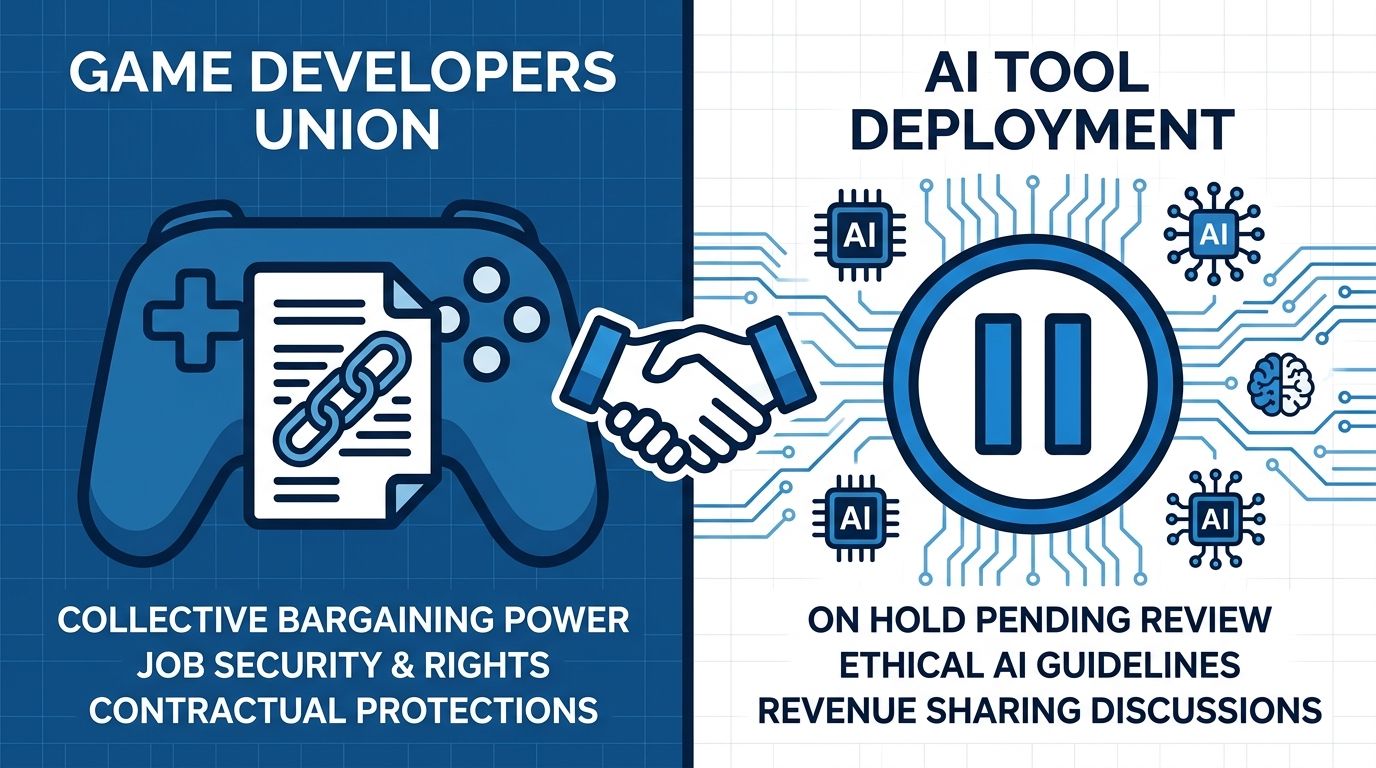
Yesterday, nearly 1,900 Blizzard Entertainment workers ratified a union contract with Microsoft that includes an explicit AI protection clause: before Microsoft can mandate any AI tool in the workplace, it must first bargain with the union. The agreement — covering workers on World of Warcraft, Diablo, Overwatch, Hearthstone, and Blizzard’s shared services — is the largest gaming union contract to include AI protections by employee count, and it landed just days before BlizzCon opens in Anaheim.
This is the template. Not because gaming is the center of the tech world, but because the Communications Workers of America just extracted from Microsoft, in writing, the things every developer wants to say to their employer about AI. Here’s what the contract actually says — and what it doesn’t.
AI Clause: What “Bargain Before You Deploy” Actually Means #
The AI clause does not ban AI tools. What it does is legally require Microsoft to discuss, evaluate, and bargain with the union before mandating any AI tool in the Blizzard workplace. More precisely: any mandate is d until bargaining concludes. Microsoft cannot announce Copilot integration by email on a Friday afternoon and expect everyone to comply by Monday.
That’s a meaningful distinction from how most tech companies handle AI deployment. Typically, the decision is made somewhere above your pay grade, announced in an all-hands, and framed as “exciting new capabilities.” The Blizzard contract inserts a legal obligation to negotiate before that happens. However, it’s worth being direct: bargaining doesn’t mean blocking. The union gets a seat at the table, not a veto. For comparison, the Writers Guild of America secured an outright ban on AI-generated scripts in 2023 — the hardest form of protection. Oregon state workers negotiated a 90-day notice requirement plus bans on AI in hiring and monitoring in 2025. Blizzard’s clause sits in the middle: real leverage, but not absolute control.
Related: Meta Muse Spark 1.3 Contributor: Meta Trains on Your Code — why AI training on developer output is now a labor issue, not just a technical one.
The Recall Right That Changes the Layoff Math #
The second major win is an industry first: workers laid off from Blizzard can be recalled to open positions across any Blizzard bargaining unit within 14 months of their layoff announcement. They also receive 60 days’ notice (or equivalent pay) and one week’s severance per six months worked — terms that didn’t exist in any prior gaming contract.
The context matters. Microsoft has conducted five-plus rounds of gaming division layoffs since acquiring Activision Blizzard in 2023: 1,900 jobs cut in January 2024, 650 more in September 2024, additional cuts throughout 2025. In many cases, workers were let go and then watched the company hire for nearly identical roles months later. The 14-month recall window closes that revolving door. It won’t stop layoffs — Microsoft is reportedly planning another 1,600 gaming cuts at non-Blizzard studios right now — but it gives affected workers first priority for openings rather than having to compete as strangers. Game Developer Magazine called the recall provision an “industry first” in gaming.
Salary Floors and What They Signal #
The contract establishes annual salary floors of $51,000 to $70,400, location-dependent. It also mandates proper crediting of current and former employees on shipped titles — a protection that sounds obvious until you realize how routinely it’s violated in game development, especially after studio acquisitions.
The salary floors matter less for their exact numbers and more for what their existence reveals. The fact that these figures needed to be negotiated means some workers were falling below them. In gaming, QA workers are the traditional target for low compensation and first-out layoffs. These floors don’t fix the underlying economics, but they establish a baseline Microsoft cannot legally undercut for covered roles.
Why Non-Union Developers Should Pay Attention #
This is Microsoft’s fourth gaming union contract, following ZeniMax QA, Raven Software, and Blizzard’s earlier QA agreement. CWA president Claude Cummings Jr. called it “new standards for working people across our industries” — and that’s not just union rhetoric. The AI bargaining model already appears in Las Vegas Culinary Workers contracts and Oregon AFSCME agreements. SAG-AFTRA’s 2025 video game performer contract, which ended an 11-month strike, secured AI consent and disclosure requirements. The pattern is clear: union contracts are the primary mechanism driving concrete AI protections for workers right now.
If you work at a non-union tech company, you don’t have this contract. But every agreement like this one raises the baseline for what “responsible AI deployment” looks like publicly — and gives developers leverage in conversations about internal AI policy. EA, Riot, and Epic are watching. So is every recruiter at Amazon Games and Netflix Games. Whether they feel pressure to match these terms depends partly on how seriously the non-union majority takes what just happened at Blizzard.
Key Takeaways #
- Blizzard’s AI clause requires Microsoft to bargain before mandating any AI tool — not a ban, but a legal seat at the table before deployment, which most tech companies do not offer
- The 14-month layoff recall right is an industry first in gaming, directly addressing the revolving-door layoff pattern following the Activision Blizzard acquisition
- Salary floors of $51K–$70.4K and mandatory employee crediting signal these protections were genuinely needed, not symbolic additions
- This is CWA’s fourth Microsoft gaming contract and the template it will push into other studios — and beyond gaming into broader tech
- Non-union developers have no equivalent protection today, which is precisely what makes this contract worth understanding regardless of your industry