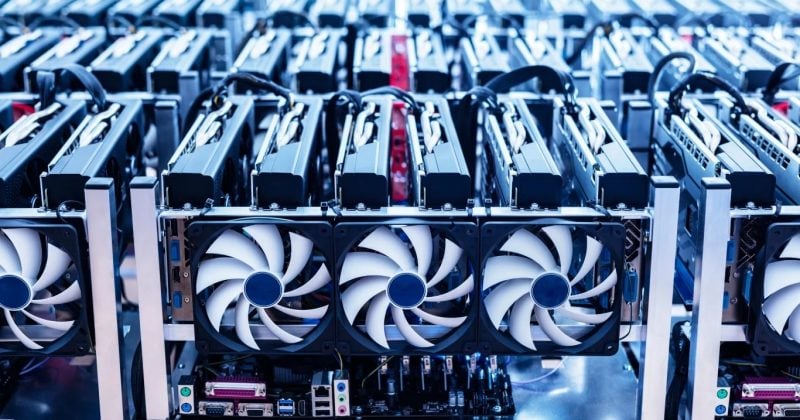
Via 247wallst.com
Public mining companies are rapidly transforming into AI and high-performance computing providers, but the transition comes with a $50 billion funding gap and rising execution risks. The Bitcoin mining industry is undergoing a metamorphosis that would have seemed absurd three years ago. Companies that built their entire identity around hashing SHA-256 algorithms are now racing to become landlords for AI data centers, and the numbers behind this pivot are staggering.
Public mining companies have collectively signed over $70 billion in AI and high-performance computing contracts. Some of these firms could derive up to 70% of their revenue from AI by the end of 2026.
The deals driving the transformation #
Core Scientific set the pace with a 15-year deal signed with AMD on July 28, 2026, covering up to 2.5 GW of energy capacity. The agreement could generate over $14 billion in revenue over its lifetime.
Hut 8 isn’t far behind. The company fully commercialized its 1 GW Beacon Point campus in Texas through a $9.8 billion, 15-year lease. That deal pushed Hut 8’s total contracted portfolio value to $26.6 billion.
The logic is straightforward. Bitcoin miners spent years building out massive power infrastructure in locations with cheap electricity. AI companies desperately need exactly that: lots of power, in places where they can actually get it connected to the grid.
Why miners are walking away from the hash #
The sector’s declining commitment to mining is already showing up in network data. Bitcoin mining difficulty fell by 7.8% in March 2026 as public miners began reallocating resources and selling off their Bitcoin holdings to fund new AI infrastructure.
The $50 billion problem #
For all the headline-grabbing contract values, this transition is far from a sure thing. VanEck reported a near-term funding gap of approximately $50 billion for the mining sector in June 2026. The long-term capital needs could reach a staggering $221 billion. Miners have signed contracts promising to deliver AI computing capacity they haven’t built yet, and building it requires an enormous amount of capital they don’t currently have. Converting a mining facility into an AI-ready data center isn’t as simple as swapping out hardware. AI workloads require different cooling systems, networking infrastructure, redundancy standards, and service-level agreements that mining operations never had to worry about.
What this means for crypto investors #
The investment thesis for mining stocks has fundamentally changed. Traditional models that valued these companies based on hashrate, Bitcoin price forecasts, and energy costs are increasingly incomplete. Investors now need to evaluate contract backlog, counterparty quality, capex timelines, and AI market positioning alongside the usual crypto metrics.
The $221 billion in potential long-term capital needs implies significant dilution risk for existing shareholders if companies turn to equity markets to fund their buildouts.
For the Bitcoin network itself, the migration of public miners toward AI could shift hashrate composition toward private and international operators, changing the geographic and corporate distribution of mining power. Disclosure: This article was edited by Editorial Team. For more information on how we create and review content, see our