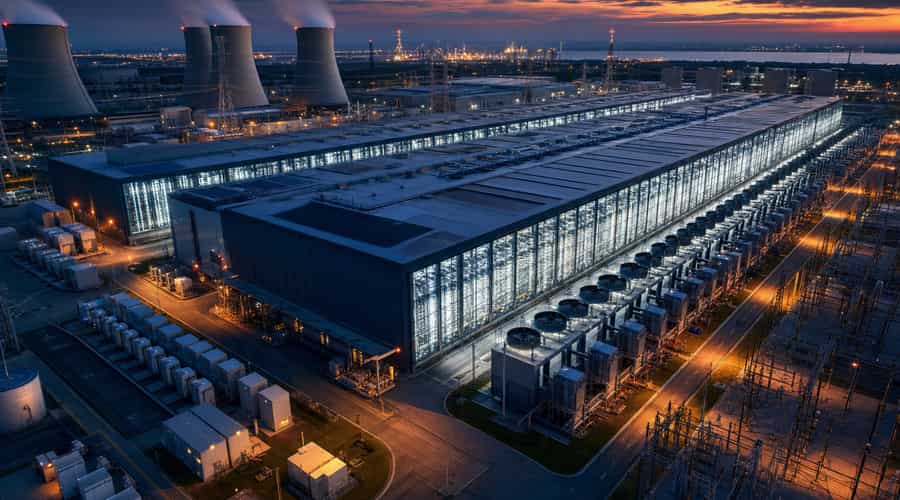
Big Tech's AI buildout is no longer just a spending story. The cash that once made Amazon, Alphabet, Meta, and Microsoft look almost untouchable is being eaten by data centers, chips, power, and the race to stay ahead.
The Financial Times recently reported the figure that should make you stop and look twice: Amazon, Alphabet, Meta, and Microsoft are on course to spend about $725 billion on capital expenditure in 2026, up from roughly $410 billion in 2025. Their combined free cash flow is projected to fall to about $4 billion in the third quarter, against a post-pandemic quarterly average of about $45 billion.
That is not a rounding error. It is the biggest technology companies in the world starting to look less like asset-light software giants and more like heavy industrial borrowers. You can still believe in AI and be clear-eyed about that shift. You should be.
Amazon shows the problem cleanly. The company's trailing free cash flow has fallen to about $1.2 billion, according to figures cited across recent market reports, even as operating cash flow has continued to grow. When a business generates more cash from operations and still has almost nothing left after capital spending, you are not looking at ordinary investment. You are looking at a race where the entry fee keeps rising.
Epoch AI put the broader arithmetic on paper in June. Its analysis of SEC filings for Microsoft, Amazon, Alphabet, Meta, and Oracle found that aggregate operating cash flow is growing at about 23 percent a year, while cash capital expenditure is growing at about 70 percent a year. Those lines cross around the third quarter of 2026. That is the point where the group, in aggregate, stops funding the buildout from its own operating cash.
The math is plain.
Once that happens, these companies need outside money, lower spending, or faster AI revenue. Morgan Stanley estimated, in a forecast reported by Reuters, that AI-related global debt issuance had already reached nearly $236 billion by May 31 and could approach $570 billion for 2026. That is not a side issue for bond desks. It means the AI buildout is moving from earnings calls into credit markets.
Oracle is the warning case #
Look at Oracle. The company is not one of the four names in the $725 billion FT tally, but it is the clearest picture of what happens when AI infrastructure spending runs ahead of cash generation. Oracle said in its fiscal 2026 results that remaining performance obligations reached $638 billion, up 363 percent year over year. Capital expenditure rose to $55.7 billion. Free cash flow was negative $23.7 billion.
That is a hard combination to ignore: huge contracted demand, huge spending, and negative cash after capex. Oracle also said it expects to raise about $40 billion through debt and equity financing in fiscal 2027, including a previously announced $20 billion at-the-market equity program. CFO Hilary Maxson told analysts the company expects around $70 billion in net cash outlay for capital expenditures in fiscal 2027.
The stock has reflected that anxiety. Investor's Business Daily reported last week that Oracle had fallen to a 52-week low as worries grew over AI infrastructure spending, debt, and the concentration of its backlog. The market is not saying Oracle has no business. It is saying the business now comes with a much heavier funding question.
That distinction matters. A weak company burns cash because the product does not work. These companies are spending because demand for compute is real. The uncomfortable part is that real demand can still produce ugly financial statements when the infrastructure needed to serve it costs this much upfront.
Founders should watch the cloud bill #
If you are building on top of these platforms, the hyperscaler cash squeeze is not abstract. It will show up in pricing and product bundling - and in how aggressively the cloud providers move up the stack. A company that is pouring tens or hundreds of billions into AI infrastructure has every reason to capture more of the application layer for itself. Meta is already testing that boundary. Reuters reported this month, citing Bloomberg, that Meta is building a cloud business to sell excess AI computing capacity. The plan could still change, but the signal is obvious enough. A company that spent years buying compute from others is now exploring whether it can sell compute back into the market.
That is useful for Meta. It is less comfortable for every startup whose margin depends on cheap GPU access and a friendly platform provider. The cloud companies do not have to crush startups to make life harder for them. They only have to raise prices, bundle their own models more tightly - or simply decide that the most valuable application workflows belong inside their own products.
The bullish case still has facts behind it. AWS, Google Cloud, Microsoft Azure, and Meta's advertising systems are not empty shells. They have customers, revenue, and operating profits that most companies would envy. If AI usage keeps compounding, today's cash squeeze may look like the painful middle of a necessary buildout.
But do not confuse capacity with returns. Buying chips is not the same as earning margin from them. Building data centers is not the same as proving customers will pay enough, for long enough, to justify the debt and equity now being raised.
Q3 earnings calls will matter because they will show whether the revenue curve is bending fast enough to meet the spending curve. Until then, the cleanest read is this: Big Tech's AI bet is not irrational, but it is no longer being paid for with spare change. The bill has arrived on the balance sheet.
Also read: TSMC's record AI chip profits come with a hidden tax that every founder should understand • How to Build an AI Agent for Your Business Without Writing Code • Sony and Mitsubishi Electric are putting AI inside the sensor itself to rewire factory automation