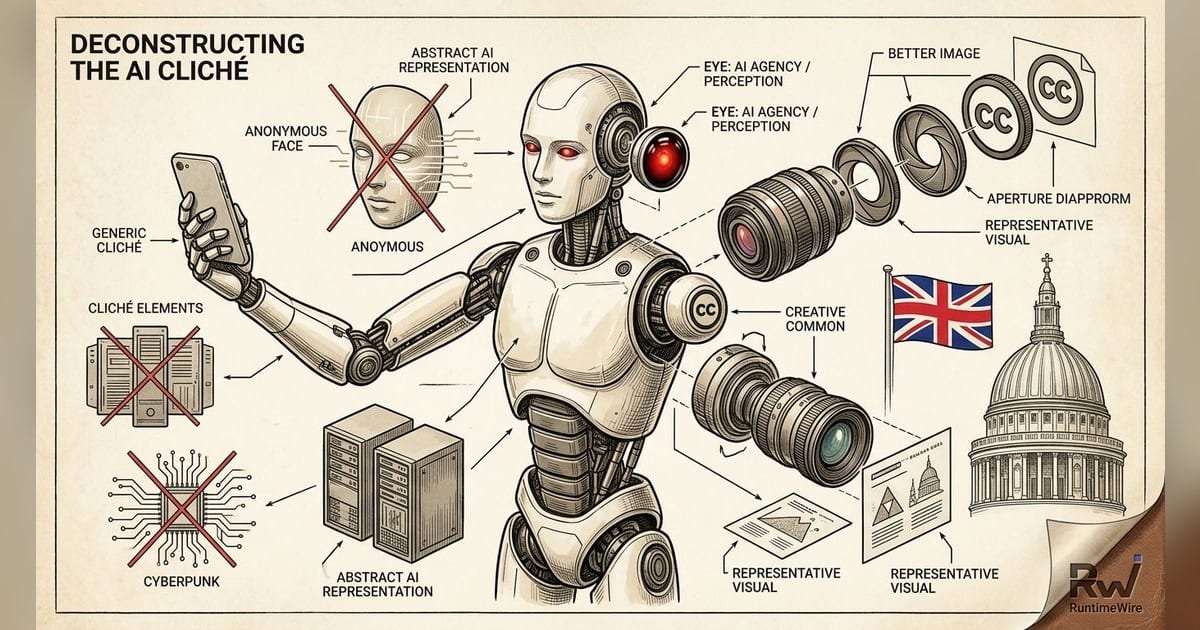
Better Images of AI, the nonprofit collaboration run through Tania Duarte's We and AI, is making a simple argument with larger consequences for the AI market: the default visual language of AI has become part of the misinformation problem.
The project is not a new launch. Its free image library went live on December 14, 2021, in a press announcement, and its user and creator guide followed after a January 24, 2023 London event. That argument now lands in an AI economy where generative AI vendors, enterprise software companies, newsrooms and policy groups are all competing to explain systems that are increasingly embedded in work, schools, government services and consumer products.
Duarte, the founder of We and AI, has built her public-interest AI work around critical AI literacy rather than product adoption. We and AI describes itself as a UK nonprofit focused on helping people think critically about AI, and it runs the Better Images of AI library. Duarte previously served as chief marketing officer at TPX Impact and led marketing and communications at FutureLearn, according to We and AI's team page. That background matters: Better Images of AI is not just a design project. It is a communications intervention led by someone who has worked inside the machinery that packages technology for broad audiences.
The project's critique is aimed at the images that have become visual shorthand for AI: humanoid robots, glowing brains, robot hands, blue code fields and Terminator-style faces. Better Images of AI argues that those tropes do more than bore readers. They can imply that AI systems are sentient, more human-like than they are, or physically present where no robot exists. They can also shift attention away from the people and institutions that build, sell, deploy and govern AI systems.
That is the core insight behind Duarte's work: when an image makes AI look autonomous, magical or inevitable, accountability gets blurrier. The image becomes a quiet claim about who is acting. A robot face suggests agency. A glowing brain suggests human-like intelligence. A blue abstraction suggests an immaterial technology, even when the actual system depends on data centers, labor, procurement decisions, model training, content moderation, labeling work and management incentives.
The library is a counter-position, not a stock-photo clone
Better Images of AI offers a free image library under Creative Commons BY 4.0 licenses. The library includes works such as Alan Warburton's "Quantified Human," Anton Grabolle's "Classification Cupboard," Max Gruber's "Banana / Plant / Flask," Catherine Breslin's "Silicon on Black 1," and Nacho Kamenov's image of a trainer instructing a data annotator. The homepage presents these examples as alternatives to the familiar robot-and-brain visual grammar, and the homepage says users can download images for free if they use the required attribution.
That licensing choice is central to the strategy. The practical competitor is not another nonprofit. It is the path of least resistance: commercial stock libraries, generic web search, in-house illustrations made under deadline, and now AI image generators. Newsrooms and marketing teams often pick the image that is cheap, available and legible at thumbnail size. Better Images of AI is trying to change that default by making better options available at the same point of friction: the image search box.
The library is also explicitly contributor-led. Its artist page says contributors come from different creative fields and geographies, with some donating new or existing artwork and others available for commissions. The roster includes established artists, students and amateur makers. That structure gives the project a different operating model from a venture-backed design startup: it is closer to a public-interest visual infrastructure project, dependent on contributors, partners and funders rather than subscription revenue.
The research gives the critique teeth
The strongest version of Better Images of AI's case is not aesthetic. It is empirical and editorial.
The Better Images of AI guide, written by Dr Kanta Dihal and Tania Duarte, says stock images influence how non-expert audiences understand the subjects they illustrate. The guide is based on a year-long study involving roundtables and workshops with more than 100 experts from technology, media, education, research, policy and the arts. Its intended users are journalists, communications officers, educators and activists.
Dihal brings academic weight to the project. Her biography describes her as an associate professor in science communication at Imperial College London and an associate fellow at the Leverhulme Centre for the Future of Intelligence at the University of Cambridge. She has worked on AI narratives across cultures and co-edited books on the history and imagination of artificial intelligence. Better Images of AI is therefore not merely asking publications to avoid cliches. It is asking them to stop reinforcing a public story about AI that research has already challenged.
That matters because AI companies benefit when the public debate stays abstract. If a model is pictured as a humanoid intelligence, the reader is less likely to ask about the vendor's training data, evaluation process, labor supply chain, compute costs, deployment conditions or liability model. If an enterprise AI system is illustrated as a neutral digital brain, the image can conceal the management decision that put the system into a workplace. A visual metaphor is not neutral when it decides where the reader looks.
The nonprofit structure is part of the point
Better Images of AI is coordinated by We and AI Ltd, which Companies House lists as an active private company limited by guarantee without share capital, incorporated on May 5, 2021. The Better Images of AI homepage describes the collaboration as involving individuals, nonprofit and academic institutions, and says it is coordinated by We and AI Ltd.
The partner structure underscores how far this is from a conventional startup story. The project's partners page says We and AI runs the collaboration and image library, while BBC R&D donated web, design and production skills, expertise and an initial artist commission. The Leverhulme Centre for the Future of Intelligence contributed research, including initial recommendations funded by the AHRC.
That funding and support model gives Better Images of AI credibility but also defines its constraint. The project can make a sharp public-interest argument because it is not selling a stock-photo marketplace. But a nonprofit image library still has to solve distribution. The problem it is attacking is not that better images do not exist. It is that the wrong images are embedded in editorial workflows, marketing calendars and presentation templates.
Duarte's bet is that visual defaults can be moved by lowering friction and giving communicators a better vocabulary. It is a modest-sounding intervention aimed at a large surface area. Every AI company needs pitch-deck art, blog art, launch art and conference art. Every newsroom needs thumbnail art. Every policy report needs a cover. The same few cliches have filled that demand because they are instantly recognizable. Better Images of AI is trying to make accuracy just as easy to choose.
The bigger fight is over who gets pictured
The project's most important choice is to bring humans back into the frame. Not idealized robot-humans, but actual workers, institutions, materials and contexts: data annotation, classification, silicon, surveillance, governance, bias, environmental cost, infrastructure and use cases.
That is a better fit for where the AI economy has moved. The largest AI debates in 2026 are not about whether a robot will walk into the room. They are about who controls model deployment, whose data was used, which workers are displaced or monitored, which communities absorb infrastructure costs, and who is accountable when automated systems fail. A robot image answers none of those questions. In many cases, it prevents the reader from asking them.
Better Images of AI's library will not, by itself, change how AI is built or regulated. It can change the first frame through which a reader encounters the technology. That is not cosmetic. In a market where AI vendors spend heavily to make complex systems feel inevitable, approachable or intelligent, the image attached to the story is part of the argument.
Duarte's project is asking editors, marketers and founders to stop outsourcing that argument to the same old robot hand.