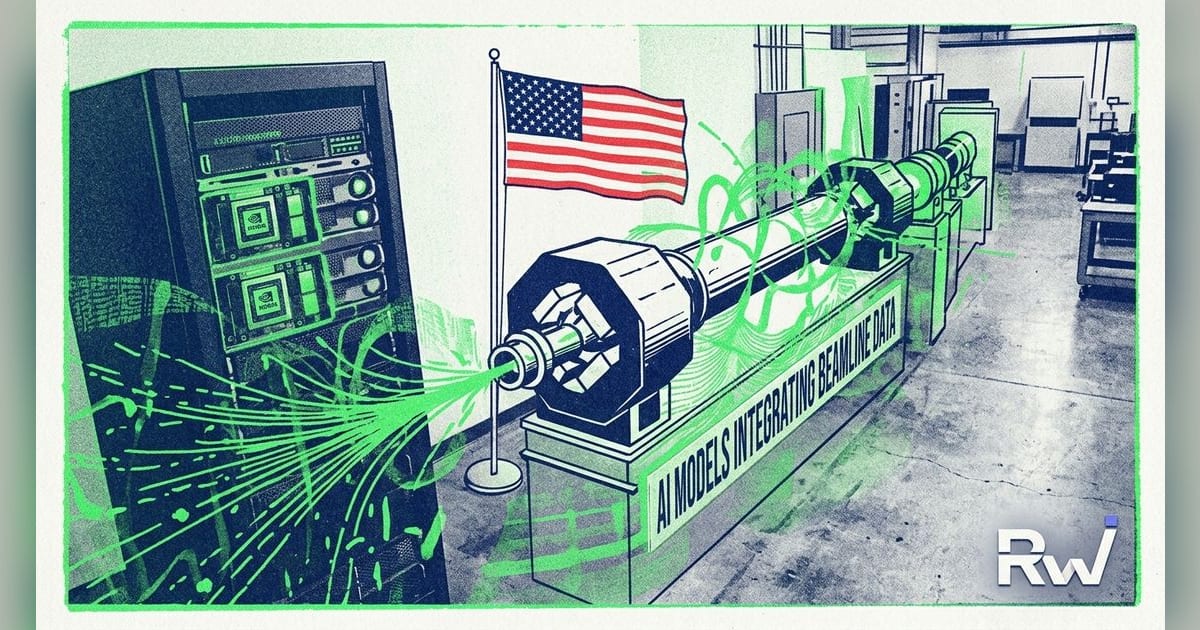
Alex Hexemer, the Berkeley Lab scientist leading the SYNAPS-I project, is using Meta's SAM 3 and DINOv3 vision models to turn raw X-ray scans into labeled, three-dimensional images while experiments are still running. Meta detailed the deployment in a July 21st blog post, positioning the work as an early implementation of the Department of Energy's Genesis Mission.
Hexemer has spent his career close to the instruments creating the data SYNAPS-I is meant to process. He joined Berkeley Lab's Advanced Light Source as a postdoctoral researcher, became a beamline scientist and received a 2013 DOE Early Career Award for a photon-science software toolkit. He has led the facility's computing program since 2018 and now runs its Photon Science Computing Group.
That background matters because SYNAPS-I is addressing a bottleneck created by better scientific hardware. New detectors at DOE light and neutron facilities can capture as many as 100,000 images per second, compared with one image every six seconds on older systems, according to Meta. The facilities collectively produce tens of petabytes of data each year. Researchers can gather information considerably faster than domain experts can inspect, segment and label it.
Hexemer described the gap more bluntly when Berkeley Lab introduced SYNAPS-I in February: segmentation models trained on everyday photographs perform poorly on specialized scientific imagery. His group is adapting general-purpose vision models rather than building every component from scratch.
From raw scans to labeled volumes
SYNAPS-I uses DINOv3 to identify visual features and provide context about their position in an image. SAM 3 traces the boundaries of individual objects. Researchers fine-tuned both models using imaging data gathered at DOE beamlines, where X-rays and neutron beams are directed at materials and biological samples.
The pipeline runs across 300 Nvidia A100 GPUs at national supercomputing facilities, including the National Energy Research Scientific Computing Center. Meta says it can return a reconstructed and semantically labeled 3D volume to the scientist operating the beamline in about 15 minutes.
For one demonstration, researchers analyzed micro-CT scans of grapevine stems from the Advanced Light Source. The system separated hydrated xylem vessels, which transport water through the plant, from dry vessels. Meta says annotating one time step previously required about a month of expert work. Faster processing could let researchers follow the progression of drought damage during an experiment instead of reviewing the scans afterward. A separate SYNAPS-I test at Argonne National Laboratory offers another measure of the project's intended scale. Argonne reported in April that the system processed 1.3 terabytes of ptychography data on one GPU in real time. Argonne estimated that a comparable workflow without the AI system would require 2,500 GPU-hours. That test was part of the wider SYNAPS-I program and was distinct from Meta's grapevine demonstration.
Open weights fit the government's security requirements
Prepublication scientific data at national laboratories generally remains on government-controlled infrastructure. Researchers cannot send sensitive experimental workloads to an outside model API simply because it is easier to use.
Meta's model releases give the SYNAPS-I group access to weights it can download, fine-tune and run inside the government's computing environment. That deployment model gives Meta an opening in scientific computing that closed commercial APIs cannot serve under the same operating constraints.
The announcement identifies no contract value between Meta and Berkeley Lab, and it does not describe Meta as a recipient of Genesis funding. The immediate payoff for Meta is distribution and validation: models developed for broad computer-vision tasks are being adapted for production work inside federal research facilities.
That is useful evidence as Meta turns its AI spending into products beyond its advertising and consumer-app businesses. RuntimeWire reported on July 1st that Meta is preparing a cloud-computing business that would sell GPU capacity and hosted models. The Berkeley Lab deployment follows a different route, with government researchers running the models themselves, yet both efforts widen the number of institutions building around Meta's research output.
Genesis creates a federal market for scientific AI
The Department of Energy launched the Genesis Mission on November 24th, 2025 under an executive order directing the agency to apply AI, national-lab data and supercomputing capacity to energy, materials science, biotechnology and national security.
DOE followed in March with a $293 million funding solicitation. Phase I awards were set at $500,000 to $750,000 for nine-month projects, while Phase II awards were set at $6 million to $15 million over three years. The solicitation covers more than 20 scientific and technology challenges and is open to combinations of national laboratories, universities and US companies.
SYNAPS-I already connects 60 researchers across five national laboratories. Berkeley Lab is working with Argonne, Brookhaven, Oak Ridge and SLAC, with the longer-term goal of serving X-ray and neutron facilities across the DOE network. Argonne says the program aims to train a billion-parameter, multimodal model using data from more than 100 beamlines at seven facilities, building on an existing archive exceeding 50 billion images.
The 15-minute grapevine result remains a demonstration rather than proof that one pair of models can handle every scientific imaging domain. Battery particles, semiconductor defects, biological tissue and neutron-scattering data present different structures and labeling requirements. Each domain will require suitable training data, validation and expert oversight.
Hexemer's wager is that a shared pipeline can absorb those specialized models and distribute improvements across facilities. Meta's role gives that effort general-purpose vision components with enough flexibility to be adapted locally. If SYNAPS-I can repeat its early results across dozens of beamlines, Genesis will have created a substantial deployment channel for open AI models, scientific data infrastructure and the startups that can connect them to laboratory instruments.