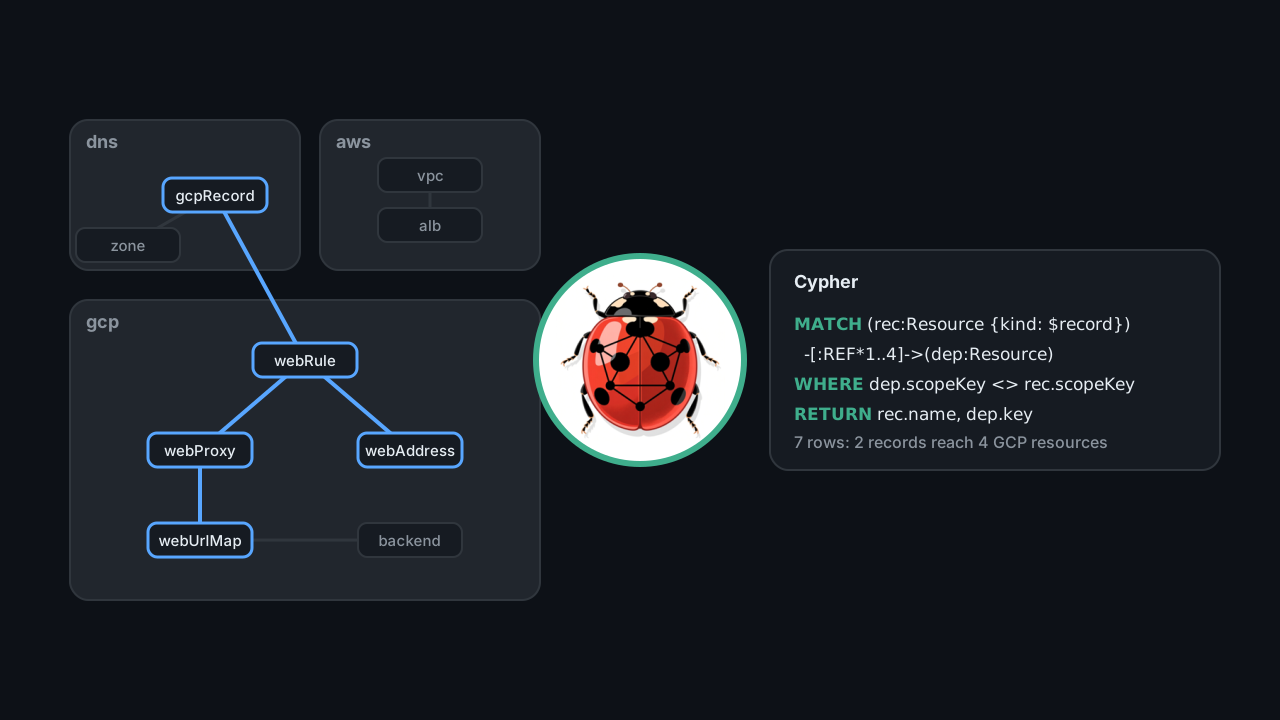
The picture above is a small cloud setup drawn as a graph. Boxes are pieces of infrastructure like DNS records and load balancers. Each line means one piece depends on another. The lit path shows which web addresses go down when Google Cloud does.
behold is free and open source. It builds this graph from a team’s own projects. A person asks their coding agent a question in plain words, and the agent writes the Cypher that behold runs. Its graph engine is LadybugDB.
Querying the graph #
Infrastructure tools already keep a graph of your resources and the links between them, and use it to plan each change. behold loads that graph into LadybugDB so an agent can query it for you.
One question #
A person types a question to their coding agent in plain words.
> Which of our domains depend on another cloud?
The agent writes the Cypher for them and sends it to behold.
MATCH (rec:Resource {kind: 'AWS::Route53::RecordSet'})-[:REF*1..4]->(dep:Resource)
...
On a sample three-cloud setup, two domain names depend on four Google Cloud resources behind its load balancer. The agent reaches behold through its MCP server, and every query is read-only.
In the browser #
LadybugDB also ships a WebAssembly build. This command writes a static page that carries the database.
npx behold export . --out ./behold-export --graphdb
Anyone who opens the page can run Cypher in their own browser.
Read more #
- The graph database : what behold loads, and how to query it
- Exporting a static page
- Queryable Infrastructure
- LadybugDB