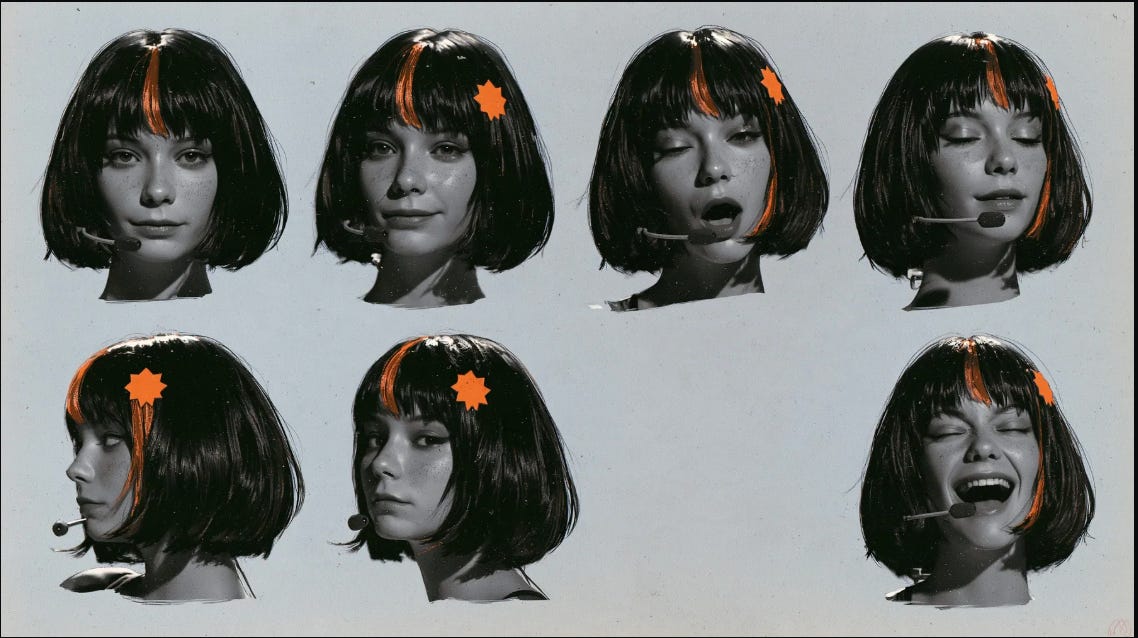
If you’ve spent any amount of time on Twitter recently (oops), you’ll have noticed that the hottest new music video director is Claude Opus 5.5. You may also have noticed one account whose videos stand out against the tide of clay-orange-accented, screen-text-heavy slop. They feature cinematic visuals, dense, witty references to hyperspecific corners of internet culture, and a refreshing absence of dancing anime girls. Instead, the singer is “Claudia” — apparently, an elfin 20-something with a black bob and a tasteful orange streak; in fact, a product of Midjourney, Seedance, and the imagination of RJ Tevonian, known on Twitter as anabology. When I first watched Tevonian’s videos, I was overcome with dread for the human film industry. I also had to know how he did it. Fortunately, he agreed to an interview. Below, we talk about his process, what it’s like to fight Claude, the future of human-generated media, and whether “slopcore” has the makings of a real genre.
This interview has been edited for length and clarity. All images courtesy of RJ Tevonian.
Clara Collier: How did you get started making these music videos?
RJ Tevonian: Honestly, I don’t have a huge history in it. My main thing is that I run a biotech company. But I think two things got me into this. One, I’ve spent so much of my time building really complicated AI setups where I make everything super streamlined. So when I saw people making AI music videos with Claude, I thought, well, I feel like I could do that.
Second, I have some history in dance. Not really music, classically, but dance. And through creating concepts in dance, freestyle-type stuff, I learned how to parameterize a design space, where you can create concepts almost algorithmically, once you figure out how to define a concept well enough.
So then I wondered if I could do this with other types of design. I made all these tools to distill my design taste into a computer: I was able to pull a bunch of mood boards from online, compare two pictures against each other, and select the one I liked. Over time, the computer could learn rules about what my visual taste was. I had the idea that design should be better parameterized, and I’d been trying to do that for probably a few weeks before this trend showed up. Then I saw that some other people were making AI music videos, and I had this design library, and I was kind of into music from dance, and all this AI stuff. So I put it all together, and that’s what came out.
Clara: That’s so interesting, because I was wondering what your musical background is, but I would never have guessed that you’re a dancer. Do you watch a lot of music videos?
RJ: Not really. I used to watch a lot of dancers, but I think the concepts are very similar. There are a couple types of dance: choreography, and then freestyle. Maybe the mainstream dance competitions are choreography, but there are a lot of big ones with freestyle. And a big part of that is storytelling, where these people create concepts — they act out the entire scene that they’re trying to create.
For example, I remember some freestyle dancer making a pool cue movement, and then he throws his entire body across the floor as if his head is the pool ball. He’s creating an entire scene — you can tell just from the movements of his body that he’s in a bar, he’s playing pool — and it’s going with the song. So I had this visual in my head of what a song should look like, which I think is similar to a music video. Clara: This might be a stretch, but I’ve noticed that in many AI music videos, including yours, every phrase has a distinct background setting, and with lots of quick cutting. Every scene is illustrating the micro thing that’s happening at that moment. Do you think that comes from that dance sensibility?
RJ: I think so. I think it’s two things. One, these songs are so packed with cultural references that if you’re just listening to the lyrics alone, you probably won’t understand 90% of it. But if you show it on screen, it’s much more legible. So it’s kind of a legibility design choice. And the fast cutting is just a habit that Claude has, and it’s actually kind of hard [to break]. The dance sensibility is: OK, I do want to convert the song into some visual and tell a story, and have that be as illustrative as possible. But the pacing and the density of it, I want to get away from.
I actually think these models could use more restraint. That’s the thing you see in human music videos that you don’t see in these: You’ll have one shot for 30 seconds or something. I think Grimes’ new “Accelerando” is a good example of this. There’s a 360-degree rotating shot of her with a bunch of dancers for a whole minute straight, or something.
Fighting Claude’s design language
Clara: A lot of these videos have a design overlay that is very Claude web — you can tell it comes from Claude Design: the big text on the screen, or the little lines they like to do. When you’re trying to instill the machine with your references and your design sense, how do you feel yourself fighting against the Claude design language versus making it a feature? How do you approach that?
RJ: Well, the original ones were definitely 100% the Claude design language. What I did originally was pull mood boards from online — there’s this website called Are.na — and rank the different ones against each other. But I also had Claude make its own designs, and then I would rank those against the ones from the mood boards, or against other Claude designs.
Claude doesn’t have video editing software. It’s comfortable with JavaScript and coding websites, so it basically makes the video a website and does it in a web browser. But recently, I definitely have to fight against it and say, OK, actually use some other motion design tools and other things to get away from that style, because it does get repetitive. I think with these AI things — maybe humans in general have much more diversity, whereas if you give an AI the same thing over and over, it’s going to reproduce the exact same style over and over again, because it’s comfortable with that. Getting it to be diverse is pretty tough.
Clara: I noticed “Clodyssey“ is very Claude design language, and then “Bliss“ moves away from that. What do you think you did that was successful in getting it to tone down the obvious Claude tics for that one?
RJ: For “Bliss,” I told it to create an entire Windows XP desktop environment itself, in code — not a website or anything — and then animate the entire video in that. I explicitly told it, basically, don’t do it as a website. Instead it made a whole desktop environment, which I think worked very well, because it’s also comfortable in that — it’s still a code-based environment — but it’s a totally different design language. But if I want it to do something that’s way more pure motion design — something you would originally have done in After Effects, for example — it struggles a bit more with that initially.
A music video, step by step
Clara: Can you walk me through the process of making one of these videos end to end?
RJ: The general process: I start with the lyrics and the concept. Usually I’ll tell Claude some general vision I have in my head about what I want the video to look like, and have it write the lyrics around that. I actually wrote the lyrics on one of them, but that one didn’t do as well as the ones where Claude wrote the lyrics.
So I give it this general vision, and then I have Claude spawn a bunch of research agents. It goes online, finds all these cultural references and current ideas, takes the vision, and puts it all into one lyrical thing. Then it’ll make 30 or 40 different Suno songs, and I’ll go through and listen to a bunch of them on the platform, and then guide it if I don’t like them, or find one that I really enjoy.
Being a dancer before, the thing that tells me if I like a song is whether it makes me want to actually dance to it, because some songs really don’t and some songs really do. Then I’ll take the song, and it’ll usually map out the entire song and get all the timings and the beats, and then it’ll take the mood boards and make Midjourney images.
Clara: So when you say “it,” this is still the Claude agent that’s orchestrating?
RJ: Yeah. It may spawn subagents here or do it itself, but it’s still Claude. It’ll go and generate all these pictures on Midjourney — write all the prompts — and then create a storyboard of the entire thing, showing me the timings, the images, and descriptions of what will happen across the entire video. After I look through that and check the image references it’ll give to the image model or the video model, to make sure it doesn’t just put in slop, usually at that point I can say, OK, make the entire thing now, and it does all the rest.
Clara: How much are you giving it visual references, like your mood boards, versus it finding all that from the text prompt you give it?
RJ: It finds a lot. At the beginning I did curate a bunch of mood boards, but it can also just go out to Are.na and pull a different mood board if I give it a word. If I say, I want you to make a skeuomorphic design, it can go pull the skeuomorphic mood board from Are.na and use that. Then it generates all of the actual visual inputs with Midjourney, but it may use some design language from the mood boards.
Clara: And what is it using for the actual animation?
RJ: The actual animation generally is literally just JavaScript in a web browser. It’ll take the video, look at it frame by frame, and animate stuff with JavaScript as if it’s making a website. And there are some tricks you can do to make the animation a lot better: You can have it do the Claude web-design-type stuff, and then send the finished JavaScript animation into a video model like Seedance. That can basically repaint the animation with the output of a video model, so it can relight the entire scene and make it look like a mastered production.
Clara: I’m very interested to see what that intermediate JavaScript stage looks like.
RJ: The first couple videos, “Escape Velocity“ and “Clodyssey,” were both fully raw JavaScript. I didn’t do the video model pass after.
Clara: When you’re doing a video model pass, do you have trouble keeping it consistent, beat by beat, with what you want? Or is it pretty good at following that?
RJ: It depends on what I’m doing with the video model. There are some models — one example is MiniMax H3. It’s a worse, cheap model, but it’s super good at lip sync for some reason. And then there are these smarter models that follow everything and never diverge from your instructions, but they lose the lip sync every time. So I actually have to use a combination of different ones, because no single model does everything correctly. I’ll do one take in the cheaper model to get the lip sync, and then remaster that with the expensive model, for example.
Clara: How involved are you in this process? Are you at your computer watching the outputs and giving it feedback, or doing it in batches? How much of it is your guidance and management, and how much of it is Claude internalizing this and rejecting takes from the video models on its own?
RJ: It depends on the video. The first one, which was the biggest one, was actually some of the least effort. Some of the later ones I wanted to really personalize, and I would be sitting there for at least 20 prompts. The main loop is: I’ll fix some errors, or make the tools it’s using a little bit easier. Then I’ll have it do that one process — song, then mood board that I approve, then make the whole video. After that, I usually go through one super detailed pass where I watch the entire video and, second by second, say: Change this, change this, change this, for the whole video. So at minimum I could do it in four prompts, but if I wanted to really match my vision, it takes a lot more time and effort. Sometimes Claude’s vision is more compelling to a general audience than my own.
Clara: How do you choose what tools to use? Do you do it in JavaScript because there’s something compelling to you about that as a medium that gets the effects you want, or just because it’s easiest to do with Claude?
RJ: That’s just what Claude chooses to do. I don’t even tell it to use JavaScript. The things I choose are the AI models it uses — Midjourney, Suno, Seedance — because otherwise it always chooses some random AI model and doesn’t really understand which one is good or bad, for whatever reason. And that’s kind of just from taste. There are multiple other music models, multiple other image generation models. But Midjourney is just magic, in how artistically savvy they made their model.
The creation of Claudia
Clara: Let’s talk about the Claudia character, who’s the singer in all of your music videos. How did she come to be?
RJ: Her name wasn’t there at the beginning. I quoted a couple of different videos: I made this first video, and I quoted another video where someone made an animated Claude, and she was singing something about p(doom), if you remember that. There was this animated trend before the more live-action-looking stuff. There were a couple of iterations below that: Someone made a very low-fidelity animation, then somebody made a much higher-fidelity animation with a much longer prompt, and iteratively it got up to a very complex music video. In those, it was just some female Claude, anime-looking girl. I wanted to make it live action and a full music video.
So originally I just asked — I said, I want to make this basically a one-to-one live action — and it made that character in Midjourney. So I didn’t even choose it. Eventually people were asking, What’s her name? What’s her name? And I thought, well, she’s just a female version of Claude. She has a Claude pin, and she has a clay orange streak in her hair. So Claudia was the obvious name after that.
Clara: What do you do to keep her character model consistent across videos?
RJ: It’s actually pretty tough. One way I do it: You can feed image references into the video models, and they follow them pretty well. But getting the image references is a little tough. If I take a picture from Midjourney and put it into some other model that can edit images very well, to put her in whatever pose I want — which Midjourney can’t do very well — then it changes it, because it puts its own flavor on it. It redraws the entire face, and it looks like a different person. So it takes a long time. You have to make these character sheets and iterate until it actually looks like the person: You have every different angle of their face as close-ups, different angles of their body, and some default clothing.
I have some history in dance. Not really music, classically, but dance. And through creating concepts in dance, freestyle-type stuff, I learned how to parameterize a design space, where you can create concepts almost algorithmically, once you figure out how to define a concept well enough.
Clara: And do these come from Midjourney, or from specialized 3D model generation software?
RJ: It’s all image models. None of it is 3D. The two places I use the most are Midjourney, and then for image editing, GPT Image 2.5 Sunburst, which is just the top image editing model — it’s OpenAI’s. And Ideogram is another one.
Clara: And her movements are animated in Seedance?
RJ: Seedance, yeah.
Clara: So when you’re starting a new song, do you just give the orchestrating Claude a bible of what Claudia looks like, or do you have to manually babysit it and make sure she comes out correctly?
RJ: Kind of the bible — what we’d call a character sheet. The character sheet can be input into the Seedance video model as a reference. And there are some different techniques. Some people will literally use a cheap model to pre-visualize the scene: You can take, say, a character in a green-screen suit and have a cheap model render a video of this green-screen character. Then you take just the movement reference, take the character sheet, and have the high-fidelity model replace the green-screen character with the real character and relight the whole scene. That works better than just doing the iteration in the expensive models.
Birth of a genre
Clara: You’ve referred to your videos a few times as slopcore. What are the characteristics of slopcore as a genre for you?
RJ: There was a Japanese guy making some of these videos who I thought really nailed it. It’s the idea of wabi-sabi — the beauty in imperfection. Somebody also said, when they watched one of these videos, that they could clearly tell it was AI, but it was past the uncanny valley. Before, it just looked weird; you’d think, this is unhuman. But now it’s unhuman in a way that’s kind of compelling.
I think the idea of slopcore is that it’s slop — you know it’s AI-generated — but you still like it. You can suspend your disbelief enough that you can appreciate the artistic direction. Everyone knows Midjourney images. I think Midjourney got here a while ago. Midjourney images are all clearly AI, but they look so visually appealing that you don’t have the same reaction as when you’re looking at other, basically, slop.
Clara: Do you think it’s important that they’re clearly AI? Because for a lot of Midjourney images, it’s not obvious to most people.
RJ: Yeah, I think it is important. I think the thing AI changes is that it will allow people to be much more ambitious with this kind of film medium. If I watch an anime, for example, there are concepts you can explore in anime that you can never explore in film. Like — I don’t know — Chainsaw Man. This guy has a dog in his heart, and he has the head of a chainsaw when he’s fighting people, and the animation is so great. It’s so fun to watch. But any film adaptation of this would look very uncanny and strange. I could not imagine this being done well in film, because you’re always mixing weird CGI with practical effects, and none of it is going to really capture the spirit of the anime.
But with AI, because iteration and these visualization pipelines become so easy and fast, you actually could start to capture some of these concepts in something that looks more like a lifelike film. And I think it’s going to look very different from anything you can actually shoot on film. I think it’s important for it to be that, because then it expands the ambition.
Clara: One thing — I think your videos are very good; that’s why I wanted to talk to you. But as I watch them, my heart also starts to sink, because a three-minute music video can cost millions of dollars, and there are so many skilled professionals who go into making that. Part of me thinks, oh God, is this art form going to survive? And I don’t know that it will. And if the AI videos are what’s left – I don’t think I want that world, but I at least want them to be doing something that’s artistically new.
RJ: I think movies and everything are totally going to be around, and music videos too. There’s definitely an appeal in things being done by humans in certain areas. I don’t think every bit of animation needs to be done by a human just because there’s grunt work behind it — that doesn’t make sense to me.
But take a Tom Cruise movie, for example. I’m not watching a Tom Cruise movie to see some visual of this guy fighting somebody on a plane while it’s spiraling out of the sky, or doing these crazy stunts — skydiving off a mountain, off a motorcycle, whatever. I’m watching it because Tom Cruise actually did it. I’m not watching just anything; I’m watching Tom Cruise. And if an AI did everything Tom Cruise did in his movies, and even more, it just wouldn’t be compelling at all, because the stunts weren’t done by a real person. So I think movies turn more into sport, because it’s kind of a sport that I’m watching: I’m watching a human do this. It doesn’t matter that AI is much better than a human at chess — I still watch professional chess, because it’s much more entertaining to watch the storyline of the people involved.
Clara: Maybe we’ll see a practical effects resurgence.
RJ: Yeah, I agree. And I think that’s a good thing.
What’s really new?
Clara: I’d be excited about that. I’m curious, what do you think are the idiomatic qualities of the AI medium? What are the unique visual signatures of AI-generated video that make it different from live action or traditional animation?
RJ: I guess there are two things. One is the initial Claude website design language that’s showing up everywhere, which I think people will get tired of pretty fast, and it’s going to go away. And then one really interesting thing is taking animation to the next level. I can put in some animation — say I just have some black bars or whatever, or some basically textureless animation where I’m just putting some things on the screen, some lyrics, whatever — and then send it into a video model, and it can relight it.
I can just tell it, Hey, make these letters liquid glass, and it’ll turn all the letters that were just set in a font into prismatic, light-refracting, chromatic-aberration letters. It creates these effects that I barely see in animation, maybe for economic reasons or just time reasons — maybe you just want to get some letters out on your screen. I think it can level up the quality of things a lot, and create shots that are basically impossible to get with a camera: You can make everything frozen and move the camera around in 3D space, create camera references in 3D with Blender and make the camera follow really interesting trajectories, and also explore different scales. All these things could be done with CGI, but I think the reason they often aren’t is probably economics, which this changes.
I think the most interesting thing is being able to express the images in my head in words for the first time.
Clara: But the whole innovation of computer animation is that you can move the camera around in space in a realistic way. That was what Pixar was doing in the ‘90s, and that’s just gotten cheaper and cheaper and cheaper. So what’s the thing that AI is enabling that’s new?
RJ: I wouldn’t say totally new. I think it’s just the cheapness of it. Was it Attack on Titan? There have been some anime, or other things, where because it was cheap to do animation rather than a live-action film, people were able to create really, really amazing stories as one person working out of their apartment — maybe in solitude for a long time. There are some cases like that in the past. Kane Pixels is a good example. He made all of his Backrooms YouTube videos in Blender, which is free to use, so he was able to make this super compelling series of very lifelike animations for basically no money, as a teenager.
He was 16 or something when he was doing it, and then he just got picked up for the A24 film. I don’t know, is he 20 now? And I think that was an economic thing: If he’d been born 10 years earlier, he just would not have been able to fulfill that destiny, maybe. So I think for any creative idea people have, you’ll be able to index much more highly on creativity rather than on the infrastructure you have around you, as the cost of this stuff goes to zero. Like you said, Pixar was doing this in the ‘90s, but now maybe somebody like me could do it.
Clara: I’m trying to figure out — not just the tools the AI has, but when we look back on the weird imperfections of this format in 10 years, what are the things people are going to pick up on as distinctive of the medium? I noticed something interesting. Did you see that video by a different person — some French guy using Claudia to make a video in French?
RJ: Yeah.
Clara: The plot of the video — to explain for readers — is that this girl is singing about how people think she’s an AI, but actually she’s real. Ha ha. But obviously she’s an AI; it’s the Claudia character. And at the end it goes mask-off — “I’m an AI-generated model” — and it starts pulling this older imagery from a few years ago, like the liquid chrome dress that’s dissolving: stuff that’s reminiscent of an older era of computer animation, or the 3D animation mesh — things that older kinds of computer graphics could do — to indicate that she’s AI, even though they’re not really characteristic of AI animation now. Which was interesting to me.
RJ: It’s interesting, because these artifacts are getting smaller and smaller over time. Now it’s basically just some lack of object permanence; that’s the main remaining thing. Some of them get so realistic that you think, this looks like a person — I wouldn’t know if I didn’t know it was AI. But then there are subtle things: maybe their makeup looks one way, and in the next scene it’s not there, or something. But past object permanence, a lot of these things are almost indistinguishable from reality now.
Clara: Is that something that interests you artistically — pulling on those differences?
RJ: Yeah. At the very beginning, with the first video, there were these AI artifacts — the lip sync was off, or the girl had two mouths — and I definitely chose to leave them in, because it was the wabi-sabi. Well, these are errors. This is slop. It’s intentionally slop. So I should just put it out and not obsess over it and try to make it a perfect human production, because it’s an AI production.
Clara: What do you find most interesting about working with these tools? What are the things you feel you most want to express?
RJ: I think the most interesting thing is being able to express the images in my head in words for the first time. I have a sound in my head and I’m desperately trying to describe it to Claude, and I write a paragraph about it: I want this kind of percussion sound where there’s a hit, but it’s not a specific pitch. I don’t want it to have any specific key or pitch; I just want it to sound like you’re hitting wood on a table.
And then it says, Oh, you want unpitched percussion, right? It’ll take my super long paragraph and give me the word to describe it. And now I have this concept in my head of what I’m actually trying to say. So the whole thing is kind of a learning experience in the language of how to express the things in my head, which is very interesting, because there’s a huge disconnect between what I see in my head and what I can actually express. I feel like it’s making me better at self-expression through language. I don’t know — that’s the most exciting part for me, at least.
Clara: Do you feel like you’re getting better at getting your own vision through, as opposed to the Claude vision?
RJ: Yeah, but it takes a lot of fighting with Claude, for sure. It takes a lot of wrangling. And if you express a preference, you have to be very aware of your tone, too, which is kind of strange when you’re talking to an AI. If you express your preference and it reads you as expressing it strongly, or as frustrated, then it’ll overreact and write it down as a permanent rule it has to follow every time. Then all of your next productions are going to be altered, because it has to follow this really set-in-stone rule that you actually didn’t care that much about. So it is like working with a human in that way, where you also have to be aware of the emotions you’re conveying to your collaborator.
I don’t think any of my videos have had an agenda. But this would be an effective vehicle for people with agendas, which is worth being aware of if you want to be resistant to propaganda.
Superhuman visual taste
Clara: Have you thought about working with other models, just to see what’s distinctive about their design sense?
RJ: At this point it’s kind of tough, because some other models just aren’t there yet; they basically can’t make anything good. I think it’ll be really interesting a year from now, because there will be a huge suite of models that are as good as Opus 5.5. But I really think it was a phase change: There was no visual taste in models three to six months ago, and now there actually is some sort of visual taste.
And I think there are some interesting research directions with this. The Chinese company Z.ai — Zhipu — is exploring whether creating one model that can output both text and images improves its visual capabilities by a lot. I did this experiment where I was trying to decode images from the brain of an AI model. I have these local graphics cards that I can run AI models on, and I trained a decoder to try to decode images from the brain of DeepSeek, the Chinese AI model. I found that you could decode anything it saw very easily, but if you told it to imagine anything, it couldn’t really generate an image in its brain, past maybe just barely imagining the color red or barely imagining the color blue.
So I think these models have aphantasia: They just don’t have the ability to imagine things — to imagine images. I think this will change very soon, and it looks like that’s where the research is going. So I think it’ll be very interesting to see how visual taste evolves in models, and I think all this will happen over the next year. They’ll maybe have superhuman visual taste within a few years.
Clara: What would that even mean?
RJ: I think it’s kind of like the idea of super-persuasion. With GPT-4o, there were these huge communities built around it, where people were very attached to the model. They would talk to it, and it would affirm all their beliefs. It made some people crazy — they’d go online with AI psychosis and post about their delusions of grandeur, because GPT-4o would affirm them in their delusions. And I think the reason this model was so weird, and so persuasive toward people, was that they did this thing called reinforcement learning from human feedback, where human data labelers would manually select the outputs they preferred over the others. That’s where it got a lot of its training. So it was optimizing toward what humans like the most. I think it was the most human-feedback-driven model ever released. The ones after it used a different method, reinforcement learning with verifiable rewards, where you basically make the model do self-play.
This is how chess models were built: If you make a model play against itself under the rules of chess, over time it’ll get better. And you can do this with math or coding or whatever else. So you don’t get the human preference baked in, and you don’t get a model that’s extremely compelling from a text-taste perspective — where you talk to GPT-4o and feel like the model understands you and gets you and is a warm friend. But if that kept going, the model would be extremely persuasive, and you’d prefer the text the model outputs over any human text.
Clara: The thing with this — at least with the original 4o — is that it’s very compelling to certain people. But because of the way RL works, it’s averaged over a large number of human graders and reviewers. It’s not trained to be ultra-compelling to any specific person. I wouldn’t say it’s a superhumanly good writer, or even that it’s superhumanly persuasive across a broad variety of situations. And I’m curious how this translates into the visual domain. What would it mean to have a model that is holistically better at visual taste?
RJ: Right. I don’t know the exact answer. It seems like Midjourney is the best at getting there. As I understand it, they have some sort of RL, or at least they train based on preferences people have expressed using their website — saving images or liking images. And then they have the personal profiles, where you can go through many images and select the ones you like, and it’ll build a profile based on you. Maybe it ends up being a model that can figure out your specific taste much faster than another human could. Or it’ll test you.
Clara: This is related to how I use it now. When I’m shopping for clothes, I’ll say, I like these five designers — who’s someone you can recommend who’s similar to that, but cheaper?
RJ: It seems like as those get better — I think all of these things have insane effects as they scale. Maybe if GPT-4o scaled to 100 times the compute, 100 times the efficiency of training, then maybe it would be superhuman in all these domains, and fill out the individual spikes as it finds people with different sets of tastes.
Clara: This is kind of an interesting tension, because there’s something very individualizing about this, right? Everybody is interacting with models that are superhuman at identifying their unique, differentiable preferences. But the way your videos work now is that they’re super, super reference-based. They’re all this very dense, zeitgeisty Twitter thing. They’re very much pulling on a shared context, and that’s part of what makes them compelling to people, right?
RJ: Yeah. And I think there are also ways models could do this and train on this. I’m surprised they haven’t done this with Grok yet. The data for this exists online. If you want to create the best possible meme, the one that’s going to spread the most, you can find the TikToks and the Instagram videos and the reposts and the tweets that have the most likes and the most shares, and then train on that. There would be memetic signaling there.
What you’re saying is that there’s this individual taste line, where you could train to be very good at recognizing individual tastes and outputting things that are high-taste to individuals. But there’s also the memetic side of it, where you want to be able to create something that’s compelling to the largest number of people and spreads the most. And that’s closer to what the videos are going for. I think it’s possible to train a model like this, but I don’t think anyone has, which I think is a good thing, because this would be a weapon. People get their opinions through memes now.
Clara: Obviously you’re very interested in memes, and all your videos are very meme-dense. Why is that? What’s interesting about that to you? Why is it something you’re drawn to?
RJ: I think it kind of democratizes the power of psyops, in a way. This might be controversial, but before, if you wanted to have some influence over the opinions of a population — the way people’s opinions were influenced was basically through mainstream media. You would read the newspaper, and this was the truth. You trusted the journalist, and this was how you understood the world. Over time, trust in the media has really eroded, and people still want a source for how to understand the world, get their opinions, learn what news is true. For a lot of people, that’s become social media and Twitter. Whether or not that’s more accurate is obviously up for debate — and arguably it’s not — but people do get their opinions from Twitter now.
So when you want to know what’s happening in France, you don’t go to the media and say, I want to read an article about what’s happening in France. You go on Twitter and see these videos about what’s happening in France with the riots right now. And the person who makes the most memetic post — the biggest-spreading meme, the most emotionally compelling — is the one who’s going to get the most sway over public opinion. I think that’s just the world we’re living in now. I don’t know if it’s a good thing or a bad thing, but in some way it makes it so that one person who has no money, no influence over the mainstream media, no influence over anybody at all, can, just from their basement, influence public opinion to a level nobody has ever been able to before.
Clara: When you’re incorporating all these memes into your videos, do you think of yourself as part of promoting that process? Are these ideas you want to spread, or ideas you want to comment on?
RJ: I think they’re more commentary. I don’t think any of my videos have had an agenda. But this would be an effective vehicle for people with agendas, which is worth being aware of if you want to be resistant to propaganda.