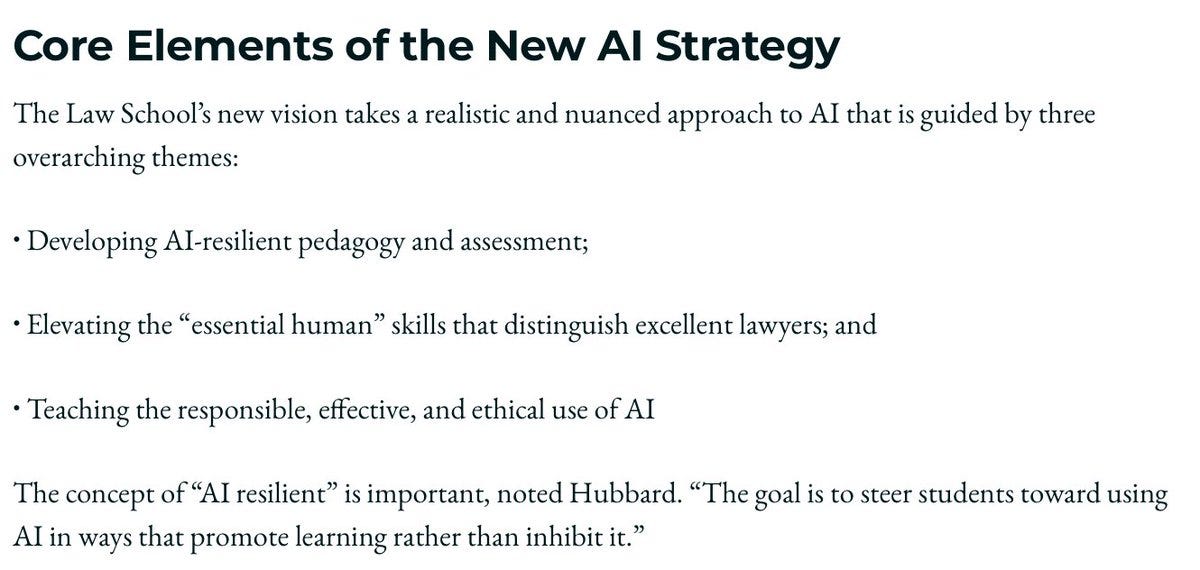
The University of Chicago Law School announced a new policy for teaching AI with headlines "AI strategy bans phones, laptops in class for first year students." What does history have to say?
This week the University of Chicago Law School announced a new policy regarding the use of AI in teaching law. The headlines read “AI strategy bans phones, laptops in class for first year students.” What does history say about this sort of action so soon in the evolution and understanding of a new technology?
Whether this is the right thing for a short time, a new long-term approach to knowledge tools, or a step backward is the subject of much debate. In the short term, it is probably fair to say the general concerns over the rise of AI in terms of jobs, replacing humans, and current limitations of the technology (to name just a few debate topics) mean this change is seen broadly positively. This is especially true because it is from a thought-leading intellectual powerhouse.
It might be a surprise to some, but almost 45 years ago Harvard Law School banned the use of the first truly portable computers. Students were bringing (lugging) the 25lb (11.5kg) Osborne 1—the computer I learned to program on—to exams to type and then print their answers. There were no caselaw databases, no internet (didn’t exist!), no modem, no battery even...just a loud grinding tractor fed dot matrix printer and the first version of WordStar on a 5” screen and extension cords. Other students used a typewriter, probably the one they got as a gift for graduating college.
Two students brought computers to the exam in Alan Dershowitz’s criminal law class. Mid-exam a note was passed to the Dean of Students. The brave computer user who sought no special permission to use a computer—not because they were a hero or rule breaker but because using a computer seemed as obvious as using a calculator in math class—instead of a typewriter was summoned to the Dean’s office. In a follow-up meeting the student was given permission to use a computer while a hearing was scheduled. The primary concern it seemed was the anxiety the computer created for other students with regard to fairness. The hearing was months off.
First the story was written about in the Harvard Law Record. Then the Wall Street Journal picked up the story, March 23, 1982, with the title of the front page story quoting one of the computer users “Will Computer Memories Replace Notes on the Shirt Cuff in Exams?” Then, Time Magazine covered the story:
This was huge news among a tiny set of very interested people, myself included. Computers were new and scary, but the world was optimistic. Time Magazine had yet to announce the computer as “Machine of the Year” (December 1982) but the world was abuzz with the potential of a computer in every home and on every desk. Atari sold twice as many computers as the next leading company, Radio Shack, both more than either Apple (279,000 units) or IBM (240,000.) Literally almost no one had a computer with about 1.8M units sold collectively worldwide since 1977.
While the initial concerns were about a potential unfair advantage for students with computers—something that will later be known as the digital divide—some began to speculate about longer term concerns of computers providing a form of cheating such as pre-written text. Interestingly the idea of connecting the computer to a database of other text or case law resources was simply speculation at this point. It is worth noting that just a year later it would be routine to use a dial-up service to gain access to databases like legal cases as I did with my Osborne. I was in high school using my Osborne when I first learned about this story. It appeared in the #2 issue of the magazine dedicated to Osborne users. Back then every computer had its own magazines. The story detailed with photos the whole Harvard experience. Below you can see the whole story. It is just too wild to read today. Deans and university presidents getting involved. Banning the use of a tool. Fear. Anxiety. It all seems too absurd over a computer.
Oh wait…this time is different.
In the end the school banned the use of computers and word processors from exams. The brave student told the Dean “I opened the door to 21st century technology and they slammed the door in my face.”
Seems crazy. I know.
Regardless, students increasingly used a computer in preparation of course notes, outlines, and assignments, though not in exams or take-home exams. In just a few years, the computer was ubiquitous in law school. By far the most interesting development at first was just how much students were typing compared to how recent graduates were practicing law where typing was the first thing you stopped doing as a lawyer.
Business school was the same way but instead of word processors it was spreadsheets. MBA students began using Lotus 1-2-3 in droves years before the banks and consultancies they would work for would make worksheets ubiquitous. The most tech savvy students were using VisiCalc on Apple ][ first of course.
My own college experience looked a lot like what I read about at Harvard Law. I brought my Osborne to school. I had the computer because my father had bought one to use for his wholesaler, even though he had no knowledge of computers whatsoever. It was a wild fluke that I ended up moving from the warehouse to the front office to figure out how to make use of it.
My freshman year (1982) had a required writing course. I just assumed I would use my computer as I had to write my admissions essay and even some papers in high school. I had the only computer in my dorm of nearly 100 students where *Smith-Corona *typewriters were the ubiquitous tool. To use a computer at Cornell meant slogging up the hill to the “terminal room” and using a connection to the IBM 4300 mainframe which was housed at the airport. When I set my Osborne up on my desk and dialed into the mainframe—no small feat—I was able to amaze my new classmates during orientation week.
I was so anxious having read the story about Harvard I actually asked my prof if I could use a computer before the first class even started. She was very excited to tell me that the writing program was embarking on an “experiment” (her words) to “test the quality of writing that students produce when using a word processor compared to a typewriter” and our section was deemed one of the sections that would use a word processor.
I kid you not. In my limited world view computers were already ubiquitous. I had computer books and magazines. I sold computer software I wrote the summer before arriving at school. I was in a computer club filled with NASA engineers working on the Space Shuttle. I was dialing up to FIDONet bulletin boards and down CP/M utilities. Literally everyone I knew used a computer.
But Cornell, like most every school, was skeptical. The first week of our writing class the dozen of us in class took a field trip from our 19th century, wood-paneled seminar room to a tiny and sterile closet of a room that housed two Wang “word processors.” These were computers from a then famous Boston-based company that did one thing and one thing only, which was word processing. They cost $10,000 and had monochrome portrait-oriented screens with elaborate keyboards featuring rows of dedicated function keys for word processing capabilities. There was what was called a “letter quality” printer which was like a Selectric typewriter with no keys. To use one we had to buy our own 8” floppy disks at the bookstore.
It was then my turn to meet with the Dean. When I asked to use my own Osborne in my room I had to seek permission from the Dean who was overseeing this experiment. Would using a computer invalidate the “data” or give me an advantage. A demo was impractical but I was asked to bring a sample printout to see if the prof could read it. I was told I needed to achieve letter quality output. I called home in a panic and using my magazine knowledge I secured a Royal electric typewriter that connected to the Osborne with a 2” wide ribbon cable from 47th Street Photo in NYC. It sounded like a strafing A-10 Warthog when I printed a paper. It was impressive because it basically “typed” faster than any human.
My classmates using the Wang constantly complained about the fact that the two word processors were oversubscribed by all the experimental sections and to use one required making a reservation. What the experiment failed to consider was that students would actually write at the computer not simply type. They originally thought students would use paper and pencil for a draft then reserve time to type the result in. Using the word processor was just a fancy typewriter.
The process of writing with a typewriter varied depending on whether it was an essay, report, or research paper. Generally one had handwritten notecards that could be sorted and organized. Following that, a hand-written outline was created. From that outline a draft was written out longhand. Some assignments required going over that with the prof or TA. Corrections were made with red ink on that draft. Then a final draft was typed from that. As the semester progressed and deadlines approached, many of those steps got skipped. It turns out those analog tools were ripe for misuse as well.
This was a really important lesson. The people controlling things had no idea how the actual “work to be done” would change because of the tool. Writing on a typewriter while difficult was also expensive. One could only correct small mistakes, and awkwardly so, with whiteout or just a pen. Once you removed the paper from the typewriter aligning any fix was impossible. A typewriter was not for writing or thinking. It was simply better handwriting.
I had no paper drafts. I was using a word processor to outline, write, rewrite, arrange, spell check, and more. I was somewhere between annoyed and puzzled at the experiment being done. I wrote my entrance essays using a word processor. In fact, it soon became provable that using a word processor freed a person to—potentially—be far more productive and produce much better output.
The writing program experiment no longer mattered. I don’t even know if they ever filed a report and I can find no evidence of one.
Reality rolled right over testing the theory. Even the need for “letter quality” output was relaxed as ImageWriter dot-matrix printers with tractor fed paper were standard. Late night on Thursday or Sunday you could sit in the courtyard between our dorms and hear the ever-present grinding of those printers as students put the finishing touches on their assignments. The tractor feed edges of paper would be strewn throughout the dorm the next morning. Every artistic and handwritten sign and announcement hanging on cork boards around campus was replaced with a “ransom note” of outline and shadow printing by an ImageWriter.
Yes I said “reality rolled over” on purpose. The logic of “preemptive regulation” or “presumptive negatives” is what incumbents use to slow technology adoption. They do so using the language of fear or appeals to morality to just slow down and consider... The problem is you really can’t consider a technology that is already out there. You can’t put it back in a bottle. You can’t make people stop using something they like out of concern without making a case that the mere worries negatives provably exceed the realities of the benefits. The ability to express concern does not replace the need to demonstrate arm. Preemptive regulation is the enemy of progress. We would definitely not have had the 20th century with such a mindset.
I know for many there is a visceral reaction to this. The government should protect us. Industry should not move forward until it can prove something is both good and safe. The easiest algorithm I have for this is to ask if some new technology will be used by the government alone before it is approved or neutered for use by everyone else. If that is the case then history tells us the technology is being used for control or even oppression first and foremost. I do not intend to be political here, but practical. In the case of AI, the connection of AI to freedom of expression is unshakable and irrefutable.
Make no mistake, students were still writing shitty papers. They just lacked spelling errors if they used the right word processor and they might have had some bold and italics. An important lesson was being learned—one that matters for today—which is for all the fears that the tool would make things too easy and take away the process of writing, the reality was that there were those that used the tool effectively and those that did not. The mistakes were new. There were weird typos. There were duplicate paragraphs from errant block moves aka copy and paste. There were loads of half-finished sentences. These were all things that you didn’t see when writing a paper meant transferring a hand-written draft to a typed final draft, which is all one did with a typewriter.
In my opinion based on my own real world experience leading up to that point, this new normal diffusing across campus was completely obvious.
Over the next three years of college, the entire curriculum and teaching process was upended. Everyone became connected, not just those in the computer science department. Every professor used a word processor for preparing papers. Every numbers-oriented department was using Excel on Macintosh. Every engineering department was using Macsyma (or μMath) and early design software on PCs. Databases that were kept on mainframe cards and tape were migrated to dBase or File. The first connected computers over BitNet allowed us to “chat” in real-time with other students.
This wasn’t just a university thing. In the four years since Harvard had temporarily banned computers the working world had begun to acquire IBM PCs and use word processing, spreadsheets, databases, and soon “presentation graphics.” Most everyone technically inclined was using a PC for their internships and all of us had stories to tell about how we impressed our bosses with cool computer tricks. In my job I turned around an idea my boss had for a inventory reports on Javelin handheld anti-tank weapons and Pershing Missile repair histories using Lotus 1-2-3 and CrossTalk that had been backlogged with the COBOL team for months.
We were in a new era. The optimism for the possibilities drowned out those that thought of these tools as shortcuts, cheats, or unfair advantages. It was obvious by 1985 or so that not using a computer was a disadvantage, in academics or business.
This all has me thinking about the University of Chicago. While many immediately came to the defense of the wisdom of the school, my experience put me right back talking to the Dean about using a word processor. What seemed obvious to him seemed like a risk to teaching and learning. The short term accolades that came from pacing the introduction and experimenting with the right way to use the technology were basically steamrolled by reality of the “native” generation.
That is what is happening right now with AI. The generation entering law school and frankly those entering the profession are AI natives. They are going to use AI no matter what anyone says. Trying to stop them is like trying to stop a new banking associate from using 1-2-3 in 1983. Not only is it impossible but it makes little sense. This is not about not having rules—for example the rules for cheating, stealing, hurting people and more all still exist and are in full force. This is about realizing that freedom of expression and use of information tools are intrinsically linked and controlling information tools is akin to controlling expression. Again, this isn’t political, just practical.
Many (many!) will dismiss this assertion—and that is all it is—immediately because as we know will be said, “this time is different.” The narrative goes something like AI is different. AI is not simply faster typing. AI replaces the whole process of writing (or analyzing or learning or reading or whatever).
There is some truth to this. But you cannot say those things about AI without recognizing that is precisely what was said about the rise of the PC. I sat at Thanksgiving dinner with some relatives who were first year banking associates who had gone to a fancy MBA program that had not yet adopted 1-2-3 or VisiCalc. Their view was banking was about knowing what questions to ask and then getting an intern to use a computer to work out the answer.
What they didn’t see was that the new tools were not about automating the answer to a question but about taking a problem and turning it into 100 variables, analyzing the interaction of those variables, and simulating thousands of potential questions. The idea of “solve for” completely changed how banking operated day to day. Modeling was the new thinking. And yes, if you had bad assumptions or bad formulae then you would be in a lot of trouble. The expression GIGO was already hanging in every computer operating room for a generation already—Garbage In, Garbage Out. I learned that from my NASA buddies at computer club.
If that isn’t convincing, this same logic was said about the rise of the internet. Many critics of the internet (and I’m not talking about Paul Krugman in 1998 saying the internet would amount to nothing more than a fax machine by 2005) were saying that the internet with its ability to find the exact right answer would replace thoughtful research and consideration. It would replace output with theft. The internet would make us all lazy at work. No one in 1995 saying those things was predicting the true impact of the internet. Not only would it fail to have those negatives so adamantly declared, but the positives came in entirely new ways. Jobs were not eliminated but unleveled. People did not become lazy about doing new things, they just expected old things to be more efficient. We all know this now. And yes, whole new kinds of mistakes or bad behaviors arose. The same could be said of electricity or cars, or fire.
I can’t prove that AI will evolve in as favorable a manner as PCs or the internet, or even my Ti-35 calculator. I can say that the forces in play already point in that direction. We have a generation of natives going to college and joining the workforce. We have a technology that so clearly does new things in new ways.
Yes we have risks. Hallucinations are supercharged AutoCorrect typos. But you know, AutoCorrect (or spell check) typos were simply a much more efficient way to have typos than simply mistyping. AI might bring more versions of the Excel date formatting problem. I grew up in an era where we called things like these “stupid computer tricks” after our hero David Letterman. AI will have its own versions of stupid computer tricks.
One of the most popular ones to talk about now is the rise of hallucinations in legal briefs in court. Suddenly there is an explosion of court-submitted documents with made up citations or quotes. You know when you get a new car and suddenly you see that car everywhere.1 That’s what’s going on now. I ran across a compilation of all the court cases where hallucination came to the attention of the judge. There were just over 1,000 cases. That seems huge. You know what the denominator is? It is about 65,000,000 new cases filed every year (most lasting more than a year.) What is the rate of disciplinary action for shady filings without AI? Turns out that is common too. In the 1980s courts began a concerted effort to take note of attorneys stretching the facts in briefs—human hallucination—and since then most federal judges encounter that at least every year. There are almost 1800 federal judges. The reasons are different.
I am not dismissing any concerns at all, but a reminder that all the millions of laws we live under and rules in place at every institution still apply. No one is confused about accountability. This is even true with nascent agents as they are running as someone in an organization. AI is already a governed and regulated technology. AI is still overseen in its entirety by the post-war regulatory apparatus. This includes everything from liability to copyright to civil rights to antitrust.
New tools give us new ways to fail doing old things. And more importantly new ways to succeed at doing new things. To anyone who made it this far, be a native AI user. Hire native AI users. Let them do native AI things. Let’s together see what a new technology can do. That’s how optimists and builders approach new things.
Author’s note: LLM was used for typos and grammar. I asked for pointers on where a skeptic would be provoked and in my own words made about five additions. FWIW, the model said those changes would result in simply putting down the essay and “reacting poorly to what you wrote.” Thank you Clippy.
Below is the full article on Harvard Law banning the use of computers.