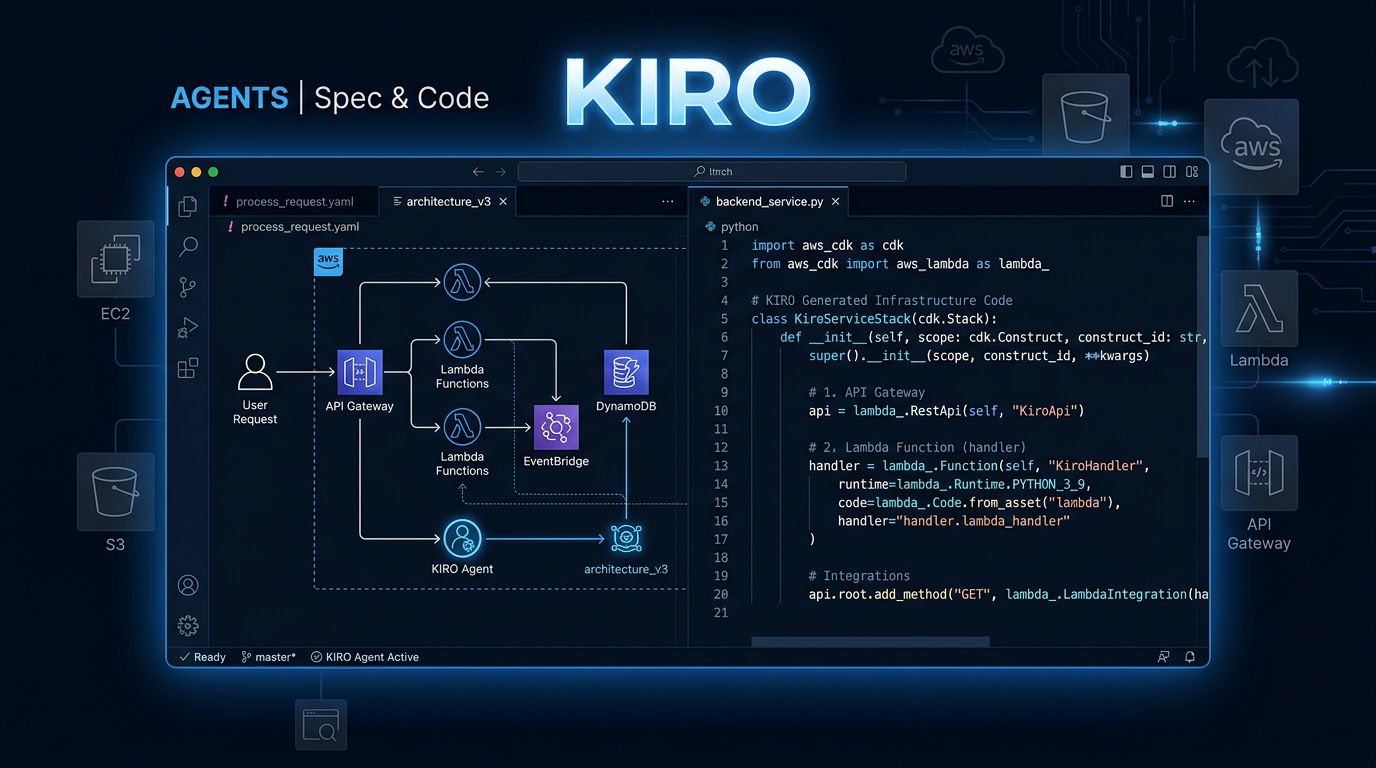
AWS added Claude Sonnet 5 and the full GPT-5.6 family to Kiro this week, and if you haven’t been paying attention to Amazon’s agentic IDE, now’s the time to start. Kiro already replaced Amazon Q Developer — new signups are blocked, Opus 4.6+ models are Kiro-exclusive, and the original Q Developer IDE plugin reaches end-of-support on April 30, 2027. The model upgrades are the news peg. The tool itself is the more interesting story.
What Kiro Actually Is #
Kiro is a VS Code-based agentic IDE that AWS launched on May 7, 2026 to replace Amazon Q Developer. It runs across Mac, Windows, Linux, and iOS, and it’s built on Amazon Bedrock with intelligent routing across Claude, Amazon Nova, and now OpenAI models.
What isn’t standard is the workflow. Kiro enforces a spec-driven development process before it generates a single line of code. You describe what you want. Kiro turns that into a formal requirements document. Then an architecture proposal. Then a sequenced task list. Then — only then — does it start building. You can’t skip the queue. You cannot vibe-code your way through a Kiro session.
The Spec Workflow: Why It’s Different #
Most AI coding tools treat your prompt as a starting point and let you iterate toward something that works. Kiro treats your prompt as a rough draft and forces you to sign off on a structured spec before anything gets implemented. The requirements use EARS notation — a lightweight formal syntax that makes intent unambiguous:
WHEN the user submits a form with invalid email
THE SYSTEM SHALL display an inline error message below the email field
AND retain all other form field values
This looks like overhead. For small tasks, it is. But for teams building regulated systems, features that touch multiple services, or anything that needs compliance documentation, this is a structural advantage. The spec is the documentation. It also catches the most expensive class of AI coding error: plausible-looking output that gradually diverges from actual intent.
The spec workflow extends across the IDE, CLI, and web platform via shared “steering files” — markdown documents that encode project conventions, coding standards, and architectural patterns. Every interface sees the same context.
What’s New in July 2026 #
The July updates moved fast. Check the Kiro models changelog for full details, but here’s the short version:
July 14: GPT-5.6 Sol, Terra, and Luna added across the IDE, CLI, and web. Sol scores 80 on the Coding Agent Index and 88.8% on Terminal-Bench 2.1, with a 272K context window and 2.4x credit multiplier. Terra handles balanced workloads; Luna is fastest and cheapest for terminal tasks.July 1: Claude Sonnet 5 went live with a 1M context window and 1.3x credit multiplier. It “plans before it edits, runs longer without supervision, and checks its own output” — which pairs well with Kiro’s architecture.Also July 1: IAM role sandbox access, letting agents operate directly on AWS resources during development sessions without manual credential management.July 9: Automatic OAuth for MCP servers, so tools like Figma and custom databases connect without manual token setup.
Kiro is now the only IDE carrying both the full Claude family and the full GPT-5.6 family natively. That’s not a trivial claim in a market where model access is increasingly a competitive differentiator.
Agent Hooks: Automating the Automation #
Agent hooks are Kiro’s answer to “agent babysitting” — the constant manual prompting that agentic tools tend to require. Hooks are automated triggers tied to file events: on save, on commit, on new file creation. When a hook fires, a predefined agent action executes without any manual input.
A team can configure Kiro to update documentation every time a function signature changes, run property-based tests on every save, or regenerate API schemas when data models are modified. This makes the automation ambient rather than deliberate — which is where AI tooling actually needs to go to become genuinely useful rather than just impressive in demos.
Where Kiro Loses #
The spec workflow adds 20-30 minutes of upfront friction. For solo developers doing rapid prototyping, Cursor is objectively faster. The MCP ecosystem is broader and more mature around Claude Code. And with 2,700 open issues on the GitHub repository, this is a product still working through early-adopter rough edges — capacity errors, session instability, and Windows trust issues have all been documented.
The honest competitive picture: most professional developers in 2026 aren’t loyal to one tool. The common production stack is Cursor for daily editing and Claude Code for complex, codebase-wide tasks. Kiro fits best as a third tool for AWS-native shops that need the planning discipline and the IAM integration.
Migration: What Amazon Q Developer Users Should Do Now #
The timeline is set:
May 15, 2026: New Q Developer signups blockedMay 29, 2026: Opus 4.6+ models now Kiro-exclusive — Q Developer cannot access themApril 30, 2027: Full end-of-support for the Q Developer IDE plugin
Q Developer continues to work in the AWS Console, documentation website, mobile apps, and Slack/Teams chat integrations. The migration is IDE-specific. Free-tier Kiro (50 credits/month) is enough to evaluate the spec workflow on a realistic feature before committing to Pro at around $19-20/month.
The Bottom Line #
Kiro isn’t trying to beat Cursor at Cursor’s game. The spec-driven approach is a deliberate philosophical choice that trades iteration speed for correctness and traceability. With Claude Sonnet 5 and GPT-5.6 now in the roster, it’s no longer outgunned on model quality either. If you’re building on AWS and your team has been burned by AI-generated code that looked right but wasn’t, Kiro’s workflow exists precisely for that problem. If you’re a solo developer who wants to ship fast, Cursor still wins. The tool has a real use case. It just isn’t everybody’s use case.