The Short Answer #
The system enables autonomous crane building by using reinforcement learning to plan crane motions while an LLM produces near real-time progress updates and safety guidance within the execution loop. It was validated in full-scale concrete retaining wall construction experiments.
So what: during construction execution, the crane can suspend operation when a person is detected in the work area and then resume after the person leaves, with the reported reaction latency on the order of seconds.
Caveat: this approach is task- and safety-workflow dependent—its benefits rely on integrating safety constraints into the control loop and operating in scenarios that match the framework’s intended lifting setup.
Autonomous Crane Building With LLM Safety & RL Progress
Construction is stuck in a weird spot: we need more housing, faster, with fewer skilled workers—and yet traditional job sites still run on slow, manual, sometimes unpredictable processes. New research from Yifei Xiao, Huasheng Lin, and T.Y. Yang tackles this directly by combining large language model (LLM) updates with reinforcement learning (RL) control for an autonomous construction system. The core idea is simple to describe but powerful to execute: let an AI plan crane motions for construction tasks, while another AI keeps the system updated on progress and safety in near real time.
What’s especially interesting in this work is the “full loop” approach. The researchers don’t treat AI as a dashboard that only reports status—they wire it into the decision process. A robotized mobile crane plans lifting paths using an enhanced RL method, while ChatGPT 5 generates progress reports and safety guidance for the control system. And to prove it’s not just a lab demo, they validate the framework through full-scale concrete retaining wall construction experiments.
This blog post breaks down what they built, why it’s a meaningful step toward smart construction, and what kind of real-world projects could benefit first—based on the new findings in the paper published at ACDSA 2026.
Why This Matters (And Why It’s Coming So Soon) #
Construction companies don’t fail because they lack ideas—they fail because the real world is messy: workers show up unexpectedly, obstacles appear, sensors misbehave, and timelines don’t forgive computation delays. A big reason prior “AI construction” work stays mostly in simulation is that most systems can’t reliably connect high-level intelligence to low-level robotic control while also handling safety constraints.
This research is significant right now because it addresses that exact gap. It uses RL to plan crane actions (the part that actually moves the heavy machinery) and an LLM to interpret what’s happening on-site (the part that needs context: where workers are, how far the load has progressed, whether to ). That’s the difference between “AI that talks about construction” and “AI that helps construction run.” In the paper’s experiments, the system also manages a real safety workflow: when the model detects a person in the construction area, the crane operation is suspended, then resumed after the person leaves—within a reported 2–3 seconds reaction latency.
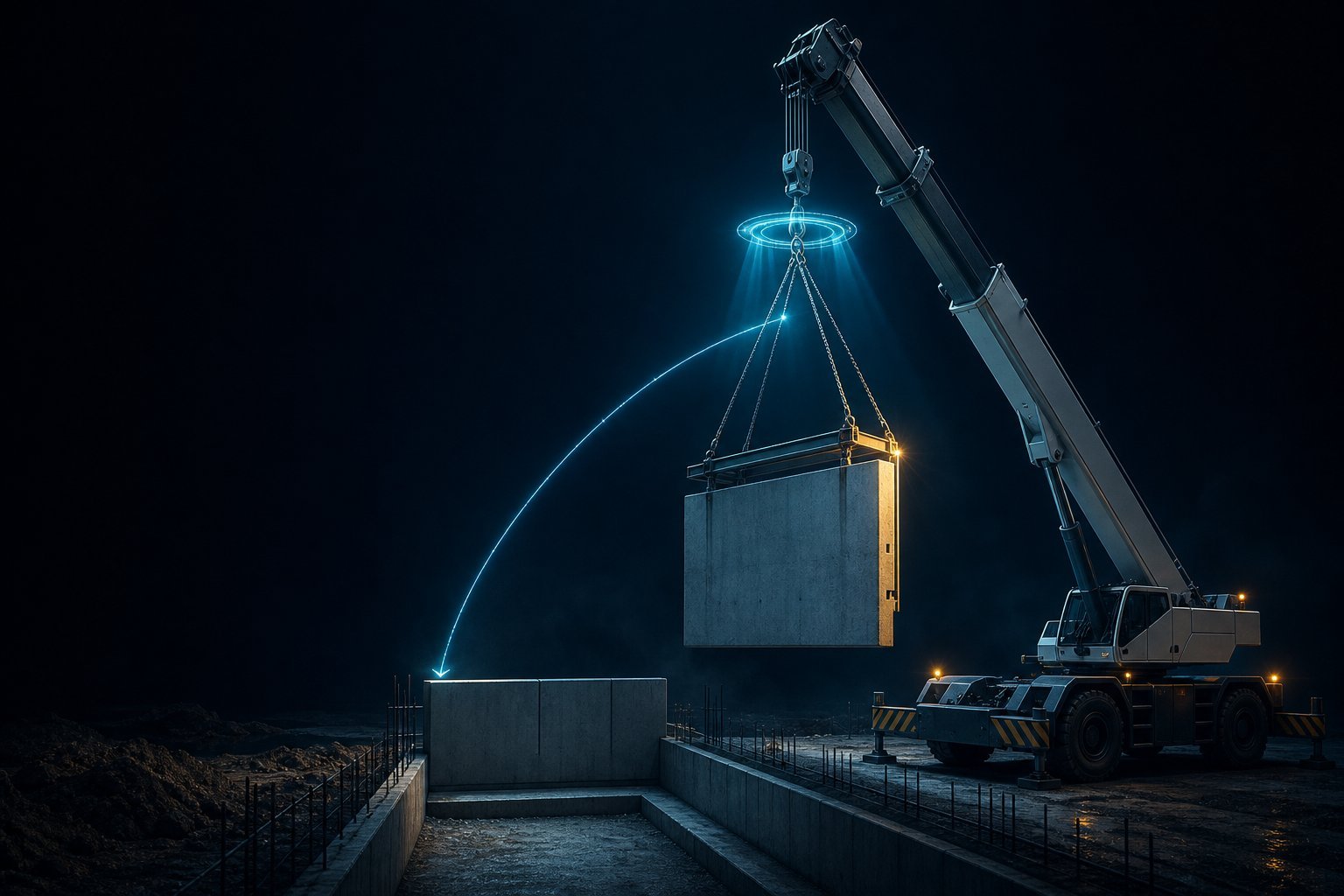
A concrete scenario where this could be deployed today: imagine a small-to-mid sized civil job like building a retaining wall or installing heavy modules in a constrained urban site. You typically have repeatable lifting steps, similar obstacle patterns, and frequent safety concerns around pedestrian presence and exclusion zones. This framework’s first “unit of work” is exactly that kind of task: transporting a 2400 kg concrete block from a crane platform to a target location, including obstacle avoidance.
Compared to earlier AI research in construction, this work blends three things that are often separated:
-
RL for control (many papers stop at planning or small simulation tests),
-
LLMs for language/reporting and instruction (many papers stop at generating text),
-
and a safety integration mechanism that can actually halt execution.
It builds on prior research from the same team (notably their earlier enhanced soft actor-critic crane monitoring work, referenced in the paper) but pushes it into an end-to-end construction loop where progress updates are produced during execution, not after the fact.
How the System Works: RL Crane Control + LLM Progress & Safety Loop #
At a high level, the system has two brains working together:
- RL (enhanced SAC) plans the crane’s lifting path as a sequence of 3D coordinates.
- Robot kinematics + PID control convert each planned coordinate into joint movements the crane can execute precisely.
- LLM (
ChatGPT 5) reads robot feedback, an environment image, and a compact “embedded environment vector,” then:
- updates construction progress,
- generates progress reports,
- produces safety information for the control system.
A crucial detail: the crane doesn’t just follow one “go here” command. The lifting path is broken into multiple 3D waypoints. After the crane reaches each waypoint, the system updates crane state and uses that updated state as the RL input for planning the next step. This creates a feedback-driven workflow rather than open-loop guessing.
The RL planner: enhanced soft actor-critic (SAC-E) for lifting paths
The paper uses a variant called SAC-E—an enhanced soft actor-critic approach designed to be more stable than traditional SAC in training and safer when applied to reality. Standard SAC uses multiple networks (an actor network that proposes actions, Q-networks that evaluate actions, and a target Q-network for stability). Here, the authors highlight that vanilla SAC wasn’t stable enough for their needs and real-world use.
So they apply improvements such as:
-
adaptive temperature,
-
random sampling,
-
learning rate decay,
-
reward scaling.
While the paper points to their earlier work for full training details, the important takeaway is: the RL component is engineered for stability and scalability, not just “it learns in simulation.”
Turning waypoints into real crane motions: kinematics + PID
RL outputs a path as 3D coordinates. But coordinates aren’t control signals. So the system uses robot kinematics (inverse kinematics) to compute reference joint movements for the crane, then a PID controller drives each joint toward those references.
This matters because it directly connects “AI planning” to “physics execution.” A planner that can’t be executed by the machine is basically a fancy guess. Here, each waypoint is validated through joint control before moving on.
Building a “User-Focused” On-Site Memory: Custom Embeddings From Vision #
If the crane is the “muscle,” the system also needs a way to understand what’s happening around it. The paper builds a customized embedding model that converts visual scenes into a compact, structured representation the LLM can reason over—without drowning it in irrelevant details.
Segment Anything Model (SAM) to track task-relevant objects
The authors use SAM-style segmentation to identify key entities in each frame, including:
-
the moving block (the load),
-
workers,
-
obstacles,
-
the target placement position.
From those segmented masks, the system computes geometric features and serializes each frame into a compact state vector:

`V_e = (p_n, N_obs, S_ob, S_w)`
Where:
-
Work progress
p_nis defined by horizontal distance between current block position and target position. -
Obstacle count
N_obsis the number of detected obstacles.
- **Obstacle-crossing stage** `S_ob` is in `{0,1,2}`:

  - `0`: not crossing

  - `1`: crossing

  - `2`: crossing completed
- Safety warning index
S_wis triggered when workers are detected in images.
The paper also emphasizes an important design choice: combining this structured vector with the original environment image gives the LLM both:
-
context for what the scene “looks like,” and
-
targeted inputs for the information it actually needs.
That’s a practical trick—because LLMs can otherwise get distracted by irrelevant parts of the image and the surrounding clutter that’s common on construction sites.
What progress means in this system
They compute progress p_n using a normalized distance-based measure:
p_n = 1 − (x_t,n − x_d) / (x_t,0 − x_d)
So when the block approaches the target, p_n increases toward 1. This is how the system can report meaningful “how far are we?” updates, not just “the crane moved.”
What the LLM Actually Does: Progress Reports, Safety Decisions, and /Resume Control #
The LLM pipeline is designed so that ChatGPT 5 can generate meaningful outputs quickly enough to matter during a slow crane operation. The authors report that computation for RL and the LLM is fast relative to the physical motion, and that ChatGPT can generate a simple progress analysis report after one 3D coordinate is executed.
Prompt inputs: task + robot feedback + image + embedded vector
Each LLM prompt includes four parts:
-
task description,
-
results from robot kinematics,
-
the original construction environment image,
-
the embedded environment vector
V_e.
That makes the LLM’s job more focused. Instead of “describe the scene,” it gets guided instructions tied directly to construction tracking and safety.
Safety logic that can suspend the crane
Safety is where this system becomes more than an automation demo.
The paper describes S_w carefully: it is first triggered if a worker is detected in the image, but then the LLM decides whether that detection actually warrants a safety suspension. The logic is:
- If
S_w = 1because a person appears, - the LLM checks whether that person is inside the construction zone (and not just someone far away),
- if the person is indeed in the relevant zone, the system suspends crane operations.
The reported behavior is concrete:
-
During experiments, people were detected in multiple images.
-
Crane suspension happened only when people were detected within the construction area.
-
The latency from detecting a person in the construction area to suspending operation was about 2–3 seconds.
In other words, the system doesn’t panic at every person-shaped blob—it uses the scene context and the embedded safety index to decide whether to stop.
Progress reports for operators
Besides safety, the LLM updates construction progress and generates reports. While the paper emphasizes “simple progress analysis” during each coordinate step, the overall design is clearly meant to support human operators: the crane operation is monitored by professional operators, and the AI outputs are meant to be actionable.
What They Tested: Full-Scale Retaining Wall Construction and Measured Success Rate #
To validate the framework, the authors ran several experiments using a robotized COPMA 430_ENG mobile crane built by their team.
The task: move a heavy block with obstacle avoidance
The crane task is:
-
transport a concrete block from the crane flatbed
-
to the retaining wall structure
-
including obstacle avoidance
Key numbers:
-
concrete block size: 1.6 × 0.8 × 0.8 m
-
concrete block weight: 2400 kg
Sensors and control setup
They used sensors to measure crane motion and extension, including:
-
string potentiometers on the turntable and boom joints to measure rotations,
-
a laser sensor on the telescopic boom extension.
These sensor feedback signals feed the PID controller used to track the RL-planned waypoints.
Execution timing and overall success rate
The paper reports that:
-
each transporting task took about 4 minutes,
-
there were about 6 failures out of 35 experiments,
-
which yields a success rate of about 83%.
In failed cases, the blocks were not fully placed in the target position due to small errors of approximately 1–3 cm. The authors note that such errors are generally permissible during hoisting and can be corrected by human intervention—meaning the remaining gap is partly about fine positioning rather than total autonomy failure.
This is an important nuance: the system isn’t claiming perfection yet, but it demonstrates that end-to-end autonomy (planning → control → progress reporting → safety ) works in full-scale experiments.
Practical Implications: Where This Approach Fits in Real Construction Work #
The most useful way to think about this research is as a template for autonomous construction workflows—especially for tasks dominated by repetitive heavy lifting and clear safety zones.
Why this might work better than “LLM-only” approaches in the field
LLMs alone are great at interpreting text and generating explanations, but they aren’t naturally suited to stable robotic control under physical constraints. RL alone can learn control policies, but often struggles with safety interpretation and progress reporting unless paired with additional logic.
This framework solves both:
-
RL handles the continuous control problem,
-
kinematics and PID handle accurate execution,
-
and the LLM handles human-facing reporting and safety judgments.
What types of projects are likely best candidates next
Tasks that share these characteristics are good fits:
-
repeatable multi-step lifting sequences,
-
structured work zones (construction area boundaries),
-
predictable failure modes (e.g., slight positioning errors),
-
need for safety s when people enter restricted zones.
Retaining walls are one example. Module assembly, precast placement, or other crane-based heavy installation steps are similar in workflow shape—even if the exact geometry changes.
How it builds toward production systems
The paper also includes ethical considerations, emphasizing that automation should reduce hazardous exposure and that human operators monitor crane operation. That’s not just compliance talk—it’s key for real adoption, because safety culture on construction sites is not something technology can replace overnight.
Key Takeaways #
Key Takeaways #
- End-to-end autonomy loop:
SAC-Ereinforcement learning plans crane lifting waypoints, while kinematics + PID execute them;ChatGPT 5generates real-time progress updates and safety guidance during execution. - On-site “focused perception” for the LLM: A customized embedding vector
V_e = (p_n, N_obs, S_ob, S_w)summarizes task progress, obstacle status, and safety-relevant worker detection, reducing irrelevant noise for the LLM. - Safety with measured responsiveness: When a person is detectedwithin the construction area , crane operation is suspended with about2–3 seconds latency in experiments.
- Full-scale validation on a real robotized crane: In35 retaining wall block transport experiments, the system achieved ~83% success (about6 failures), with placement errors in failures around1–3 cm .
- Human-in-the-loop remains central: Professional crane operators monitor operations, and ethical safeguards focus on worker safety and privacy.
If you want to dive deeper, the original paper is available here: https://arxiv.org/abs/2610.26899.
Sources Used #
This article is a plain-English breakdown of the following peer-reviewed preprint. Read the original for full methodology and results:
- Large language model and reinforcement learning based autonomous construction and progress updates — arXiv
- Authors: Authors: Yifei Xiao, Huasheng Lin, T. Y. Yang