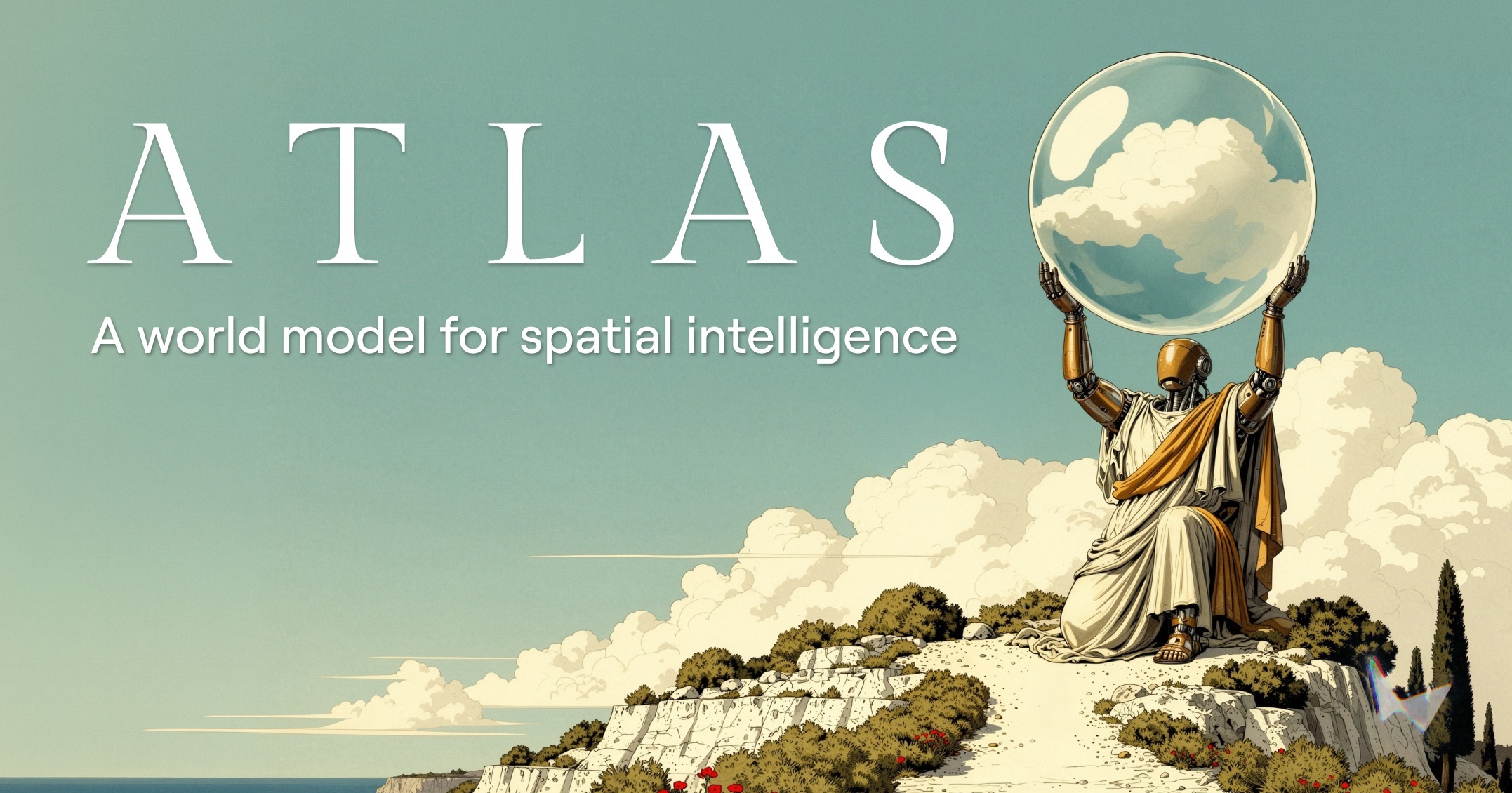
World models generate, reconstruct, and simulate any possible world. They understand how worlds appear, behave, and evolve so that we can render imagined worlds for creative users, simulate the real world in high fidelity, and help robots plan actions. At World Labs, we build these general purpose world models in pursuit of spatial intelligence.
Today we are introducing Atlas, our next-generation world model. Atlas is an omni model that we pretrained from scratch to natively operate on text, images, video, and 3D. It is a multimodal autoregressive diffusion transformer: all inputs are combined into a shared spatial context. Atlas uses that context to generate what comes next, staying consistent in 3D with everything it has seen and imagining what lies beyond it. Atlas is built to scale: its performance improves with increased training compute, and we expect this trend to hold as we continue scaling.
Atlas can perform a broad range of tasks spanning world generation, reconstruction, and simulation:
: Atlas generates images and videos from one or more images with pixel-perfect camera control, outputting up to 1 minute of video at 1440p.Camera-Controlled Generation: Atlas reconstructs real world scenes from one to dozens of input images. It generates both image frames from novel views and explicit 3D outputs, outperforming state-of-the-art models specialized for 3D reconstruction.Spatial Reconstruction: Atlas models space and time from input videos, reframing videos for dramatic visual effects and enabling** Space-Time Simulation**Real-to-Simworkflows for robotics.: Atlas generates images and 360 panoramas from text; it can follow complex prompts, render text, and generate a wide variety of visual styles.Image Generation
Atlas will power future versions of Marble and other products from World Labs.
Camera-Controlled Generation #
Atlas takes one or more reference images and generates new views at any camera position and angle you specify. Generated views match the content and geometry of the input images, smoothly extrapolating beyond them to imagine parts of the scene not visible in the inputs.
Atlas handles a broad range of scene types, visual styles, and camera motions.
Pixel-Perfect Camera Control
Atlas uses precise camera geometry as a native input type, going beyond coarse text-based instructions for camera control. This lets you frame every shot and control every motion.
In the examples here, Atlas generates a complete scene from a single input image. It uses the content of the input image along with its broad world knowledge to imagine what the scene should look like from new angles. For example, it generates the back side of the robot, and it guesses that there should be a grassy lawn next to the pool.
Generating with Spatial Context
Similar to an LLM, Atlas first encodes its inputs into a context, then generates outputs conditioned on the context. However Atlas is unique because each image is grounded at a 3D position in space; this forms a spatial context.
Managing this spatial context unlocks entirely new kinds of creative control. For example, you can place two unrelated reference images in the context, position them in 3D space, and Atlas generates a world that smoothly interpolates between them.
These examples demonstrate the model's world knowledge and creativity; it imagines doorways, hallways, nooks, and other transitions between otherwise unrelated input images.
Controllable Long Videos
Atlas lets you generate long videos with precise control by combining camera movement and spatial context management. You design every scene and every camera angle. This puts you in the director's chair: you are staging the scene, not pulling the lever of a slot machine.
In the example below, we generate a 1 minute video at 1440p resolution using a small number of reference images. We hand-design a camera path through the scene, and Atlas generates a coherent world. The rest of the videos on this page have been compressed to optimize page performance.
Spatial Reconstruction #
Atlas reconstructs real-world spaces from one or more input images. It doesn't require special capture equipment or hundreds of dense views to faithfully reconstruct objects and scenes. We believe Atlas is a major step forward toward solving the problem of novel view synthesis from sparse input images, a decades-old fundamental problem in 3D computer vision.
Reconstructing from Multiple Images
Atlas can take a variable number of input views of a scene. When parts of the world are not visible in the input views, Atlas imagines a plausible way to fill in the gaps by drawing from its rich world knowledge.
But sometimes you don't want imagination; you might want an exact reconstruction of a real-world location. Passing more input images gives Atlas more context: the more it sees, the less it imagines. Atlas typically gives faithful reconstructions with as few as two or three images, outperforming state-of-the-art results by models specially trained only for 3D reconstruction. However, Atlas can also make use of over a hundred input images in its spatial context, allowing for faithful recreation of real world environments.
In the first example below, Atlas generates an aerial view of the scene from just a single ground-level photo. The garden visible in the single input photo is accurately recreated in the model output, but the rest of the scene is imagined. After adding a second real-world input image of the cottage next to the garden, the model's output shows both the garden and the cottage, but it still imagines the house to the left. After adding a third input image of the main house, the entire scene is accurately depicted.
In the second example, we build up Stanford's Main Quad piece by piece, beginning with the grassy main entrance and ending with the colorful mosaics decorating the facade of Memorial Church. Though Atlas only receives two to twenty-five ground-level input images, it can generate paths from aerial views flying far above the campus.
Reconstructing Diverse Paths
Atlas can generate many different trajectories through the same scene, giving new perspectives on the same input images. No matter how many times you change the camera path, the scene stays consistent.
In the example below, we show that given a small set of input images, Atlas can generate multiple camera paths through the same scene. Different camera paths can emphasize various parts of the scene, or change moods by varying in speed, length, or complexity.
Explicit 3D Outputs
In the results above you have seen Atlas output 2D images and videos, which are sufficient for some applications. But workflows in robotics, gaming, design, VFX and beyond often require explicit 3D outputs. Atlas natively operates on both 2D image frames and 3D depth maps, enabling it to output worlds as point clouds or 3D Gaussian splats.
From a single input image, Atlas produces a full 3D world by jointly generating new views and estimating their geometry. From a video of a real space, it predicts the depth of every frame and combines them into a 3D reconstruction. In either case, Atlas fills in regions that no camera ever saw.
Point clouds estimate a scene's geometry, but 3D Gaussian splats make it usable. Atlas fills the remaining gaps and turns the point cloud into a complete splat scene that renders on-device at high resolution and framerates. This is the same representation used in Marble, enabling Atlas to integrate naturally with the rest of our products.
Space-Time Simulation #
Atlas serves as a world simulator. It understands both the spatial structure of the world and how the world evolves over time. Combining its spatial and temporal abilities leads to new applications for VFX, robotics, and beyond.
Reframing Video
Atlas turns a handful of ordinary cameras into a "bullet time" multiview capture studio. With footage from as few as three cameras, Atlas can freeze time and reframe shots, letting you view events from impossible angles.
Notably, these shots did not require professional photographers or specialized equipment. Each of them was filmed by a few engineers and researchers with ordinary cell phones on tripods and clamps that fit in a backpack. Atlas reconstructs the scene from three to five camera views, after which you can reframe shots however you like.
Robotics Simulation
Atlas opens up new ways to scale Real-to-Sim for both navigation and manipulation.
You've already seen Atlas reconstruct a space in explicit 3D from a few images. For robotics, reconstruction is only half the job: as a simulated robot moves through space, Atlas also generates the RGB and depth data its sensors would observe along the way. The world and the robot's view of it come from the same model.
In these examples, we captured two large environments with a cell phone video, using 24 frames each for reconstruction. Scanning spaces like these traditionally requires elaborate and expensive equipment. We then simulate different kinds of robots navigating different paths, and use Atlas to generate images from the perspective of the robot's body-mounted cameras.
Robotic manipulation goes a step further. From a few casual recordings, Atlas aids in building a simulation that also captures how objects move and interact. Once a task is simulated, you can vary it easily: change the objects, their positions, the robot's motion, the lighting, the background. The result is diverse training data and testing environments for robotics at scale.
Image Generation #
The primary focus of Atlas is world modeling, and every image is a window to a possible world. Though image generation is not its primary focus, Atlas is a capable image generator: it follows complex prompts, renders text, and generates a wide variety of visual styles.
Atlas also generates 360 images from text or image prompts, where again it can generate a wide variety of scene types and visual styles.
Technical Details #
Model Architecture
Atlas is an omni model designed to handle many tasks and many kinds of input and output data in a single unified architecture, putting spatial control at the heart of the model. These goals require us to depart from standard architectures used both by LLMs and video models, and design a new base architecture to serve as the foundation of future world models.
Atlas is a multimodal autoregressive diffusion transformer. It operates on multimodal sequences, generating each new element of the sequence one at a time. Each of these architectural properties work together to achieve our goals, and taken together they enable a new paradigm of generation based on a spatial context. We unpack these ideas in turn:
Multimodal: Atlas can natively process many different data types. At present it can operate on text, images, camera poses, and 3D depth maps; videos are represented as sequences of images. Each image and depth map is conditioned on an explicit camera pose, making spatial control a central component of the architecture.Autoregressive: Atlas operates on sequences of elements, where each element is one of the multimodal data types above. Each output is generated one at a time, conditioned on earlier parts of the sequence. This flexible design naturally adapts to a wide variety of tasks: each task is just a different kind of sequence, where inputs are followed by outputs.Diffusion: Atlas is a rectified flow model that generates outputs by gradually denoising them. Diffusion models excel at modeling high-dimensional continuous data like images and video, and can naturally trade off speed and quality by varying the number of denoising steps used during inference.Transformer: The transformer architecture consists primarily of large matrix multiply operations and is well-adapted to modern hardware. It is a robust backbone for world modeling.
Atlas is a blend of ideas from modern LLMs and video models. It can benefit from architectural, algorithmic, and systems advances used in both types of models.
Like an LLM, it is an autoregressive transformer, so it can take advantage of innovations used to serve and accelerate LLMs including KV-caching, cache-aware routing, disaggregated serving, and more. Like a modern image or video model it is a latent diffusion model, and can make use of algorithms such as diffusion distillation, classifier free guidance, shifted noise schedules, and advances in VAE design.
Benchmarks
Atlas is an omni model for world modeling that performs many tasks. There is thus no single benchmark that fully captures its generality. We highlight quantitative evaluations of Atlas on two key tasks: camera-conditioned generation and 3D reconstruction. On both tasks it outperforms more specialized models.
We compare against a selection of top-performing video models for camera-conditioned generation. In each trial, we pair a single input image with a sequence of one to three cinematic camera motions (pan, truck, crane, etc).
We prompt each model with a single input image and a target camera path. For Atlas, we encode the camera path using its native camera input format. Other models do not accept cameras as a native input format, so we describe the camera path in the input text prompt, using standard cinematic terms. It is possible that more sophisticated prompt engineering or creative multimodal prompts could improve camera following for some models, but we use text as it is the most common input modality for describing camera motions.
A team of third-party human raters judge which model better follows the intended camera path. These results confirm that Atlas outperforms recent video models at camera-controlled generation, and this advantage grows as camera trajectories become more complex.
We additionally evaluate Atlas on the task of 3D reconstruction from sparse input views. In each trial, the model receives a set of images and their camera poses, and predicts a 3D point corresponding to each input pixel. This problem has attracted much interest in the academic community, and many specialist reconstruction models have been developed in recent years.
Atlas is an omni-model which performs both generation and reconstruction. Despite its generality, Atlas outperforms the best specialized open-source reconstruction models.
We evaluate on several state-of-the-art benchmarks for this task, reproducing the results for all baselines to ensure a common and fair evaluation protocol across all methods.
Model Scaling
Most progress in modern AI has been driven by scaling. Models improve in large part by scaling up simple algorithms to make use of more data and compute.
We see strong evidence that Atlas will continue to improve with scale. We pretrained Atlas from scratch on a large diverse corpus of multimodal data. Over the course of development, we trained a series of models of increasing size and training compute, and found that each new level of compute unlocked new model capabilities. We are confident that our future world models will follow this trend, dramatically improving their capabilities as we continue to scale.
Build with Atlas #
Atlas is entering early access with select partners. If you'd like to build with it, request access below and we'll reach out. We're excited to see what you build, and to work with you to make Atlas the go-to world model for generating, reconstructing, and simulating any world.
We're also hiring across research and engineering to advance spatial intelligence.
This post was produced by the World Labs team. Please cite as:
@article{worldlabs2026atlas,
    author = {World Labs Team},
    title = {Atlas: A World Model for Spatial Intelligence},
    journal = {World Labs Blog},
    year = {2026},
    note = {https://www.worldlabs.ai/blog/atlas},
}