Imagine you hire a world-class chef and pay them $50,000 a month. The chef chops ingredients with blinding speed in two seconds flat—and then stands with their arms crossed for forty-five seconds, staring at a slow kettle on the stove waiting for water to boil, refusing to touch any other dish until that single kettle whistles.
You would fire that kitchen manager on the spot. Yet if you look at how most reinforcement learning (RL) teams train reasoning models today on complex engineering tasks, that is exactly what their GPU clusters are doing all day long.
In toy math benchmarks like GSM8K, reward verification takes less than a millisecond: you just string-match a number. In those simple setups, GPU token generation represents 95% of your wallclock time.
In real-world enterprise post-training, however, the bottleneck is completely inverted. When training specialized models for synthesizable hardware design (Verilog simulation), multiphysics modeling (Modelica solvers), aerodynamic optimization (OpenFOAM CFD), or formal theorem proving (Lean 4 kernel checks):
- Inference is blistering fast: Modern engines like vLLM emit rollouts in1 to 2 seconds on NVIDIA H100s.
- The environment rollout is slow: Running compilers, test suites, and simulators takes15 to 60+ seconds of heavy CPU work .
Under traditional synchronous Group Relative Policy Optimization (GRPO), your multi-million-dollar GPU cluster hits a global synchronization barrier and sits completely idle for 75% to 85% of total training time, burning expensive cloud allocations while waiting for CPU verifiers to finish.
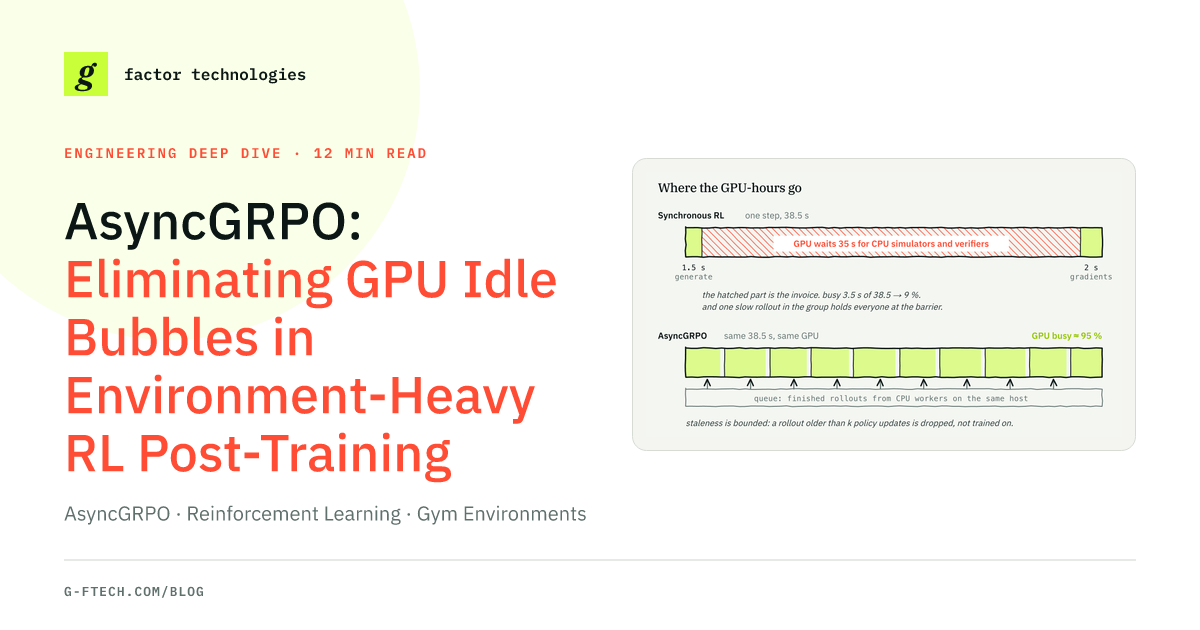
AsyncGRPO blows up this stop-and-wait loop. By decoupling rollout generation, concurrent gym execution, and policy updates into an asynchronous streaming pipeline, the GPUs never have to wait.
1. The Anatomy of the GPU Bubble #
Here is what a standard synchronous training step looks like when you graph it over time:
**The Synchronous Stop-and-Wait Loop:**

`[GPU: Generate 16 Rollouts (1.5s)] → [CPU: Run Simulators & Verifiers (35.0s, GPUs Idle ⏸️)] → [GPU: Compute Gradients (2.0s)]`
In a 38.5-second loop where GPUs only work for 3.5 seconds, your GPUs are busy only about 9% of the time, and Model FLOPs Utilization (MFU), which also counts how well those busy seconds use the Tensor Cores, is lower still. You are paying full price for H100 Tensor Cores that spend most of their lives taking naps.
Worse: GRPO introduces the Straggler Problem. To train on a prompt, the model samples a group of G candidate trajectories (e.g. 16 completions). Even if 15 of those completions fail or pass quickly in 3 seconds, if just one completion triggers a pathological simulator recursion, an infinite loop, or a timeout-bound unit test (e.g. 45 seconds), the entire distributed cluster halts at the barrier until that single slowest test completes.
2. AsyncGRPO: Turning Stop-and-Wait into a Continuous Factory #
AsyncGRPO breaks the lockstep by restructuring the RL loop into an asynchronous producer-consumer pipeline:
| Pipeline Stage | Hardware Engine | What It Actually Does | Sync Model |
|---|---|---|---|
| 1. Rollout Workers | Inference GPUs (vLLM / SGLang) | Continuously streams candidate token rollouts from the latest policy snapshot without waiting for grading. | Non-blocking async queues |
| 2. Gym Replica Pool | Host CPU Cores / Sandboxes | Executes compilers, hardware simulators, test suites, and deterministic reward scoring concurrently. | Concurrent worker pool; streams completed rewards directly to training queue |
| 3. Ready Buffer | Host Memory (POSIX IPC) | Holds fully graded groups with pre-computed advantages, ready for training. | Priority streaming queue with staleness filters |
| 4. Policy Trainer | Training GPUs (PyTorch / Megatron) | Pulls ready batches from the queue, runs backpropagation, updates weights, and broadcasts deltas. | Continuous backpropagation with periodic background NCCL weight sync |
How Overlapping Keeps Silicon Hot
Compare sequential execution against overlapped asynchronous scheduling in the interactive 3D timeline below:
Overlap work without changing the resource count
Try this: Both schedules have three jobs, one generation worker, one environment worker, and one update worker.
What changed: Each job takes 2 + 6 + 2 = 10 time units. Running the complete jobs one after another takes 30 units.
Numbers 1–3 identify jobs; rows identify resources. A gap means that resource is idle. The time axis stays at 0–30 in both views.
- While Gym Replica Pool A is grinding through a 30-second Verilator simulation for Batch N , the inference GPUs are already generating candidate trajectories for BatchN+1 .
- Simultaneously, the training GPUs are running backward passes on Batch N-1 , which just completed its verification checks a second ago.
- By sizing the concurrent Gym Replica Pool to match the ratio of simulator time to generation time, both your CPU cores and your GPU Tensor Cores operate at near-100% continuous duty cycles .
3. Worker Capacity Math: Sizing the Queue #
More queues do not magically create compute capacity. If generation produces 10 rollouts per second while your CPU verifiers can only score 2 per second, the buffer grows by 8 rollouts per second until host memory explodes or the data becomes hopelessly stale.
We can model the required concurrent environment worker capacity using queueing theory:
Here λ is the arrival rate in candidate attempts per second, E[S] is the average environment service time in seconds per rollout, and n is the number of concurrent worker processes. To sustain the pipeline without unbounded queue growth, utilization ρ must remain strictly below 1:
Sizing Rule of Thumb: Always size the concurrent worker pool with at least 25% to 30% headroom above the arrival rate:
n ≥ 1.3 × (T_env / T_gen) × Group_Size
If an H100 emits 16 rollouts in 2 seconds (λ = 8/s) and verification takes 6 seconds ( E[
S] = 6), you need more than 8 × 6 = 48 concurrent CPU workers just to keep up, and about 1.3 × 48 ≈ 63 with the recommended headroom.
4. Bounded Staleness: Keeping Policy Gradients Honest #
Whenever you make a training loop asynchronous, every reinforcement learning purist immediately asks the same question: “What about policy staleness? If the trainer updates weights while a slow simulator is still running, isn’t that rollout off-policy?”
Yes, it is slightly off-policy. But modern asynchronous RL systems (such as Tencent’s AReaL, ByteDance’s Relax, and Red Hat / Hugging Face TRL’s AsyncGRPO) handle this with clean mathematical rigor:
4.1 Importance Sampling with a Strict Staleness Ceiling
The system tracks the policy version difference:
We enforce a strict boundary (typically max_staleness = 1):
- Fresh Enough (Δt ≤ 1): The trainer applies standard PPO/GRPO importance sampling. Because weights are synchronized rapidly over high-speed NVLink/NCCL, the policy drift between adjacent steps is tiny, well within the safe surrogate clipping corridor
[1 - ε, 1 + ε]. - Too Stale (Δt > 1): If a pathological simulator run or hung container takes too long and exceeds the staleness ceiling, the trajectory is dropped from the queue. It never touches the optimizer.
4.2 Intra-Trajectory Consistency
In multi-turn agent tasks, an episode might require multiple actions in sequence. AsyncGRPO guarantees that all intermediate decisions in a single episode are generated by the identical policy checkpoint. Weight updates are synced only at episode boundaries, so the model never suffers from policy schizophrenia within a single rollout.
5. The Hidden Killer: Why Gyms Must Live on the Same Machine #
When teams first try to scale asynchronous RL, they almost always make the same architectural mistake: they set up their expensive GPU nodes in one cluster, and spin up a giant Kubernetes pool of separate CPU instances somewhere else in the VPC to run the simulators.
In heavy agent environments, this architecture causes a devastating network transport disaster.
The Massive Payload of Real Tool Traces
In toy NLP tasks, an episode emits a 50-byte string. But real engineering environments generate massive artifacts:
- Compiler stdout/stderr logs and full stack traces (often 1 to 2 MB).
- Hardware simulation signal waveform files (VCD dumps, 5 to 50 MB per rollout).
- Abstract Syntax Trees, intermediate code representations, and CAD geometry meshes.
Across a batch of 128 parallel rollouts, a single training step generates 1.5 GB to 5 GB of raw ephemeral trace data!
| Architecture Strategy | How Data Moves | Latency Penalty per Step | Cloud Network Bill | Serialization Overhead |
|---|---|---|---|---|
| Remote Gym Cluster (TCP/IP) | 10GbE / 25GbE VPC Network | 450 ms – 1,800 ms | Severe ($$ cross-AZ fees) | High (JSON / Protobuf marshalling) |
| Colocated Host Gyms (Shared Node) | POSIX Shared Memory ( /dev/shm ) / IPC | < 5 ms | Zero ($0 egress) | Zero-Copy (Memory pointer pass) |
Look at What Modern GPU Servers Actually Are
An 8x NVIDIA H100 SXM server is not just a box of GPUs. It is a supercomputing monster equipped with:
- 128 to 256 high-performance CPU cores (dual AMD EPYC or Intel Xeon processors).
- 1.5 to 2.0 Terabytes of high-speed DDR5 RAM .
- 15 to 30 Terabytes of blazing NVMe SSDs running at 12+ GB/sec.
When you train standard models, those 192 CPU cores and 1.5 TB of host RAM are barely doing anything! By colocating your Gym Replica Pool directly on the host CPUs of the GPU machines:
- Zero Network Hops: vLLM hands tokens to local sandboxes via Unix Domain Sockets or shared memory.
- Zero-Copy Ingestion: Multi-megabyte waveform dumps and compiler outputs are written directly to
/dev/shm(in-memory RAM filesystem). The trainer reads them in sub-millisecond memory lookups. - Zero Cloud Egress: You stop paying cloud providers thousands of dollars a month just to stream temporary simulation logs across availability zones.
6. The Hard Numbers: What Published Benchmarks Show #
Data from recent open-source asynchronous RL systems (Red Hat Async-GRPO, Tencent AReaL, ByteDance Relax, and DORA arXiv:2604.26256) confirms the massive leap in hardware efficiency:
| Framework & Workload | Environment Task | Synchronous Baseline | AsyncGRPO Performance | Observed Gain |
|---|---|---|---|---|
| **Async-GRPO (Red Hat 2025/2026)** | Math Reasoning (DeepScaleR) | TRL v0.16.0 (Sync): Baseline | Async Streaming: **11.0x – 12.5x** | **11.0x – 12.5x vs Sync TRL** |
| **Async-GRPO vs VERL (v0.2.0)** | 8-rollout Math Reasoning | VERL Baseline: 1.00x | Async-GRPO: **1.42x** | **42.4% gain over VERL** |
| AReaL (Tencent 2025/2026) | Code Generation & Test Execution | Synchronous PPO/GRPO Baseline | Decoupled Streaming | 2.77x Training Speedup | | DORA (arXiv:2604.26256) | Industrial Long-Horizon Agent Tasks | Global-Batch Sync Scheduling | Multi-Version Streaming Rollout | 2.0x – 4.0x Acceleration |
The Big Takeaways
- GPU Idle Time Drops from 76% to < 4%: In benchmarks from Relax and AReaL, trainer idle ratio collapsed from 70%–80% in synchronous mode down to0.1%–3.5% in fully async mode . You get roughly 3x the training throughput on the exact same hardware.
- Zero Quality Penalty: As long as
max_staleness ≤ 1is enforced, final benchmark accuracy and reasoning scores track synchronous baselines perfectly.
7. The Engineer’s Checklist for Heavy RL Gyms #
- Profile First: Measure your token generation time (T<sub>gen</sub> ) against your simulator time (T<sub>env</sub> ). If your verifiers take more than twice as long as generation (T<sub>env</sub> > 2 ×T<sub>gen</sub> ), synchronous GRPO is actively wasting over half your GPU budget. Switch to AsyncGRPO immediately.
- Colocate on the Host Node: Run your gym sandboxes on the host CPU cores of your GPU machines and pass data via
/dev/shm. Never ship temporary simulation logs over network switches. - Set Aggressive Timeouts: A single hung compiler or infinite loop in a rollout will choke your queue. Set hard execution timeouts (e.g. 2.5x median task time) and fail the trajectory immediately.
- Keep Staleness Tight: Start with
max_staleness = 1. Only expand to 2 if your verifiers have extreme runtime variance and your importance-sampling ratios remain stable.