file
The Aston Martin Aramco Formula One Team appears to be using CoreWeave and NetApp technology in a different way than the original announcements said it would, and B&F's interrogation of the story shines a light on the complexity of racing's storage tech stack. We discovered some interesting information, including that the Aston Martin Aramco team owns its own GPUs and that CoreWeave runs them or runs AI models on them, and that all of its data processing is currently on-prem.
Various sponsors supply technology facilities at Formula One race events at at Aston Martin’s Silverstone HQ for marketing purposes.
The largest sponsor is Aramco, and two others are NetApp and CoreWeave. NetApp started sponsoring the team in 2021. Pure Storage had supplied all-flash storage via a ServiceNow deal starting around 2020. NetApp took over the storage role around 2023, and the team completed its full migration to 100 percent NetApp storage, replacing Pure Storage (now EverPure) arrays in 2025, with the migration completed in October 2025.
It says the Aston Martin team is using FlexPod (both trackside and at HQ), BlueXP, Data Infrastructure Insights, ASA A-Series (Block storage), StorageGRID (Object Storage), and Cloud Volumes ONTAP for data reliability in the main public clouds: AWS, Azure. and GCP.
Neocloud market leader CoreWeave supplies GPUs as a service from datacenters around the world, including a couple in London, UK. It said in May 2025, “Aston Martin Aramco has today announced a multi-year partnership with CoreWeave, the first AI Hyperscaler, who joins the team as Official AI Cloud Computing Partner….With Aston Martin Aramco, CoreWeave will support the team in relocating their on-premises computing infrastructure to a new, large-scale cloud computing environment.”
We understand that CoreWeave datacenters mainly use VAST Data storage, not NetApp, but they also support other suppliers: “CoreWeave’s storage stack includes local, object and distributed file storage services. Local storage supports up to 60 TB of Kubernetes-based ephemeral capacity, while dedicated clusters use technologies from VAST, WEKA, DDN, IBM Spectrum Scale and Pure Storage. Its S3 object storage layer uses a Local Object Transport Accelerator (LOTA) to cache data directly on GPU nodes.”
We wondered if NetApp’s StorageGRID and Cloud Volumes ONTAP might be being used in some way in a CoreWeave datacenter for Aston Martin Aramco work.
An obvious use of GPUs is to run wind tunnel simulations involving Computational Fluid Dynamics (CFD) to better understand how air moves around the car as it makes its way around a race track. The sport’s regulatory body, the FIA, limits the maximum double-precision compute power teams can use and a scale model of the race car is used in a wind tunnel, not a full size car, with myriad sensors measuring what’s going on with the airflow and compute clusters used to analyze the data. The Aston Martin Aramco team’s wind tunnel at Silverstone is branded the CoreWeave wind tunnel in recognition of CoreWeave’s role here.
A typical CFD run has three phases: Pre-processing to set up the model, a solver phase where computers run software to solve mathematical equations to simulate air flow, pressure and turbulence around the model car, and a third post-processing phase where the results are analyzed and visualized. The solver phase is computationally intensive, vital, and well-suited to GPUs.
But, as we understand it, in the Aerodynamic Testing Restrictions (ATR) in the FIA’s Sporting and Technical Regulations, GPUs are currently prohibited for the solver phase of Restricted CFD (RCFD) simulations.
The solver (the core computation part of CFD) must run only on nominated, homogeneous CPU cores.
Floating-point, fixed-point, and integer operations cannot be offloaded to GPUs or other accelerators.
Teams must declare their exact compute resources (hardware specs) to the FIA in writing. The FIA audits usage with periodic logfiles.
To prevent richer race teams with more advanced hardware getting an unfair advantage, the FIA limits CFD usage through Allocation Unit hours (AUh or MAUh). These are calculated based on CPU core count, clock speed, and performance metrics (e.g., FLOPS with specific instructions like AVX). It’s expected that, from 1 January 2028, the FIA will introduce regulations allowing GPU core use for CFD solvers. Until then, CoreWeave’s GPUaaS facilities would seem to be irrelevant to the Aston Martin Aramco team.
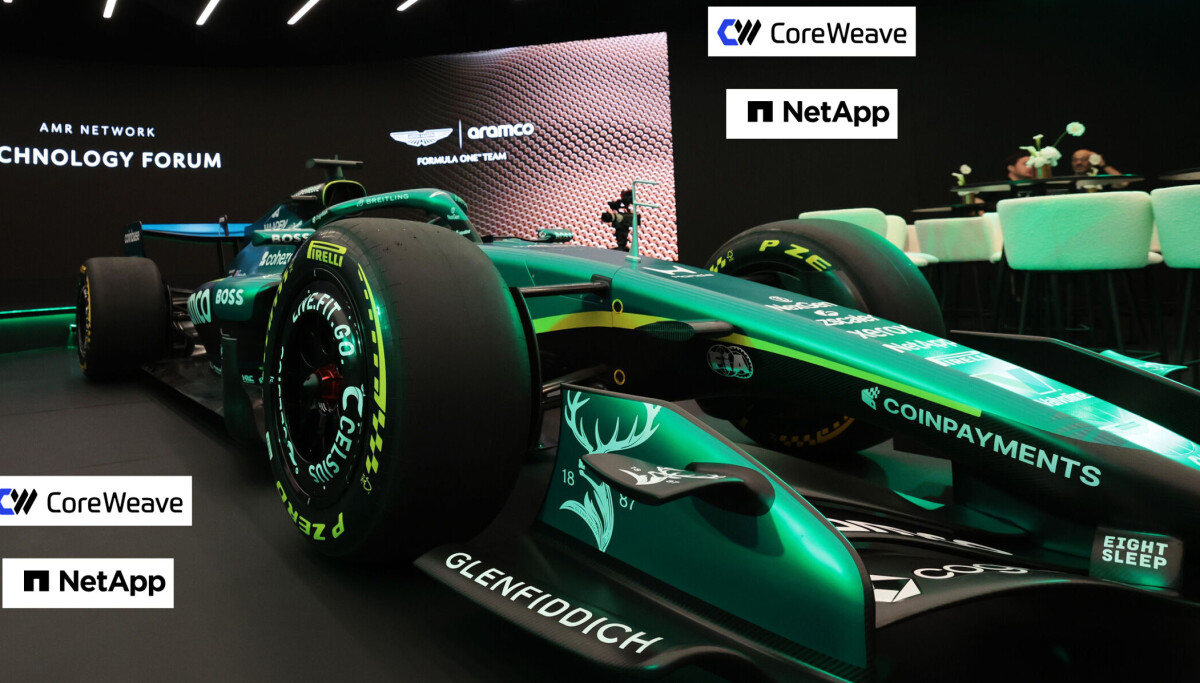
Earlier this month, the Aston Martin Aramco team held an AMR Network Technology Forum event at its Silverstone HQ with ecosystem partners CoreWeave, Zscaler, Cohere, ServiceNow, Cognizant, Cognition, NetApp, Xerox, Arm and Eight Sleep. There was a series of panel discussions and media roundtables focused on the role of technology for the team.
At a roundtable during that event, the Aston Martin Aramco team’s CIO, Fabrizio Pilotti, answered some questions we asked about CoreWeave and NetApp technology use. He said:
-
NetApp’s Cloud Volumes ONTAP is not used by the Aston Martin Aramco Formula One Team.
-
All data processing is done on-premises.
-
Data processing is not done in a CoreWeave datacenter.
-
The Aston Martin Aramco team owns its own GPUs.
-
CoreWeave runs them or runs AI models on them.
Seeing some dissonance with existing CoreWeave and NetApp announcements, we then asked the Aston Martin team some questions after the event:
-
Is it actually using Cloud Volumes ONTAP?
-
Is it doing any data processing in a public cloud facility supported by Cloud Volumes ONTAP, meaning AWS, Azure or GCP?
-
Is it doing data processing in CoreWeave’s datacenters? Is it using GPUs in them?
-
If so, how does its on-premises NetApp storage send data to CoreWeave’s cloud and how does it receive processing results back? I understand that CorteWeave datacenters don't include NetApp storage.
The team told us that, as with all teams competing at this level in the sport, Aston Martin Aramco Formula One Team does not share specific information concerning its architecture publicly in order to protect its competitive sporting advantage. It did provide some general information:
On Cloud Volumes ONTAP - "Cloud Volumes ONTAP is part of our data infrastructure as described in our 2024 partnership renewal with NetApp. Our technology stack evolves season to season, and elements of that 2024 configuration may have changed since."
On Public Cloud Data Processing - "We do not disclose the specifics of which workloads run on which parts of our infrastructure, as this is competitively sensitive information for the team. Our environment is designed for extreme agility, allowing specific workloads to remain dynamic and shift between on-premises and cloud resources based on real-time computational demands."
On CoreWeave Data Center Processing and GPUs - "CoreWeave has been our Official AI Cloud Computing Partner since May 2025, supporting the team in relocating on-premises computing infrastructure to their cloud environment to unlock AI-accelerated engineering. That partnership is active and ongoing. We do not detail specific current workload placement or hardware ownership structures publicly."
On Interoperability - "That level of architectural detail is not something we discuss publicly, for competitive and security reasons."
It would seem that the Aston Martin Aramco race team is taking more time to implement use of CoreWeave and NetApp technologies than the companies initially announced, with CoreWeave GPUs only being made available for solver CFD use from January 2028 onwards.