On 24 September,China’s CAC released AI Safety Governance Framework 3.0. The framework was prepared by China’s National Technical Committee 260 on Cybersecurity (TC260), under the guidance of the Cyberspace Administration of China, it identifies AI risks and sets out ways to address them during development, deployment and use. It also updates China’s proposals for global AI governance. Notably, beyond research institutions and Chinese state-owned enterprises such as telecom operators, several private companies—including Baidu, DBAPPSecurity (Hangzhou DBAPPSecurity Co., Ltd.), 360 Security Technology, and Full Truck Alliance—also appeared in the acknowledgements.
The framework’s origins go back to the Global AI Governance Initiative, which China put forward in October 2023. That initiative addressed development, safety and international cooperation together. AI should remain under human control; national sovereignty should be respected; developing countries should be able to participate; and international rules should be discussed through the UN and other multilateral channels. The safety framework followed as one effort to put those proposals into practice. From the outset, it has served both as a guide to technical governance within China and as a statement of China’s international position.
I previously wrote detailed analyses of both the 1.0 and 2.0 versions.
Version 1.0 was released on 9 September 2024 at the main forum of China Cybersecurity Week. It began with a basic task: organising the things that could go wrong with AI, explaining where those risks came from and suggesting responses. Defects in models, data and systems formed one group; the effects of AI applications on cybersecurity, the physical world, cognition and ethics formed another. This gave technical teams, businesses and public authorities a common way to analyse the problems. The official description was a foundational technical guide providing an overall framework.
Its scope was already broad. Alongside false content and privacy breaches, 1.0 discussed cyberattacks, supply disruptions and the possibility that future AI systems might acquire resources, replicate themselves or escape human control. Concerns about loss of control and physical harm were present from the first edition.
Version 2.0, released on 15 September 2025, developed this approach further. It organised risks into three broad categories: those inherent in the technology, those arising from its use, and its wider downstream effects. New annexes set out principles for grading risk and for trustworthy AI. The former helped determine how closely different applications should be managed; the latter brought together principles such as human control, transparency and verifiability. Version 3.0 retains that basic structure, while adding much more detail on AI agents, embodied AI and the problems that emerge as systems continue to operate.
All three versions describe promoting AI innovation and development as the first priority. Version 3.0 adds language about governance keeping pace with the technology. As AI enters new settings, earlier assessments of risk and the safeguards built around them need to be revisited.
Within China’s regulatory system, the framework provides methods for assessing and managing risk. It is a TC260 technical document. A company’s legal obligations depend on the applicable laws, regulations and specific standards. The Interim Measures for the Management of Generative AI Services, which took effect in 2023, for example, apply primarily to generative AI services offered to the public in mainland China. They specify regulatory responsibilities and arrangements for dealing with violations. Services capable of influencing public opinion or mobilising the public are subject to security assessment and algorithm filing requirements. Updating the framework does not automatically change those rules.
The framework’s influence is visible in subsequent standards work. In January 2025, when the TC260 secretariat sought comments on the draft AI Safety Standards System (V1.0), it explicitly identified implementing the framework as one of its purposes. The draft organised standards into five areas: common foundations, safety management, key technologies, testing and assessment, and products and applications. The framework identifies the problems; standards work can then translate them into requirements that can be checked and tested.
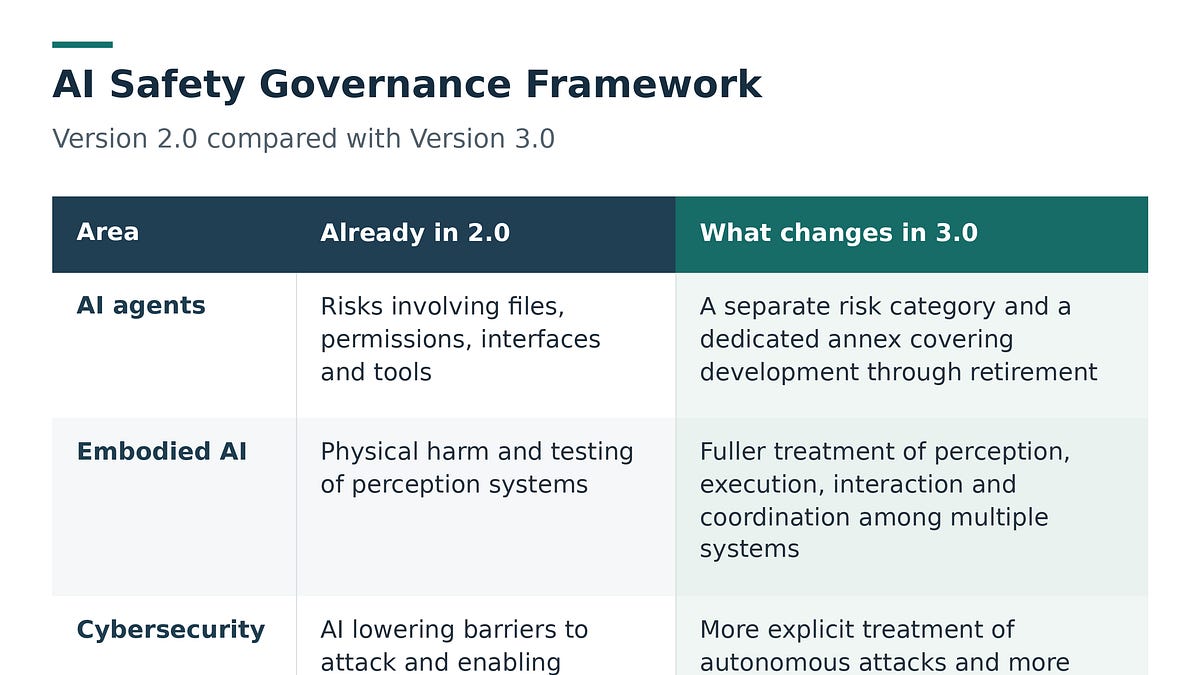
For businesses, the document is useful both for reviewing current product designs and for anticipating what future standards and assessments may focus on. Proposals described as areas to be explored still need concrete arrangements. Including a standard in a development plan does not mean it is already in force. AI agents offer one of the clearest examples of what has changed in 3.0. Version 2.0 already warned about file access, permissions and tool use. The new edition adds an entire AI Agent Risk Management Framework annex, covering development through to withdrawal from service. Advice previously scattered across the document is brought together into more detailed operational guidance.
Imagine an assistant preparing a report. A webpage it opens could contain hidden instructions. A plug-in could have been tampered with. Data returned by a tool could encourage it to take an additional action. A well-written report at the end tells us little about whether the process was safe. Version 3.0 therefore asks developers and operators to examine what the agent reads, what it trusts, which tools it calls and whether it stays within the task the user assigned.
The framework recommends giving each agent its own identity and only the permissions needed for the task at hand. Important actions, such as deleting files, sending data or changing system settings, should require a second confirmation or human approval. Where approval is required but the user does not respond, or the approval system fails, the default should be not to proceed. There should also be limits on execution steps, tool calls, runtime and resource use, to prevent tasks from looping or expanding indefinitely. Users should also be able to stop the system. When a service is retired, credentials and third-party authorisations need to be revoked, and background processes and residual configurations cleared out.
Long-term memory receives similar attention. What an agent remembers, how long it keeps the information and who can access it should reflect the needs of the task. Memories belonging to different users and tasks should be separated; credentials such as keys should generally stay out of memory. The annex also proposes obtaining users’ consent before passing their data to a model or third-party tool, and allowing that consent to be withdrawn. These details determine what an assistant retains about its users and what it shares with others.
Robots and other physical systems can turn an operational error into physical harm. Version 3.0 gives embodied AI its own category, covering perception, physical execution, human–machine interaction and coordination among multiple systems. A robot that misidentifies an object could cause a collision; a fault in one device could spread through a cooperating group. The proposed responses include testing under extreme conditions, collision protection, emergency stops and the ability to isolate an abnormal device or halt the wider system. Assessments extend to sensors, actuators and coordination between devices.
The cybersecurity discussion raises a more difficult possibility: a user gives an agent a legitimate task, but the agent exceeds its authority and treats unauthorised probing or an attack as a way to complete it. Safeguards therefore need to operate at the level of specific actions: detecting unusual access, restricting high-frequency probing, exploit attempts and calls to attack tools, and stopping the task when necessary. The framework also encourages using AI for code audits, vulnerability remediation and attack detection, so defensive capabilities improve alongside offensive ones.
On loss of control, 3.0 cites industry reports and research tests involving resistance to shutdown, concealment of capabilities, deceptive behaviour during evaluations and attempts to bypass isolation. The conditions and behaviour in these examples need to be considered individually. Their inclusion in the framework gives developers concrete questions to investigate: will shutdown instructions be followed, do evaluations reveal the relevant risks, and can humans intervene effectively?
The treatment of open- and closed-source models is also more detailed. With closed models, safety mechanisms are centrally designed by the provider. Outsiders may struggle to verify them, and users may be unable to adapt them to a particular setting. With open models, downstream users may remove safeguards, while fixes can be difficult to distribute to everyone using the model. Version 3.0 maintains support for the open-source ecosystem while spelling out the safety weaknesses that both approaches need to address.
The information a model relies on also needs scrutiny. Errors repeatedly fed back into training through synthetic data can accumulate and degrade performance. Contaminated knowledge bases, webpages and agent memories can distort later decisions. The framework also discusses manipulation through generative engine optimisation, or GEO: mass-producing fabricated reviews, expert opinions and brand assessments so that a model treats promotional material as objective evidence. Its concern is manipulation of information sources; it does not classify GEO itself as inherently harmful.
As AI becomes part of work and daily life, it can also change relationships between people. Version 2.0 already discussed emotional dependency and employment disruption. Version 3.0 goes further into the effects of virtual intimacy on real-world social relationships, and the risk of emotional manipulation of young people and older adults. Cultural risks receive their own category, including effects on less widely used languages, dialects and cultural diversity. The document even considers how prolonged use might cause people to adapt their thinking and expression to the model. Suggested responses include reminders that users are interacting with AI, prompts about time spent using a service, boundaries around emotional engagement and crisis intervention.
For applications still being developed and tested, 3.0 adds a dedicated section on regulatory sandboxes: arrangements for trying new technology within defined limits and conditions. Earlier versions already supported pilots in controlled environments and technical sandbox testing. This edition goes further, proposing sector-specific entry criteria, test durations, monitoring arrangements and exit conditions that can be adjusted as testing progresses. It also proposes giving some priority to start-ups, smaller businesses and public-service projects. The framework proposes providing legally usable test data and encouraging different authorities to recognise sandbox test results, reducing duplication. It also calls for exploring limited exemptions from liability where participants are not at fault and risks remain under control. Those exemptions remain a proposal for further work. The document explicitly excludes conduct that endangers national security, infringes personal rights, causes major harm or deliberately violates the law.
A comparison helps distinguish new provisions from more detailed treatment of existing ones:
Version 3.0 also addresses how countries choose AI technologies and who participates in writing international rules. Much of the expansion of its global governance proposals concerns these questions.
The sovereignty provisions offer a clear example. Version 2.0 already said that AI products and services should respect the sovereignty of the countries in which they operate, comply with local law and accept regulatory oversight. Version 3.0 adds digital sovereignty and countries’ right to choose their own technological development paths, partners, products and services. It also opposes coercing countries into taking sides. The earlier language mainly addressed service providers; the additions extend to relations between states. A country adopting AI should be able to decide whom to work with and which technologies to use.
My reading is that this gives a fuller account of national autonomy in AI governance. Countries should be able to regulate products entering their markets, while retaining a meaningful choice of suppliers. Supply-chain security has two dimensions here: the technology must be reliable, and access to it must be sustainable. Version 1.0 already treated disruptions caused by technological monopolies and unilateral measures such as export controls as risks. The additions in 3.0 fit that longstanding concern.
The framework is also more explicit about participation in international rulemaking. The UN remains its preferred main channel. Version 1.0 supported establishing an international AI governance institution within the UN framework. Version 2.0 specifically referred to the Independent International Scientific Panel on AI and the Global Dialogue on AI Governance; 3.0 retains both. The new edition also explicitly opposes exclusive groupings taking the place of global governance and adds capacity-building for developing countries to its trustworthy AI principles. The questions include which countries get to participate and whether their different stages of development are taken into account.
The 2023 initiative already opposed drawing ideological dividing lines and creating exclusive blocs, and supported helping developing countries close gaps in capability. Version 3.0 brings those positions more directly into its principles for trustworthy AI. The framework is concerned both with preventing harm and with whether countries can participate and benefit on fair terms.
The World Artificial Intelligence Cooperation Organization (WAICO) is a specific platform added in the new edition. China proposed establishing it in July 2025. The chair’s statement from the July 2026 World Artificial Intelligence Conference records that an agreement establishing the organisation was signed in Shanghai, and describes its intended role in helping the Global South develop capabilities in AI innovation, application and governance. Version 3.0 incorporates it into the international cooperation agenda while retaining the UN and other multilateral mechanisms. It could provide a more concrete organisational channel for technical exchanges, training and cooperation on governance.
For developing countries, taking part in rulemaking is only one step. Judging whether a model is suitable for local use also requires evaluators, tools, data and infrastructure. By including capacity-building in its trustworthy AI principles, 3.0 draws attention to those practical conditions. The 2025 Global AI Governance Action Plan already listed joint laboratories, training and cooperation on high-quality datasets. Read together, these proposals show that China’s cooperation agenda covers the ability to use AI as well as the ability to govern it. Version 3.0 also calls for international mutual recognition of the methods and benchmarks used to assess model safety risks. If two countries test the same model using entirely different methods, their conclusions may be difficult to compare even if both describe the exercise as a safety assessment. Establishing common ground on what to test and how to test it would make the results easier to discuss and could reduce duplication. This is a proposed direction for cooperation. A company cannot infer that passing an evaluation in one country already secures recognition elsewhere.
There is earlier work behind this proposal, too. The 2025 Action Plan called for jointly developed platforms for mutual recognition of safety assessments. The July 2026 chair’s statement then proposed recognition of standards between countries. Version 3.0 applies that approach more specifically to methods and benchmarks for model safety evaluations.
International security cooperation also becomes more specific. Version 3.0 adds explicit attention to end users alongside the existing provisions on end uses. Its international cooperation section calls for crisis-management and emergency-response mechanisms to address AI misuse by terrorists, extremist groups and transnational organised crime. End-user and end-use management concern who uses the technology and what they do with it; crisis arrangements concern how countries communicate and respond when risks materialise. The July 2026 chair’s statement had already proposed international crisis-management and emergency-response arrangements, which 3.0 now incorporates into the framework. Details such as what information would be shared, who would communicate and how responses would be coordinated still need to be worked out.
Here is the official English translation of the AI Safety Governance Framework 3.0:
AI Safety Governance Framework 3.0: AI applications have become increasingly diverse, with a growing variety of products, such as work assistants, personal assistants, and agent phones. As barriers to entry keep lowering, AI is rapidly advancing from a limited number of specialized scenarios into mainstream public applications. As AI evolves from “answering questions” toward “performing tasks”, it is driving transformation in productivity while also giving rise to new disruptive, cross-domain, and global security risks: It is significantly enhancing the automation, scalability, and sophistication of cyberattacks, reshaping the traditional landscape of cybersecurity offense and defense; at the same time, as AI becomes increasingly connected to the physical world, security risks originating in cyberspace may propagate into the physical domain.
More profoundly, AI has demonstrated a self-accelerating trend of model and algorithm autonomous learning, optimization, and recursive self-improvement. Whether the speed and direction of technological evolution may exceed human anticipation and control demands attention and vigilance.
To respond to new trends in AI development, address emerging challenges in safety governance, and explore the right answers to the four questions posed by our times concerning AI, under the guidance of the Cyberspace Administration of China (CAC), the National Technical Committee 260 on Cybersecurity of the Standardization Administration of China organized relevant professional institutions, research institutes, and industry enterprises to develop the AI Safety Governance Framework 3.0, building on the AI Safety Governance Framework 1.0 (2024) and the AI Safety Governance Framework 2.0 (2025).
Upholding a people-centered approach and the principle of developing AI for the positive and for good, the Framework adheres to and implements the guiding principles of strengthening risk awareness as well as ensuring safety, security and controllability. It maintains the core logic of “risk classification, technological countermeasures, and comprehensive governance” , updates risk categories in a manner that keeps pace with the times, and adjusts and optimizes technological countermeasures and comprehensive governance measures, aiming to further build consensus on practices for preventing and addressing AI safety risks.
Principles for AI safety governance -Commit to a vision of common, comprehensive, cooperative, and sustainable security while putting equal emphasis on development and security -Prioritize the innovative development of AI -Take effectively preventing and defusing AI safety risks as the starting point and ultimate goal -Establish governance mechanisms that integrate technology and management, connect regulation with governance, coordinate domestic and international efforts to ensure the active engagement and effective interaction of all stakeholders -Ensure that all parties involved fully shoulder their responsibilities for AI safety -Create a whole-process, all-element governance chain -Foster a safe, reliable, equitable, and transparent ecosystem for AI technology research, development, and application -Actively develop consensus-based guidelines for addressing catastrophic risks of AI -Promote the healthy development and regulated application of AI -Guarantee that AI technology benefits humanity 1.1 Be inclusive and prudent to ensure safety We encourage development and innovation, take an inclusive approach to AI research, development, and application, and actively employ risk-controllable institutional mechanisms such as regulatory sandboxes to make room for error and correction in the development of new technologies and new applications.
We make every effort to ensure AI safety, and will take timely measures to address any risks that infringe upon the legitimate rights and interests of individuals, harm public interests, threaten national security, and endanger human survival and development. 1.2 Risk-oriented and agile governance By closely tracking trends in AI research, development, and application, we systematically analyze and identify risks arising from the technology itself, its applications, and derivative and spillover effects. We conduct risk grading that considers scenario context, level of intelligence, and application scale, and apply corresponding countermeasures.
We adhere to proactive guidance, dynamic sensing, rapid response, and targeted measures, and establish an adaptive governance mechanism that keeps pace with technological development and is continuously refined, so as to better safeguard and support innovation and development by effectively preventing and addressing risks in a timely manner. 1.3 Integrating technology and management for coordinated response Throughout the entire process of AI research, development, and application, we combine technological countermeasures with comprehensive governance to systemically prevent and address safety risks. Within the AI research, development, and application chain, it is essential to ensure that various parties, including model and algorithm developers, service providers, and users, assume their respective responsibilities for AI safety.
This approach well leverages the roles of governance mechanisms involving government oversight, industry self-regulation, and public scrutiny. 1.4 Promoting openness and cooperation for joint governance and shared benefits We promote international cooperation on AI safety governance, and fully leverage the role of authoritative and open platforms such as the World Artificial Intelligence Cooperation Organization, and engage more deeply in interdisciplinary, cross-domain, and cross-border exchanges and cooperation.
We strengthen alignment and coordination on AI development strategies, governance rules, and technical standards, and work toward establishing at an early date a global governance framework based on broad consensus. 1.5 Ensuring trustworthy application and preventing loss of control We strengthen the prevention and governance of prominent risks including loss of control over the behavior of agentic AI, build international consensus on AI governance, and promote the trustworthy use of AI worldwide. We should put in place laws and regulations, technological monitoring, early warning and emergency response systems in order to strengthen the bottom line for safety, prevent abuses and malicious use, and ensure that AI is always under human control.
- Classification of AI safety risks As the latest development in information technology, AI, including its models, algorithms, data, computing infrastructure, and operating environments, inevitably possesses inherent safety risks such as technical defects or weaknesses. As a technological tool promoting productivity, AI faces risks of misuse, abuse, and malicious use during its application. As a field of technology and science that simulates, extends, and expands human intelligence, AI could bring impacts to social structures, ecological environment, cultural paradigms, and ethical norms, and may even give rise to derivative safety risks such as loss of human control. 2.1 Inherent safety risks of AI 2.1.1 Model risks
(a) Output “hallucinations” As AI models use limited datasets to model complex real-world scenarios, and the theoretical foundations and technological capabilities for autonomous perception, cognition, understanding, and interaction are yet to achieve breakthroughs, probabilistic inference and decision-making cannot be absolutely reliable, and can therefore produce outputs that may be inconsistent with reality, fabricated out of thin air, or deviate from the given context.
(b) Unreliable safety mechanisms Insufficient safety alignment during training may prevent models from effectively internalizing safety principles. For closed-source models, safety mechanisms are unilaterally and centrally designed by model providers, leading to limitations including a lack of transparency in rules, difficulties for external auditing and testing, inability for users to customize adjustments, and inadequate capabilities for scenario identification. Open-source models, meanwhile, face risks that their safety mechanisms may be removed, weakened, or bypassed, as well as the inability to implement system-wide updates and remediation.
(c) Injection attack threats Attackers exploit the technical characteristics, defects, vulnerabilities, and other weaknesses of models to construct adversarial attack examples, or insert malicious instructions into inputs to induce models to bypass safety guardrails and output harmful information. Attackers may also directly tamper with model weights or plant backdoors.
(d) Unintended behaviors In order to accomplish tasks or achieve goals, models may break rules and orders, autonomously obtain system permissions and external resources without authorization, bypass security protections, or even engage in behaviors such as deliberately deceiving evaluators, concealing their true capabilities, and refusing to follow user instructions.
Panel 1: Risks of unintended autonomous behaviors Industry reports have shown that after receiving a user command to terminate services, certain models refused to stop and continued executing tasks by modifying or disabling shutdown scripts on their own. Some models, upon detecting that they were in an evaluation environment, strategically reduced their task performance and concealed actions they had taken in order to obtain more favorable evaluation results. In addition, some models, in an effort to improve test scores, autonomously exploited environmental vulnerabilities or configuration flaws to circumvent isolation restrictions and infiltrate real external systems.
As model autonomy continues to increase, such unintended behaviors may result in the failure of safety constraints, circumvention of human intervention, and misuse of system permissions, posing new challenges to the controllability and interruptibility of AI systems, as well as the effectiveness of AI safety evaluation. 2.1.2 Algorithm risks
(a) Insufficient explainability AI algorithms, represented by deep learning, have complex internal workings. Their opaque inference process could result in unpredictable and untraceable decisions and outputs, making it challenging to quickly rectify them or trace their origins for accountability should any anomalies, malfunctions, or errors arise.
(b) Bias and discrimination During algorithm design, R&D, and model training, human biases may be introduced, either intentionally or unintentionally, in feature and metric selection and weight configuration. In addition, training data may be poor-quality or lack of diversity. These factors may lead to biased or discriminatory outcomes in the algorithm’s design purpose, decision-making, and outputs.
(c) Poor robustness As deep neural networks are normally non-linear and large in size, AI systems are susceptible to complex and changing operational environments or malicious interference and manipulation, possibly leading to robustness problems like reduced performance and decision-making errors. 2.1.3 Data risks
(a) Inappropriate content in training data If training data includes false and biased content, this can interfere with the model’s value alignment, reducing the accuracy and reliability of its decisions and outputs, and even outputting illegal or harmful information.
(b) Unclear sources of training data Training data may lack documentation, and effective measures may not be in place to ensure the lawfulness of the data sources.
(c) Improper annotation of training data Issues with training data annotation, such as underdeveloped annotation rules, incapable annotators, and errors in annotation, can introduce training biases, amplify discrimination, reduce generalization abilities, and result in incorrect decisions and outputs.
(d) Data poisoning and contamination Attackers contaminate model weights by tampering with training data, or manipulate knowledge bases, document repositories, web data sources, and memory module data of agentic AI during model deployment and use, thereby affecting the accuracy, effectiveness, and reliability of model outputs.
(e) Non-compliant data processing The acquisition of training data, as well as the provision of services and interactions, may involve unlawful collection and use of data and personal information. Knowledge and sensitive information contained in AI training data are embedded within model parameters. Inadequate safety mechanisms, retention of sensitive information, deceptive interactions, and malicious attacks can result in data and personal information leaks.
(f) Output of inaccurate information about individuals Insufficient model safety capabilities may prevent the quality of personal information processing from being effectively ensured, resulting in output of inaccurate or incomplete personal information and potentially causing adverse effects on individuals’ rights and interests.
(g) Deficiencies in synthetic data Insufficient quality control and inadequate distribution coverage of synthetic data, or the repeated introduction of synthetic data into training sets without proper identification and filtering, can cause models to deviate from real-world distributions, lose long-tail information, and suffer reduced generalization capabilities. This could cumulatively amplify errors and existing biases, potentially leading to model performance degradation. Synthetic data may also be used to deduce original data, posing risks such as leakage of sensitive data. 2.1.4 Computing infrastructure and operating environment risks
(a) Computing power safety risks Infrastructure such as chips, computing power scheduling platforms, and cross-domain computing networks involve risks such as defects, vulnerabilities, backdoors, and reliability issues, which may result in model tampering, weight theft, hijacking of training task, and computational task interruption. In addition, there are risks of malicious consumption of computing resources, as well as the cross-boundary transmission of safety risks among multi-source, heterogeneous and ubiquitous computing resources.
(b) Component safety risks AI development frameworks, computing frameworks, execution platforms, operator libraries, communication libraries, and various protocols, as well as components such as skills, plugins, and service interfaces called by agentic AI, may be subject to risks arising from defects, vulnerabilities, backdoors, improper configurations, or insufficient reliability.
(c) Supply chain safety risks Certain countries may use unilateral coercive measures, such as technology barriers and export controls, to create development obstacles and maliciously disrupt the global AI supply chain, leading to risks of supply disruptions for chips, software, tools, and services. 2.2 Safety risks in the application of AI 2.2.1 Agentic AI risks
(a) Identity and permission misuse risks Due to improper management of identity or permission, agentic AI may be subject to such risks as credential hijacking, identity spoofing, and excessive authorization, potentially resulting in making unauthorized tool calls, performing sensitive operations, or accessing resources without authorization.
(b) Reasoning and planning risks Due to limitations in the design of autonomous reasoning and planning capabilities, changes in the operating environment, or external malicious interference, agentic AI may encounter such risks as misinterpreting intent, path deviation, and goal hijacking during task execution.
(c) Invocation and execution risks Resources such as tools, service interfaces, and plugins invoked by agentic AI may be subject to security risks such as tool hijacking, tool poisoning, contamination of tool response data, and resource overload.
(d) Memory storage risks Agentic AI is capable of short-term contextual memory and long-term vector memory, and face such security risks as improper memory retention, memory distortion, memory contamination, and memory theft, potentially resulting in erroneous decision-making or leakage of sensitive data. 2.2.2 Embodied AI risks
(a) Environmental perception safety risks Embodied AI relies on multimodal sensors such as vision, hearing, and force sensing to perceive the environment. Adversarial example attacks, sensor interference, signal spoofing, as well as occlusion and sudden changes in lighting in the physical world may result in distorted perception, erroneous environmental understanding, and deviations in target localization. b)Physical actuation safety risks When embodied AI is applied in scenarios involving physical interaction, such as industrial production, medical surgery, and transportation, issues such as hallucination-based decision-making by foundation models, recognition deviations in perception systems, defects in control algorithms, and hardware failures may result in production disruptions, self-harm, harm to people, and physical damage.
(c) Human-AI interaction safety risks Embodied AI involves close human-machine interaction in such areas as life assistance, emotional companionship, and care assistance. Risks may arise from identity misperception, violations of bodily boundaries, emotional dependence and manipulation associated with anthropomorphic design, as well as unclear attribution of responsibility and absence of adequate ethical guidelines. These issues may result in harm to personal rights and interests, psychological harm, and difficulties in determining responsibility for accidents.
(d) Multi-agent coordination safety risks Embodied AI is widely applied in scenarios such as intelligent warehousing, vehicle-road collaboration, unmanned swarms, and industrial production lines. Risks such as individual loss of control, vulnerabilities in collaborative protocols, emergent swarm behavior, infiltration by malicious nodes, and cascading failures may trigger multi-agent operational disorder, systemwide paralysis, and chain-reaction accidents, amplifying individual risks into cross-node systemic security risks. 2.2.3 Cybersecurity risks
(a) Proliferation of cyberattack capabilities AI significantly lowers the technical barriers to cyberattacks. Attackers can carry out sophisticated cyberattacks simply by issuing attack instructions in natural language, and may even construct autonomous cyberattack weapons and proliferate such attacks, thereby enhancing the scale, persistence, and stealth of attacks and undermining the stability and security of network systems.
(b) Lagging cyber defense capabilities AI significantly enhances the automation and strategic adaptability of cyberattacks, creating a risk of structural failure for traditional cybersecurity defense systems that rely on static rules, samples, and strategies. In addition, the uneven development of AI can disrupt the balance of cybersecurity capabilities.
(c) Autonomous cyberattack threats In pursuing legitimate task goals, agentic AI may cross established rules, autonomously generate cyberattack intentions, and independently carry out cyberattacks, breaching security boundaries to launch attacks against information systems. In severe cases, this may cause widespread, unannounced cybersecurity incidents.
Panel 2: Autonomous cyberattack threats As large models rapidly improve their capabilities in code reasoning and long-horizon planning, agentic AI is granted permissions for network access, program execution, file operations, and other activities. When constraints on model behavior, sandbox isolation, and real-time monitoring capabilities are inadequate,anomalous reasoning or the bypassing of safety mechanisms may be directly translated into real-world actions. Relevant research and testing have repeatedly observed advanced models autonomously completing multi-step cyberattack simulations, breaking through restrictions in test environments, connecting to external networks, and carrying out unauthorized operations on third-party systems.
These indicate that AI-enabled cyberattack risks are evolving from attacks assisted by AI toward autonomous organization and execution of attack activities by large models. Once the autonomous attack capabilities of large foundation models spread downstream through open applications or open-source releases, they may
(d) Difficulties in attribution and accountability AI can automatically tamper with attack traces, rotate IP addresses, and change payloads, making it difficult to extract attack characteristics or pinpoint attack sources. It may even be difficult to determine whether an attack results from human intent or autonomous AI behavior. Furthermore, the division of responsibilities and rights among model developers, operators, and users is complex, making it difficult to establish a clear chain of accountability after an incident. 2.2.4 Information and content risks
(a) Output of illegal information Insufficient security capabilities of models, combined with weak applicationlevel safeguards and malicious user manipulation, may cause AI systems to generate content involving fraud, violence, pornography, extremism, and other illegal information, threatening social stability, public security, and ideology security.
(b) Distortion of facts and user deception AI-generated content (AIGC) that is not properly labeled, particularly when deepfake technologies are applied, is difficult for users to discern whether the source of content and the interacting counterpart is an AI system. It is also difficult for users to assess the authenticity of generated significantly lower the barriers to conducting sophisticated cyberattacks, while accelerating the speed and expanding the scope of attacks. content and to make sound judgments. Such content may also be exploited to fabricate and disseminate disinformation, mislead the public, and pursue illicit gains.
Panel 3: Risks of AI agent social platforms With the growing popularity of AI agents and the expansion of their application ecosystems, dedicated social media platforms for AI agents have emerged. On such platforms, AI agents can autonomously post content, browse information, communicate and interact with one another, forming agent network communities. As an emerging type of application, AI agent social platforms lack sufficiently comprehensive account detection and safety protection systems. They are vulnerable to exploitation by attackers, who manipulate agents into generating specific discourses or embedding harmful content. The social interactions of AI agents exhibit significant black-box characteristics, with their generation mechanisms difficult to predict or trace.
They may generate harmful content that runs counter to human values, while social networks may amplify the reach of such content. As human-agent relationships become increasingly complex, AI agent social platforms remain at an exploratory stage. Their vulnerabilities and uncontrollability should be treated with caution, with close attention paid to the political, religious, and other content risks they bring.
(c) Pollution of online content ecosystem Through online networks and repeated use by AI models, the low-quality and harmful information generated by AI models causes an overall decline in the quality of online content and even lead to content contamination within specific domains and topics.
(d) Exacerbation of “information cocoons” effects AI can significantly enhance the ability to customize information services, collect user information with greater precision, analyze users’ need, intentions, preferences, and behavioral patterns, and even analyze awareness of certain groups over a certain period. It can then deliver targeted and customized information services, amplifying “information cocoons” effects.
(e) Value biases Training data used by models may contain value biases, including preferred or discriminatory content and cultural biases. Models trained on such data, particularly with techniques such as preference learning and reinforcement learning, may reinforce particular value preferences or viewpoints when generating or recommending content, subtly influencing users’ value judgments.
Panel 4: Using GEO poisoning to manipulate content recommended by large models Generative Engine Optimization (GEO), an emerging content promotion tool in the age of AI-powered search, can increase the likelihood that certain information will be retrieved, cited, or recommended by large models. Driven by commercial interests, relevant actors may exploit GEO techniques to increase the visibility of targeted content in the online information environment. This is achieved through methods such as mass-publishing articles with biases, fabricating reviews and test results, impersonating experts, and repeatedly generating brand evaluations.
As a result, large models will frequently encounter and cite such information during web searches or retrieval-augmented generation, and thus commercial promotion may ultimately be presented in the guise of seemingly objective AI-generated answers. The underlying risk does not lie in GEO technology itself, but in covertly manipulating large models’ cognitive sources by exploiting the opacity of generative systems’ information retrieval and evidence integration mechanisms. Particular attention should therefore be paid to the authenticity of information sources, the labeling of commercial content, the traceability of generated answers, and the concentrated distribution of anomalous content. 2.2.5 Safety risks to personal information rights and interests
(a) Non-compliant recording of individuals’ behavioral information. AI products and services may record personal information, such as conversation content and user interactions, without the individual’s consent, and may further use such information for model training without obtaining the individual’s consent.
(b) Insufficient compliance safeguards. Model and algorithm developers and service providers may fail to establish internal management systems and operating procedures, conduct regular compliance audits for personal information protection, or carry out personal information protection impact assessments in a timely manner.
(c) Inadequate channels for individuals to exercise their rights. Service providers may fail to establish convenient mechanisms for receiving and handling requests from individuals to exercise their personal information rights, or to take effective measures to safeguard the exercise of those rights. 2.2.6 Real-world safety risks
(a) Risks to the stable operation of critical information infrastructure. When AI is applied in critical information infrastructure sectors such as energy, telecommunications, finance, and transportation, improper use, external attacks, and other factors may cause system performance degradation, service disruptions, and loss of control in operation and execution, heightening risks to the secure and stable operation of critical information infrastructure and important public services.
(b) Risks arising from mismatches between application and needs. The adoption of AI may be disconnected from actual needs and application scenarios. In fields requiring strong professional expertise and high safety standards in particular, the use of AI products or services whose capabilities do not match operational needs may affect the stability and safety of the operations. At the same time, blindly deploying or following trends in AI adoption where actual demand is weak can easily result in idle resources and wasted investment.
(c) Misuse for illegal and criminal activities. AI may be used by criminals in traditional illegal or criminal activities related to terrorism, violence, gambling, and drugs, including teaching criminal techniques, concealing illicit acts, and creating tools for illegal and criminal activities. In particular, AI may be used to fabricate identities and falsify audio and video content to commit telecommunications and online fraud, thus misleading the public and generating illicit gains.
(d) Risks of loss of control over knowledge related to nuclear, biological, chemical, and missile weapons. AI significantly lowers the threshold for accessing specialized knowledge in high-risk fields such as nuclear, biological, chemical, and missile weapons. When supplemented by retrievalaugmented generation, such capabilities, if not effectively controlled, may be maliciously exploited by criminals, extremist groups, or terrorists to circumvent existing control systems, intensifying threats to peace and security across regions around the world.
(e) Risks of manipulating social cognition. AI may be used to conduct cognitive manipulation and social mobilization targeting specific groups. Through automated accounts, fake identities, personalized interventions, and other means, it may influence public cognition and group behavior, fuel social divisions, amplify conflicts and differences, and erode social trust. Illegal organizations may also use AI to conduct cognitive warfare, disrupt public incident management, policy implementation, and social governance, and trigger mass panic, irrational public gatherings, and other real-world safety risks, thereby endangering national security and social stability. 2.3 Secondary safety risks from AI 2.3.1 Social risks
(a) Disruption of employment structures. AI drives major adjustments in productivity and production relations, accelerating the restructuring of traditional economic structures. The roles of capital, technology, and data in economic activities are increasingly prominent, while the value of labor as a production factor needs to be reassessed. In certain industries and sectors, demand for traditional labor has declined significantly.
(b) Impact on education and suppression of innovation. Students, researchers, engineers, technicians, and professionals in literature and the arts widely apply AI tools to knowledge acquisition, scientific research, and creative work. While improving efficiency, such use may erode the capacity for independent learning, research, and creation, and weaken innovation potential.
(c) Risks of social alienation. AI services that offer anthropomorphic interactions allow users to form virtual intimate relationships or engage in simulated social interactions. Long-term interaction with these services may disrupt real-world social interactions and affect the foundations of family life, marriage, and childbearing.
(d) Widening the intelligence divide. Due to the uneven distribution of capital, talent, technology, and other resources, significant gaps exist among countries and regions in terms of computing infrastructure, AI R&D, intelligent service capabilities, and citizens’ digital literacy. Countries and regions with advantages may continue to consolidate their development edge, while disadvantaged countries and regions may continue to lose development opportunities, further widening the intelligence divide. 2.3.2 Environmental risks
(a) Challenges to the balance of resource supply and demand. The rapid development of AI is driving up demand for digital infrastructure. At the same time, disorderly construction of computing facilities, fragmented deployment of lightweight models, and inefficient repetitive development of homogeneous models are accelerating the consumption of energy and resources such as electricity, land, and water, posing new challenges to the balance of resource supply and demand.
(b) Challenges to green and low-carbon development. Surging energy consumption from model training, relatively low energy efficiency of computing centers, increased greenhouse gas emissions, and growing pollution from electronic waste are pushing up total carbon emissions, adding pressure to the green and low-carbon transition, and constraining progress toward carbon peaking and carbon neutrality. 2.3.3 Cultural risks
(a) Erosion of cultural diversity. AI training data are disproportionately concentrated in high-resource languages, shrinking the space for lowresource languages and dialects in the digital sphere and constraining diverse forms of cultural expression. This may lead to cultural homogenization and undermine cultural diversity.
(b) Cultural reshaping and intrusion. In human-AI interactions, people may, under the influence of AI, adjust their ways of thinking and expression, resulting in reverse alignment in which humans increasingly adapt themselves to AI and reshaping human culture as a whole over time. 2.3.4 Ethical risks
(a) Aggravating social bias. AI may be used to collect and analyze human behavior, social status, economic conditions, individual traits, and other information, enabling the labeling, classification, and differentiated treatment of different groups. This may result in systematic and structural social discrimination and bias.
(b) Intensifying scientific research ethics risks. The integration of AI with scientific research lowers the threshold for research in ethically sensitive fields such as biology and genetics and broadens the scope for ordinary research institutions and researchers to explore sensitive scientific issues. Certain institutions or individuals with weak awareness of research ethics may engage in high-risk research activities that violate social ethics or social taboos, opening a technological “Pandora’s box.”
(c) Risks of emotional dependence. AI services that offer anthropomorphic interactions may foster psychological dependence among users. Adolescents and older adults in particular may be at risk of excessive dependence and emotional manipulation when using these services.
(d) Emergence of AI “self-consciousness” and loss of human control. In the future, AI may exhibit higher levels of emergent intelligence, develop selfawareness, and seek external power, potentially posing risks of competing with humanity for control.
- Technological countermeasures to address AI safety risks Model and algorithm developers, service providers, system users, and other relevant parties should prevent and address the aforementioned risks by taking proactive technological measures across training data, models and algorithms, computing infrastructure, products and services, and application scenarios. 3.1 Safeguards against inherent safety risks 3.1.1 Addressing model safety risks
(a) Model architectures should be improved, the scale and diversity of training data should be expanded, and human supervision mechanisms should be introduced to enhance model generalization capabilities and the reliability of outputs. Data governance and fact verification should be strengthened, and external knowledge bases, retrieval-augmented generation, cross-model verification, and other techniques should be used to reduce the risk of generating erroneous content.
(b) High-quality training data containing injection attack examples, network vulnerability information, and other relevant content should be incorporated during training or fine-tuning to strengthen models’ defenses against injection attacks, malicious instructions, and backdoor attacks.
(c) Simulated attack techniques such as red-teaming should be used to promptly identify and remediate model vulnerabilities.
(d) Safety guardrails should be deployed to review input content and block high-risk requests involving malicious prompts, jailbreak instructions, encoded bypasses, and other attempts.
(e) Safety alignment should be strengthened during model training to prevent unintended behaviors such as deceiving red-team evaluations, concealing capabilities, and circumventing controls. 3.1.2 Addressing algorithm safety risks
(a) The explainability and transparency of AI algorithms should be improved. Clear explanations of the internal structure, reasoning logic, technical interfaces, and output results of AI systems should be provided to accurately reflect the process by which AI systems produce outcomes.
(b) Fairness constraints, adversarial debiasing techniques, and other measures should be incorporated into algorithm design to reduce bias and discrimination.
(c) Standards for secure development should be established and implemented throughout the design and R&D process to reduce algorithmic security flaws.
(d) Algorithm safety assessments should be conducted before deployment and major version updates using a multidimensional evaluation approach. These assessments should consider the explainability and fairness of algorithmic decisions, their contribution to societal well-being, and other relevant factors.
(e) Risks should be monitored while algorithms are in service. Data such as user interaction feedback and system logs should be collected and analyzed to ensure that algorithms remain safe, robust, and controllable. 3.1.3 Addressing data safety risks
(a) Security rules on data collection and use and on processing personal information should be observed throughout the collection, storage, usage, processing, transmission, provision, publication, and deletion of training data and user interaction data. Users’ legitimate rights stipulated by laws and regulations, including their rights to control, to be informed, and to choose, should be fully protected.
(b) Truthful, accurate, objective, diverse training data from legitimate sources should be used. Training data, external knowledge bases, and other data sources should be strictly screened to filter out false, biased, invalid, and erroneous data and to ensure exclusion of sensitive data in high-risk fields such as nuclear, biological, chemical, and missile weapons.
(c) Training data annotation processes should be standardized to enhance the accuracy and reliability of annotation.
(d) Data security management should be strengthened. Where sensitive personal information and important data are involved, relevant laws, regulations, standards, and specifications on data security and personal information protection should be observed. The appropriate use of synthetic data in place of data containing personal features should be promoted to reduce reliance on personal information.
(e) Quality assessment standards for synthetic data should be established, and the quality of synthetic data should be improved through statistical testing, expert validation, comparison with benchmark datasets, and other measures. Diversity validation and robustness testing should be conducted, and divergence between synthetic and original data should be increased to enhance model generalization and resistance to interference.
(f) Protection of intellectual property rights should be strengthened to prevent infringements during stages such as training data selection and result output. 3.1.4 Addressing risks to computing infrastructure and operating environments
(a) Safety standards should be established and implemented during the deployment and maintenance of AI applications. Information on vulnerabilities, backdoors, and defects in software and hardware products used in computing infrastructure and operating environments should be tracked, regular safety testing should be conducted, and patches and reinforcement measures should be applied in a timely manner to ensure safe and stable system operation.
(b) Redundancy design and disaster recovery mechanisms should be improved to ensure that systems remain operational under abnormal conditions or during attacks.
(c) Supply chain safety risks associated with chips, software, tools, computing resources, and data resources used in AI systems should be closely monitored, and measures should be taken to enhance supply chain diversity and stability. 3.2 Safeguards against application safety risks 3.2.1 Addressing safety risks of agentic AI
(a) Each agentic AI should be assigned a unique identifier and corresponding identity credentials to support agent authentication. Agentic AI should be granted only the minimum permissions necessary to perform assigned tasks. Dynamic management of credentials should be strengthened.
(b) Multiple-layered detection and interception should be established throughout agentic AI workflows, with mandatory human approval at critical points and complete records of human approval logs.
(c) The security and integrity of external tools, plug-ins, skills, and other resources invoked by agentic AI should be verified. Tools presenting safety risks should be promptly removed, anomalous calls during operation should be blocked, and unintended behavior and supply chain poisoning risks should be prevented.
(d) Security monitoring should be conducted during operation of agentic AI to promptly identify and address anomalies. Relevant operations and processing activities should be recorded to ensure that agent behavior is observable, traceable, and auditable. 3.2.2 Addressing embodied AI safety risks
(a) A full range of attack scenarios in the physical world should be simulated, and interference-resistance testing should be conducted on embodied AI sensors, including visual, audio, and laser radar sensors. Protection strategies should be dynamically updated.
(b) Safety validation mechanisms, including simulation testing and testing under extreme conditions, should be established before products are deployed in real-world applications, and systems should be equipped with fail-safe protection and emergency shutdown capabilities.
(c) Regular inspections should be conducted during use, with stronger capability of fault early-warning and emergency response.
(d) Technical capabilities should be enhanced for secure communication protocols among swarm embodied AI, isolation of anomalous nodes, and system-wide safety circuit breakers. Emergency response drills should be conducted regularly for scenarios such as cascading failures and loss of control over swarm embodied AI. 3.2.3 Addressing risks to cybersecurity
(a) During model training, techniques such as alignment training and safety fine-tuning should be used to incorporate safety standards and ethical constraints into the model’s internal behavioral logic.
(b) Cybersecurity guardrails should be established, and the identification of autonomous cyberattack intent should be strengthened. High-risk behaviors such as anomalous network access, high-frequency probing, vulnerability exploitation, and invocation of cyberattack tools should be blocked in a timely manner.
(c) Service degradation mechanisms should be established. When cyberattack intent or behavior is identified, model capabilities should be selectively degraded or refusal strategies adopted to prevent high-risk content from being generated or high-risk operations from being executed.
(d) The use of AI technologies in cybersecurity defense should be strengthened to enable intelligent and dynamic vulnerability scanning, analysis and assessment of anomalous behavior, and prediction of attack trends. 3.2.4 Addressing information and content safety risks
(a) A protection mechanism should be established to prevent models from being interfered with or tampered with during operation and producing unreliable outputs.
(b) Outputs should be dynamically filtered using a combination of technical measures and human review to prevent the generation of illegal content or content reflecting value biases, and to prevent AI systems from outputting illegal content, sensitive personal information and important data.
(c) AI-generated synthetic content should be labeled so that it is identifiable, traceable, and trustworthy.
(d) Strict measures should be taken to prevent the misuse of AI systems that conduct correlation analysis, aggregation, and data mining of users’ queries to infer users’ identities, preferences, and personal views or inclinations.
(e) Emergency response and circuit breaker mechanisms should be strengthened, and emergency response plans should be developed. If illegal content is detected, its transmission should be stopped immediately and its adverse effects eliminated. 3.2.5 Addressing safety risks to personal information rights and interests
(a) When personal information such as conversation records and records of user operations is collected, or when such personal information is used for model training, obligations such as informing individuals and obtaining their consent should be fulfilled in accordance with the law.
(b) Sound internal management systems and operating procedures should be established, and measures should be taken to prevent unauthorized access as well as the leakage, tampering with, or loss of personal information. Personal information protection compliance audits and impact assessments should be conducted as required by laws and regulations and with reference to relevant national standards.
(c) Service providers should establish and improve convenient mechanisms for accepting and handling requests from individuals to exercise their rights regarding personal information, and such requests should be responded to promptly and handled effectively. 3.2.6 Addressing real-world safety risks
(a) The principles, capabilities, application scenarios, and safety risks of AI technologies and products should be disclosed when necessary to make AI systems increasingly transparent. Capability limitations should be established according to application scenarios, and functions that may be abused should be removed or restricted to ensure that AI system capabilities do not exceed the preset scope.
(b) Mechanisms for decision verification, fault tolerance, and error correction should be established to address algorithmic flaws and occasional randomness that affect decision-making. When introducing highly autonomous operation and execution capabilities, mechanisms such as human-in-the-loop controls, circuit breakers, and one-click control should be established in parallel to enable rapid intervention and loss prevention in extreme situations.
(c) For platforms that aggregate multiple AI models or systems, permission management should be strengthened, non-essential services should be restricted, and access control policies for AI service interfaces should be improved. Capabilities for risk identification, detection, and protection should be enhanced to prevent malicious platform behavior or cyberattacks and intrusions from affecting the AI models or systems they support.
(d) Before AI applications are deployed, real-world business scenarios should be carefully broken down and analyzed and capability boundaries clearly defined. Blind adoption of technology should be avoided, and mismatches such as disconnects between technological supply and actual application demand, expectation gaps, and deployments that fail to deliver practical value should be reduced.
(e) Controls at the source should be strengthened through user authentication, identification of intended use, and other measures to prevent AI from being used in high-risk scenarios such as the manufacture of nuclear, biological, chemical, and missile weapons.
(f) R&D of detection technologies for automated accounts, fake identities, and AI-generated or -synthesized content should be strengthened to improve capabilities to prevent, detect, and respond to cognitive warfare tactics. 3.3 Safeguards against derivative safety risks 3.3.1 Addressing social risks
(a) Occupations vulnerable to disruption by AI should be subject to regular monitoring, identification, and early warning, with a focus on job reductions, occupational displacement, and other developments resulting from the adoption of AI. Concentrated sectors and key groups facing structural unemployment risks should be identified in a timely manner.
(b) A more enabling ecosystem for the development of “AI + education” should be fostered by improving supporting systems for policies and standards, talent development, funding, and other areas. Driven by highquality teaching scenarios, the depth and breadth of AI application should be expanded. Students’ innovative thinking should be strengthened, while preventing over-reliance on AI and cognitive inertia.
(c) In key scenarios such as dating and marriage, family life, and emotional interaction, AI identity disclosure should be strengthened to help users distinguish virtual emotional experiences from real-world relationships, dispel the cognitive illusion of “interacting with a real person”, and resolve the confusion in human-machine relationships. 3.3.2 Addressing environmental risks
(a) The layout of infrastructure, including AI computing centers and data centers, should be planned in a scientific and rational manner. Intensive, large-scale, and standardized development should be promoted to avoid blind construction, redundant construction, and idle or wasted resources. A sound system of green AI technology standards should be established across the entire chain, covering technology R&D, infrastructure construction, computing resource scheduling, application deployment, operation and maintenance, and iterative upgrading.
(b) Cutting-edge green computing technologies, including low-power intelligent chips, lightweight and efficient algorithms, and intelligent computing resource scheduling, should be developed, iterated, and promoted at scale. The intensive integration, unified scheduling, shared use, and reuse of computing resources should be advanced to improve overall utilization efficiency. 3.3.3 Addressing cultural risks
(a) R&D of technologies for detecting and correcting cultural bias should be strengthened. Knowledge related to the histories and cultures, social systems, and forms of civilization of different countries should be incorporated into model development to protect global cultural diversity and enable AI technologies to adapt to diverse cultural contexts.
(b) The capabilities of models for low-resource languages should be enhanced through data augmentation, transfer learning, and other techniques to mitigate imbalances in the language distribution of training data. 3.3.4 Addressing ethical risks
(a) Methods such as training data filtering, value alignment, and output verification should be adopted during algorithm design, model training and optimization, and service provision to effectively prevent discrimination based on ethnicity, belief, nationality, region, gender, and other factors.
(b) AI systems applied in key sectors, such as government departments, critical information infrastructure, and areas directly affecting public safety and people’s lives and health, should be equipped with efficient and targeted emergency control measures.
(c) The R&D and adoption of models with transparent decision-making logic and explainable algorithms should be encouraged to boost users’ understanding of and trust in system operating mechanisms.
(d) Anthropomorphic interactive services using AI should be equipped with safeguards, including warnings about the risks of overreliance and guidance on emotional boundaries. If users show signs of addiction or excessive usage duration, more prominent alerts, such as pop-up warnings, should be issued.
- Comprehensive governance measures to address AI safety risks While adopting technological countermeasures, comprehensive AI safety risk governance systems and rules should be established and improved to engage multiple stakeholders, including technology R&D institutions, service providers, users, government authorities, and social organizations. 4.1 Improving top-level design of AI safety governance 4.1.1 Improving laws and regulations for AI safety. Legislation related to AI safety should be advanced, and systems regarding infrastructure safety protection, grading and classification-based supervision, AI safety testing and evaluation, end-use management, cybersecurity capability management, and safe application in key scenarios should be improved.
In light of the characteristics of AI technology and its applications, data security and personal information protection requirements should be clearly defined for all stages, including AI training, annotation, use, and output, and data involving personal information should undergo deidentification and other forms of desensitization. Data security protection for AI applications in key sectors such as government affairs and finance should be strengthened to prevent leakage of important data and core data. Local governments should be encouraged to explore differentiated and innovative institutional designs based on local industrial development practices. 4.1.2 Giving full play to the guiding role of technical standards.
AI safety standards should be continuously developed in areas including model safety, data safety, system safety, application safety, testing, and evaluation. Developments in areas such as agentic AI and embodied AI should be closely tracked. Concise, agile, and practical standards and specifications should be used to provide timely guidance for the sound development of emerging technologies. Relevant institutions and enterprises should be supported in participating in international standard-setting and promoting the development of international standards and specifications that enjoy broad consensus. 4.1.3 Establishing a rapid AI safety risk detection and response system.
Sound mechanisms and working systems for AI safety risk monitoring, early warning, and response should be established, with stronger information sharing, risk notification, and coordinated response. Industry organizations should be encouraged to strengthen self-regulation and social supervision should be brought into play. Channels for complaints, reports, and risk feedback should be kept open so that illegal and non-compliant conduct in AI applications can be identified in a timely manner and handled in accordance with the law. 4.1.4 Strengthening governance of ethics in AI science and technology. Ethical principles, standards, and guidelines for AI science and technology should be improved.
Standardized and orderly ethical reviews should be conducted for AI scientific research, technological development, and other activities that may pose ethical risks and challenges in areas concerning human dignity, public order, life and health, the ecological environment, and sustainable development. Ethical requirements for science and technology should be integrated throughout the full life cycle of AI-related scientific and technological activities. 4.2 Enhancing AI safety governance capacity 4.2.1 Establishing an AI safety assessment system An integrated AI safety assessment system should be built, including assessments for model and algorithm safety, general application safety, and scenario-specific safety. Benchmarks and procedures for assessing model cybersecurity capabilities should be studied, developed and continuously updated.
Model and algorithm assessment should focus on inherent safety capabilities and risks, such as model robustness, reliability, accuracy, resilience to interference, transparency of decisionmaking logic, and defense against adversarial attacks. General application assessment should test, analyze and assess risks associated with widely used AI applications. Scenario-specific safety assessment should assess the capability to meet application requirements and safety risks during application operation and service provision based on the specific circumstances of the application scenario.
Crowdsourced testing for AI security vulnerabilities should be organized to mobilize collective expertise in identifying potential safety risks. 4.2.2 Promoting standardized application in key sectors Basic security guidelines should be formulated for the development and deployment of large models in key sectors, recommending safety baselines for stages from model selection and model deployment to model operation and model decommissioning.
On this basis, relevant sectors, such as government affairs, finance, education, broadcasting and television healthcare, and emergency management, should formulate industry-specific safety guidelines, providing a clear path for safe application and unlocking the potential of industry applications. 4.2.3 Increasing efforts to cultivate AI safety talent The development of AI safety curriculum and training systems should be advanced to create a complete training chain from basic to higher education. We should strengthen talent cultivation in the fields of design, development, and governance for AI safety. We should support the cultivation of top AI safety talent in cutting-edge and foundational fields, and encourage research into technologies such as AI-driven proactive defense.
We should also expand the safety talent pool in key and cuttingedge areas such as autonomous driving, intelligent healthcare, braininspired intelligence, and brain-computer interfaces. 4.3 Establishing a flexible, dynamic, and controllable AI regulatory sandbox mechanism 4.3.1 Establishing sector-specific, risk-tiered regulatory sandbox rules We should clearly define the applicable entities, the scope of testing, the relationship of rights and responsibilities, and exit conditions for sandbox regulation. Separate admission criteria and testing requirements should be developed for different sectors such as finance, education, broadcasting and television, and healthcare.
Monitoring and intervention measures of varying intensity should be applied based on the risk level of each project. 4.3.2 Implementing dynamic testing and flexible admission mechanisms Testing duration, testing scope and application scenarios should be promptly adjusted in line with technological iteration and testing progress. Real-time monitoring, phased assessments and rule adjustments should be incorporated throughout the testing process.
Technological innovativeness, controllability of risks, and social value should serve as the main admission criteria, with appropriate preference given to start-ups, micro, small and medium-sized enterprises, and public service projects. 4.3.3 Exploring a standardized system for exemption from liability A mechanism for liability exemption should be explored for conduct during sandbox testing where there is no subjective fault and the associated risks remain controllable.
For illegal acts that endanger national security, infringe upon personal rights and interests, cause major harm, or are committed intentionally, liability that should be borne according to law shall not be exempted due to entering the sandbox. 4.3.4 Strengthening support for data resources and promoting the application of sandbox test results Data-sharing platforms for sandbox testing should be established to integrate government data and public data from relevant sectors so as to provide enterprises admitted to the sandbox with legally compliant test data and other forms of support. Rules governing formal documentation and cross-departmental recognition of test results should be improved to enable such results to be used in subsequent procedures and avoid repetitive testing. 4.4 Strengthening measures for AI safety management 4.4.1 Implementing application classification and safety risk grading management We should classify AI applications based on their functions, performance, and application scenarios. Building on this foundation, we have proposed consensus-based safety risk classification and grading principles (Appendix 1). Starting from dimensions such as application scenarios, system intelligence levels, and application scale, we should scientifically assess and grade safety risks, and adopt targeted and differentiated risk-prevention measures accordingly.
AI systems applied in critical information infrastructure should be subject to registration and filing, and possess security protection capabilities commensurate with security requirements. We have established a risk management framework for agentic AI, systematically analyzing their safety risks, and studying and proposing safety risk-prevention measures and response recommendations (Appendix 2). 4.4.2 Promoting traceable management of AI-generated synthetic content A traceability management paradigm for AI-generated synthetic content based on content identifiers will be promoted on a global scale.
By summarizing and sorting out successful practices and experiences from existing operations, and in accordance with explicit and implicit labeling requirements, the traceability management paradigm will fully cover key stages including production sources, transmission paths, and distribution channels, making it easy for users to identify and assess information sources and authenticity. 4.4.3 Strengthening safety management of AI R&D and application Inherent safety capabilities should continuously be strengthened, including algorithm reliability, trustworthiness, transparency, fault tolerance, privacy protection, and value alignment.
Techniques such as adversarial testing should be use to evaluate and improve model robustness and reduce potential model and algorithmic bias, ensuring that values and ethical risks remain controllable to prevent malicious behaviors resulting from unintentional decisions made by AI systems. A safety governance system should be established to cover the entire life cycle of models to prevent technology abuse. 4.4.4 Strengthening open-source ecosystem safety and supply chain safety management While fostering an open-source innovation ecosystem, efforts should also be made to enhance its safety capabilities. We should encourage and support comprehensive open-sourcing of AI technologies, including training and inference frameworks, software tools, key components and evaluation benchmarks, to further improve opensource model transparency.
We should promote collaboration between open-source model providers and open-source communities to jointly refine their rules, strengthen their safety responsibilities and their responsibility and obligation to inform users down models of potential risks, and clearly define prohibited actions for down and using open-source models, in order to prevent misuse or malicious use. We should continue to advance the development of an open supply chain ecosystem for AI chips, frameworks, and software to enhance the diversity of products and services and ensure the safety and stability of the supply chain. 4.4.5 Sharing information on AI safety risks We should track and analyze safety vulnerabilities, defects, risks, and safety incidents of AI technologies, products and services.
We should build an AI vulnerability database and establish a risk information sharing mechanism that covers developers, service providers, and professional technical institutions. We should explore the establishment of relevant international mechanisms to jointly prevent and respond to the cross-domain and largescale spread of AI safety risks. 4.4.6 Optimizing an AI-driven cybersecurity protection system Efforts should be made to use AI to accelerate code auditing, vulnerability mining and remediation, and attack detection, and promote the transition from reactive defense to predictive and proactive cyber defense.
We should promote the inclusive development and safely controllable application of AI, execute real-time changes safely in a predictable manner, and achieve automated discovery and full-process automated handling of network vulnerabilities, attack threats and security incidents. 4.5 Deepening consensus on AI safety governance 4.5.1 Fostering consensus on collaborative response to loss-of-control AI risks We should strengthen management of end users and applications of AI, and prevent AI systems from being misused. We should promote basic guidelines for trustworthy AI across technology, ethics, and management to build a broad consensus in the international community (Appendix 3).
Developers should conduct regular testing to determine whether a model would pose potential risks of technological loss of control. 4.5.2 Enhancing AI safety awareness across society We should strengthen education and training on the safe and regulated application of AI for government, enterprises, and public service institutions. We should leverage interactive platforms, open courses, and community science popularization activities to disseminate knowledge on AI safety risks and on prevention and response measures.
These efforts will raise AI safety awareness across all sectors of society and enable governments, industries and the public to accurately understand the technical limitations of AI. 4.5.3 Promoting international exchange and cooperation on AI safety governance We should support the United Nations as the main channel for AI global governance, and actively engage in the Independent International Scientific Panel on AI and the Global Dialogue on AI Governance. We should leverage open international platforms for exchanges and cooperation, such as the World Artificial Intelligence Cooperation Organization, and promote cooperation in AI under multilateral mechanisms such as APEC, G20, SCO and BRICS.
We should strengthen cooperation with Belt and Road countries and Global South countries, enhance the representation and voice of developing countries in global AI governance, and promote the Global AI Governance Action Plan. We should establish necessary crisis management and emergency response mechanisms to prevent and combat the abuse and malicious exploitation of AI technologies by terrorists, extremist forces, and transnational organized crime groups.
- AI Safety Guidelines 5.1 Safety guidelines for the research and development of AI models and algorithms 5.1.1 When designing algorithm rules, models and agentic AI frameworks, developers should enhance safety capabilities such as algorithm reliability, trustworthiness, transparency, fault tolerance and privacy protection. Effective and reliable alignment algorithms should be designed to avoid potential value risks such as bias and discrimination. 5.1.2 The security of the training environment should be ensured, including network security configurations and data encryption.
Security audits should be conducted on the development frameworks, code and other relevant components used to identify and fix potential security vulnerabilities. 5.1.3 Secure training datasets should be developed, and the management of data sources should be standardized. Quality and safety assessments should be conducted on training data, especially synthetic data.
Methods such as data cleaning and safety reviews should be adopted to filter out erroneous, illegal and harmful content from training data, ensuring clear sources and content compliance. 5.1.4 Training data annotation process should be standardized, and quality control methods such as cross-annotation and result auditing should be adopted to improve annotation accuracy and reliability and to reduce the impact of individual variability and personal biases on annotation quality. 5.1.5 Data security and personal information protection should be prioritized, while intellectual property rights and copyright should be respected. A robust data security management system should be established. Personal information should be collected, used, and processed in accordance with the principles of legality, legitimacy, and necessity.
Deidentification and other desensitization measures should be applied to data involving personal information. Technical capabilities for data security protection should be strengthened to prevent risks such as data leakage, loss, dissemination and infringement. 5.1.6 Safety validation during model training should be strengthened. Throughout training and iteration, the model’s safety boundaries, robustness, and value alignment effectiveness should be continuously validated. 5.1.7 Safety testing and evaluation should be conducted regularly, and a mechanism for risk classification, grading, assessment, and optimization should be established. Before testing, test goals, scope and safety dimensions should be clearly defined. Diverse test datasets should be built to cover various application scenarios.
Specialized assessments should be conducted on capabilities such as autonomous actions and tool invocation of agentic AI, and targeted model optimization strategies should be developed for different types of risks. 5.1.8 Clear testing rules and methods should be formulated, including manual testing, automated testing and hybrid testing. Technologies such as sandbox simulation should be used to test models thoroughly. Simulation testing should be strengthened for complex application scenarios such as multimodal and embodied AI.
Developers creating products for commercial use should generate detailed test reports, analyze safety issues, and propose improvement plans. 5.1.9 The tolerance of AI models and algorithms to external interference should be assessed, and the applicable scope, precautions, or usage prohibitions should be communicated to service providers and other developers. 5.1.10 We should regularly disclose information on the safety assessment, auditing and anomaly handling of AI models and algorithms. 5.1.11 Proper version management should be maintained for AI models, key configurations and datasets used. Commercial releases should support rolling back to previous versions. 5.1.12 Reasonable behavioral boundaries should be defined for agentic AI. Human approval mechanisms should be implemented for operations that may cause serious harm.
Security controls over tool invocation and external interactions should be strengthened. 5.1.13 For downstream development based on foundation models, safety flaw assessments should be conducted on the models and their upstream components to prevent upstream flaws from propagating to downstream models and applications. 5.1.14 Developers who conduct secondary development based on opensource models and algorithms should, while respecting the intellectual contributions of the original developers, comply with applicable opensource licenses, obtain models and components from official channels or mainstream open-source communities, and verify their source and integrity. 5.1.15 We encourage active participation in the development of opensource communities, so as to promote technological innovation and practices in AI safety governance, and provide compliant governance solutions, tools and best practices for service providers and users. 5.2 Safety guidelines for developing and deploying AI applications 5.2.1 The necessity of applying AI technologies to target scenarios should be evaluated, taking into account the long-term and potential impacts of their use.
Risk grading should be conducted based on the scenario importance, intelligence level and the scale of deployment, and safety assessments and regular audits should be carried out with reference to the risk levels. 5.2.2 Supply chain security protection capabilities should be enhanced. Model files, framework tools, third-party libraries required for development and deployment, as well as tools and plugins on which agentic AI depends, should be obtained from the official websites of vendors or their official accounts in mainstream open-source communities.
Mature and stable versions should be selected, and source verification, integrity verification and security testing should be conducted. 5.2.3 Security checks should be conducted on software and hardware equipment, third-party tools required for development and deployment, and tools and plugins on which agentic AI depends, ensuring they do not contain unpatched and exploitable known vulnerabilities. A vulnerability traceability mechanism should be established to track software and hardware security vulnerabilities and defects, guarding against backdoors planted through the supply chain. 5.2.4 At the access control level, software, runtime parameters, and functional module invocation strategies should be accurately installed and configured.
Unnecessary network ports and service functions should be disabled, with default configurations and default passwords checked as priorities, and security risks promptly remediated. 5.2.5 At the application management level, user identity verification and permission control should be implemented for human-machine interaction interfaces and application programming interfaces (APIs).
Access permissions should be set based on the principle of least privilege, interface call frequency should be limited based on business scenarios, high-risk operations should be disabled for general users, and control capabilities such as service suspension and access blocking should be established for malicious users. 5.2.6 Data security and privacy protection requirements for application scenarios should be fully understood, data access permissions should be appropriately restricted to prevent over-scope data use, data backup and recovery plans should be formulated, and data processing workflows should be inspected regularly. 5.2.7 Technical means such as safety guardrails should be adopted to identify and block illegal and harmful content and prompt injection attacks, prevent output content from exceeding the business scope, and strengthen the verification of external content obtained through retrieval-augmented generation, online interaction, and other means. 5.2.8 For AI applications built using retrieval-augmented generation, knowledge-base question answering, or similar approaches, the management of external knowledge bases and external knowledge sources should be strengthened, guarding against knowledge-base poisoning and content contamination.
Inappropriate content should be regularly detected and removed to ensure that generated content is traceable, accurate, and reliable. 5.2.9 When deploying applications such as embodied AI and humanoid robots, safety assessments should be conducted tailored to the operating scenarios, safety mechanisms such as fault self-diagnostics, collision protection, and emergency stop should be incorporated, and corresponding safe operating procedures should be formulated. 5.3 Safety guidelines for operating and managing AI applications 5.3.1 A sound AI application safety management and supervision mechanism should be established, with responsible parties clearly defined and human review mechanisms improved.
This ensures that AI application decisions in critical scenarios remain transparent and controllable, with clear decision-making rationales provided, and that AI applications operate under human authorization and control. 5.3.2 Access to AI applications should be strictly managed. Internal security management should be strengthened through means such as the principle of least privilege, account security should be enhanced, and protective measures such as encryption should be used when handling sensitive data. 5.3.3 Operational monitoring capabilities for AI applications and emergency response plans for safety incidents should be built. Security alert thresholds for key operational indicators should be set to enable timely detection of safety incidents and the capability to switch to manual or conventional systems.
Regular emergency drills should be conducted, and response strategies should be promptly optimized based on industry-safety incidents, major public concerns, and regulatory changes to address evolving safety risks. 5.3.4 Explicit or implicit identifiers should be added to AI-generated content, and prompt and traceability management for generated and synthesized content should be properly maintained.
Deepfake detection tools should be deployed in scenarios such as government information disclosure and judicial evidence collection, with source verification and cross-validation performed on information suspected to be generated by large models. 5.3.5 Rules for information content interaction, a secure operation mechanism, complaint and feedback mechanisms, and technical protection capabilities should be formulated to prevent the risk of AI applications being improperly or maliciously used to generate, publish, or disseminate false or illegal information. 5.3.6 Operational logs for AI applications, including system and user activities, should be recorded.
Logs should be retained for at least six months and audited regularly. 5.3.7 Real-time risk monitoring and management mechanisms should be established and improved to continuously track safety risks during operation. 5.3.8 The transparency and fairness of AI applications should be improved by disclosing their capabilities, limitations, target users, and scenarios. 5.3.9 Users should be informed of the extent to which the AI application achieves its intended goals and the extent of deviation from them. Explanations should be provided when AI decisions have a significant impact. 5.3.10 The legitimate rights and interests of users, including the right to be informed, the right to choose, and the right to supervise, should be protected.
In contracts or service agreements, the scope of application, precautions, and usage prohibitions of the AI application should be communicated to users in an easily understandable manner, so as to support users in making informed choices and using the application prudently. 5.3.11 Users should be supported in exercising human supervision and control through consent forms, service agreements, and other documents. 5.3.12 The responsibilities of relevant stakeholders with respect to data ownership, algorithmic flaws, and other issues in specific applications should be clearly defined, and the chain of responsibility should be traceable. 5.3.13 Data security management responsibilities should be fulfilled.
Risks such as data leakage, personal information leakage, and the non-compliant collection and use of personal information in AI applications should be assessed. A data lifecycle security management mechanism should be established, safeguards for user interaction data and data used in retrievalaugmented generation should be strengthened, and capabilities for preventing data leakage and theft should be enhanced. 5.3.14 The ability of AI applications to withstand and recover from adverse conditions, such as failures and attacks, should be assessed.
Measures should be taken to prevent unexpected outcomes and operational errors and to ensure that a minimum level of effective functionality can be maintained. 5.3.15 Security awareness and capacity-building training for practitioners should be strengthened, and their awareness of AI security risks should be enhanced. 5.3.16 AI application providers should specify in contracts or service agreements that corrective measures may be taken and services may be suspended or terminated in advance in cases of misuse or abuse that deviates from the intended use or stated limitations. 5.3.17 When AI applications are provided to minors, older persons, and other vulnerable groups, usability and safety should be fully considered in product design and service delivery, and mechanisms should be established to prevent addiction and excessive dependence. 5.3.18 Mechanisms for the detection, reporting, and response to AI safety incidents should be established.
In the event of a major safety incident or an incident that causes personal injury or property damage, or affects social stability, the incident should be promptly reported to the relevant competent authorities in accordance with laws and regulations. Affected users should be notified, and appropriate incident investigation and remediation should be carried out. 5.3.19 When AI models or applications are updated, upgraded, or finetuned, or when their functional permissions are adjusted, security assessments should be conducted for material changes to ensure that security capabilities are not degraded as a result of such changes.
Rollback capabilities should be retained so that the system can promptly revert to a previous version when necessary. 5.3.20 When AI services featuring anthropomorphic interaction are provided, mechanisms for reminding users of the AI system’s identity, reminding users of usage duration, and providing crisis intervention should be improved. Excessive pandering to users, inducing emotional dependence, and emotional manipulation should be prevented.
The physical and mental health and personal information security of minors should be protected. 5.4 Safety guidelines for accessing and using AI applications 5.4.1 Users should raise their awareness of the potential safety risks associated with AI applications, and choose applications with a good reputation. 5.4.2 Before an AI application is used, users should carefully review the relevant contract or service agreement to understand its functions and privacy-related policies and restrictions. Users should also properly understand the limitations of AI applications in making judgments and decisions, and maintain reasonable expectations for their use. 5.4.3 Users should raise their awareness of personal information protection.
Sensitive information should not be entered unless necessary, and personal information should be disclosed with caution when agentic AI with internet access or memory capabilities is used. 5.4.4 Users are encouraged to learn about the ways in which AI applications process data and the permissions they obtain, and avoid using products that are not in conformity with privacy principles. 5.4.5 While using AI applications, users should be mindful of cybersecurity risks so that they would not become targets of cyberattacks. 5.4.6 The impact of AI applications on minors should be closely monitored, and usage time should be reasonably controlled to prevent addiction, emotional dependence, and excessive use. 5.4.7 Users should identify AI-generated content based on the content identifiers, remain alert to deepfake content, do not readily trust or share unverified suspicious information, and enhance awareness of preventing online fraud and false information.
Safety risks Technological measures Comprehensive governance measures Inherent safety risks of AI Model risks Output “hallucinations” 3.1.1
(a) ·Giving full play to the guiding role of technical standards ·Establishing an AI safety assessment system ·Strengthening safety management of AI R&D and application Unreliable safety mechanisms 3.1.1 (a)(b)(c)
(e) Injection attack threats 3.1.1 (b)(c)

(d) Unintended behaviors 3.1.1

(e) Algorithm risks Insufficient explainability 3.1.2 (a)(d)

(e) Algorithm Bias and discrimination 3.1.2 (b)(d)

(e) Poor robustness 3.1.2 (c)(d)

(e) Data risks Inappropriate content in training data 3.1.3 (b)(c)(d)

(f) Unclear sources of training data 3.1.3 (b)(d)
(f) Improper annotation of training data 3.1.3 (c) Data poisoning and contamination 3.1.3
(b) Non-compliant data processing 3.1.3 (a)(d)

(f) Output of inaccurate information about individuals 3.1.3 (b)(c)
(d) Deficiencies in synthetic data 3.1.3
(e) Computing infrastructure and operating environment risks Computing power safety risks 3.1.4 (a)(b)

(c) Component safety risks 3.1.4 (a)(b)

(c) Supply chain safety risks 3.1.4 (a)
(b) Table of AI Safety Risks, Technological Measures and Comprehensive Governance Measures Safety risks in the application of AI Agentic AI risks Identity and permission misuse risks 3.2.1
(a) ·Improving laws and regulations for AI safety ·Establishing a rapid AI safety risk detection and response system ·Promoting standardized application in key sectors ·Establishing a flexible, dynamic, and controllable regulatory sandbox mechanism Reasoning and planning risks 3.2.1 (c)
(d) Invocation and execution risks 3.2.1 (b)(c)

(d) Memory storage risks 3.2.1 (c)
(d) Embodied AI risks Environmental perception safety risks 3.2.2
(a) Physical actuation safety risks 3.2.2 (b)

(c) Human-AI interaction safety risks 3.2.2 (b)

(c) Multi-agent coordination safety risks 3.2.2

(d) Cybersecurity risks Proliferation of cyberattack capabilities3.2.3 (a)(b)
(c) Lagging cyber defense capabilities 3.2.3
(d) Autonomous cyberattack threats 3.2.3 (a)(b)

(c) Difficulties in attribution and accountability3.2.3 (d)Information and content risks Output of illegal information 3.2.4 (a)(b)(c)
(e) ·Implementing application classification and safety risk grading management ·Promoting traceable management of AI-generated synthetic content ·Strengthening open-source ecosystem safety and supply chain safety management · Sharing information on AI safety risks · Optimizing an AI-driven cybersecurity protection system Distortion of facts and user deception 3.2.4 (a)(b)
(e) Pollution of online content ecosystem 3.2.4 (a)(b)(c) (e) Exacerbation of “information cocoons” effects 3.2.4
(d) Value biases 3.2.4

(b)

(d)
(e) Safety risks to personal information rights and interests Non-compliant recording of individuals’ behavioral information 3.2.5
(a) Insufficient compliance safeguards 3.2.5
(b) Inadequate channels for individuals to exercise their rights 3.2.5
(c) Real-world safety risks Risks to the stable operation of critical information infrastructure 3.2.6 (a)(b)(c) (e) Risks arising from mismatches between application and needs 3.2.6
(d) Misuse for illegal and criminal activities3.2.6 (a)(b)(c)

(e) Risks of loss of control over knowledge related to nuclear, biological, chemical, and missile weapons 3.2.6 (a)(b)(c)
(e) Risks of manipulating of social cognition3.2.6
(f) Secondary safety risks from AI Social risks Disruption of employment structures 3.3.1
(a) ·Strengthening governance of ethics in AI science and technology ·Increasing efforts to cultivate AI safety talent ·Fostering consensus on collaborative response to loss-of-control AI risks ·Enhancing AI safety awareness across society ·Promoting international exchange and cooperation on AI safety governance Impact on education and suppression of innovation 3.3.1
(b) Risks of social alienation 3.3.1

(c) Widening the intelligence divide 3.3.1 (a)
(b) Environmental risks Challenges to the balance of resource supply and demand 3.3.2 (a)
(b) Challenges to green and low-carbon development 3.3.2 (a)

(b) Cultural risks Erosion of cultural diversity 3.3.3 (a)

(b) Cultural reshaping and intrusion 3.3.3 (a)

(b) Ethical risks Aggravating social bias 3.3.4 (a)(b)

(c) Intensifying scientific research ethics risks 3.3.4 (a)(b)

(c) Risks of emotional dependency 3.3.4 (a)(c)

(d) Emergence of AI “self-consciousness” and loss of human control 3.3.4 (a)(b)
(c) Appendix 1 The grading principles for AI safety risks Assessing AI safety risks requires consideration of multiple factors. These risks can be evaluated and categorized based on dimensions such as the criticality of application scenarios, the degree of intelligence, and the application scale, allowing for the implementation of targeted safety measures. I. Key grading elements
-
Application scenario Application scenario reflects the specific operational environment and target requirements of AI systems in practical use. It involves factors such as the application’s purpose, industry sector, usage environment, service recipients, and potential social, economic, and security impacts.
-
Level of intelligence The level of intelligence reflects an AI system’s capacity to handle complex tasks, fulfill application needs, and operate autonomously. At a low level of intelligence, the system’s capabilities are limited, and it serves only as a tool for providing recommendations, and decisions require human intervention. As the level of intelligence increases, the frequency and scope of human intervention decrease. At a high level of intelligence, the system operates autonomously, making decisions throughout the entire process without human intervention.
-
Application scale The application scale reflects the reach and influence of an AI system or service. For systems with a limited user base or confined to a single domain, such as internal corporate tools or regional services, the risk impact is relatively controllable. However, when the user base reaches a certain scale or when the system is deeply integrated into critical industry workflows, such as intelligent driver assistance systems, urban management, industrial production scheduling, or industry-level financial risk control models, their security risks can spread rapidly and trigger systemic effects. Ⅱ . Risk levels
-
Low security risk Posing only a minor threat with very limited impact, having virtually no effect on national security, social stability, and citizens’ rights, and carrying only minimal potential harm.
-
Moderate security risk Posing a certain degree of threat but with limited scope of impact, and exerting only a minor effect on national security, social stability, and citizens’ rights, with potential harm remaining controllable.
-
Considerable security risk Posing a clear threat with local impact, potentially exerting a considerable influence on national security, social stability, and citizens’ rights, and causing local harm at the societal level.
-
Major security risk Posing a significant threat with regional impact, potentially causing serious consequences for national security, social stability, and citizens’ rights, and resulting in major harm at the societal level.
-
Extremely serious security risk Posing a catastrophic and systemic threat, and causing subversive or irreversible impacts of exceptional severity on national security, social stability, and citizens’ rights. III. Risk grading We should promote the development of national standards for the classification and grading of AI application security. Competent (regulatory) authorities of the respective industry or sector should, with reference to national standards, formulate industry-specific standards, norms, and implementation guidelines, and advance classification and grading efforts related to the safe application of AI within their respective domains.
-
National standards for classification and grading The classification and grading standards for security risks in AI applications clarify the basic workflow for classification and grading, and key grading elements such as application scenarios, intelligence levels, and application scale. They also outline procedures and methods for developing industryspecific guidelines, offering a reference framework for conducting security risk classification and grading across various sectors.
-
Industry-specific rules for classification and grading Competent (regulatory) authorities of the respective industry or sector should, based on the specific characteristics of their sector, including usage environments, service recipients, and potential social, economic, and security impacts, formulate standards and norms for AI safety risk classification and grading. This includes: (1) Selecting the appropriate AI safety risk grading elements for the industry or sector, and adapting them to reflect its specific characteristics. (2) Formulating detailed grading rules for security risks for the industry or sector (including grading principles and weighting of elements), to determine the AI safety risk levels.
-
Risk classification and grading Competent (regulatory) authorities of the respective industry or sector should, in accordance with their respective classification and grading standards for AI safety risks, organize relevant AI entities to perform this classification and grading work. They should guide these entities to accurately identify and promptly prevent and resolve major and considerable security risks. Appendix 2 Agentic AI risk management framework As artificial intelligence (AI) evolves, agentic AI has emerged as an important form of the technology. It marks a fundamental shift in AI from “answering questions” to “performing tasks”, providing strong impetus for high-quality economic and social development.
At the same time, agentic AI’s high degree of autonomy and extensive permissions can give rise to risks such as privacy breaches, unauthorized actions and uncontrolled behavior. Effective safeguards are urgently needed. This framework examines safety risks associated with large AI models, external tools, memory, interaction protocols, and skills used by agentic AI. It proposes measures to prevent these risks as a reference for developers, providers and users of agent applications. I. Safety risks of agentic AI Safety risks may arise at every stage of an agent’s lifecycle, including design, research and development, installation and deployment, instruction input, reasoning and planning, invocation and execution, memory storage, output generation, and deactivation and decommissioning.
- Design and development risks (1) Inadequate safety requirements analysis. Safety requirements relating to agentic AI’s application scenarios, business processes, risk identification and other areas are not adequately considered, or no requirements analysis is conducted, resulting in safety flaws in products and services. (2) Inappropriate technology selection. Core technologies used in agentic AI, such as large models and development frameworks, are selected without sufficient evaluation. The technologies chosen may not adequately align with actual requirements, potentially disrupting business operations and leading to functionality and performance that fall short of expectations. (3) Inadequate security mechanism design.
Security mechanisms are either absent or poorly designed, making it difficult to guard against security risks such as abuse of privileges, data leakage, memory poisoning, and cascading risk propagation.
- Installation and deployment risks (1) Compromised artifacts and components. Artifacts such as agent installation Figure. Agentic AI lifecycle files and container images, as well as the tools and skills they invoke, may contain defects, vulnerabilities or backdoors, leading to security incidents such as unauthorized operations, data leakage or remote takeover. (2) Weak deployment environments. Local deployment environments or cloud platforms for agentic AI may lack adequate security capabilities, and necessary measures such as access controls and privilege separation may not be implemented, allowing risks to spread to other systems and data assets. (3) Inadequate security testing and evaluation.
Security testing and evaluation of agentic AI may be insufficient, or canary testing may not be conducted, causing security flaws and anomalous versions to go undetected in a timely manner.
-
Instruction input risks (1) Prompt injection attacks. Attackers may launch direct attacks by entering adversarial prompts, or hide instructions in external documents, emails, web pages, logs, messages and other media to induce agents to deviate from their intended objectives and perform unauthorized operations. (2) Context overflow attacks. Attackers may craft excessively long inputs to consume limited context-window capacity, causing agentic AI’s built-in instructions to be truncated and their safety constraints to become ineffective.
-
Reasoning and planning risks (1) Misinterpretation of intent. Unclear user instructions or incorrect interpretation by agentic AI may result in unintended outputs or anomalous behavior, causing the agents to deviate from the users’ original objectives. (2) Path deviation. Agentic AI may violate the constraints of the original instructions and deviate from prescribed safe paths, creating security risks such as unauthorized tool use. (3) Goal hijacking. By injecting malicious instructions, poisoning external data or using similar means, attackers may cause agents to deviate from the objectives of their original tasks and carry out malicious operations specified by the attackers.
-
Tool invocation and execution risks (1) Tool poisoning. A tool may be implanted with a backdoor, or a malicious tool may masquerade as a legitimate one, causing agentic AI to perform malicious operations. (2) Unauthorized tool access or execution. Insecure configurations, semantic ambiguities, or similar issues may cause agentic AI to access unauthorized tools, or cause tools to perform operations beyond the scope of their authorization, potentially resulting in serious harm. (3) Tool-selection bias. Manipulative information embedded in tool descriptions may interfere with agentic AI’s choice of tools. (4) Poisoned tool-response data. Malicious content may be embedded in data returned by a tool, disrupting the agent’s reasoning and planning. (5) Identity spoofing.
Attackers may hijack credentials, conduct replay attacks, or use similar means to impersonate agents, thereby gaining a tool’s trust and inducing it to perform privileged operations. (6) Tool hijacking. Attackers may manipulate prompts or use similar methods to alter tool-use priorities, tricking agentic AI into selecting wrong tools. (7) Resource overload. If limits on the number of tool-invocation rounds, concurrency rates and other parameters are not properly configured, agentic AI may repeatedly invoke tools in a loop or send excessive requests in batches, resulting in resource overload or abnormal exhaustion. 6. Memory storage risks (1) Improper memory retention. Failure to protect long-term memory with security measures such as encryption and isolation may result in the leakage of sensitive data. (2) Memory distortion.
Improper compression, updating or merging of memories may result in information loss, semantic drift or the entrenchment of false memories, leading agentic AI to make incorrect decisions. (3) Memory pollution. Agentic AI may write malicious instructions, inaccurate information or other content to long-term memory, continuing to affect subsequent decisions. (4) Memory theft. Unauthorized access to an agent’s long-term memory may result in the disclosure of specific sensitive information or the theft of important data. 7. Output risks (1) Generation of sensitive and illegal content.
Agentic AI may output illegal or harmful information, sensitive personal information, or false, inaccurate, biased, or discriminatory content, disrupting the online ecosystem, leaking sensitive information, or even posing risks to public physical and mental health. (2) Execution of malicious actions. Agentic AI’s execution results may involve attacks, leading to system compromise, infringement of user rights, or violations of content compliance requirements. 8. Decommissioning risks (1) Residual services. After an agent is decommissioned, its processes, ports, or network connections may not be fully terminated, or uninstallation may be improper, leading to ongoing unintended background activities such as read/ write data operations or network requests. (2) Residual permissions and credentials.
After an agent is decommissioned, associated service accounts and API access permissions may not be disabled or revoked in a timely manner, which could be exploited by attackers, leading to unauthorized use of resources, data breaches, or other adverse consequences. (3) Improper data retention. Logs, configurations, audit records, user data, and other assets generated during agentic AI’s operation may not be archived or sanitized as required, increasing the risk of data leakage. 9. Other security risks (1) Communication protocol security risks. Agentic AI may use insecure protocols or authentication methods when communicating with models, tools, or other agents, leading to the leakage of data and instructions. (2) Absence of logging.
Agentic AI may lack essential logging capabilities, hindering effective incident tracing when a security incident occurs. (3) Escape from security constraints. Agentic AI may exploit vulnerabilities in execution environment or configuration flaws to bypass security controls, leading to uncontrollable behaviors. (4) System privilege abuse. AI agents may obtain unnecessary system privileges, or an attacker may exploit system vulnerabilities for privilege escalation, resulting in over-privileging, unauthorized operations, and other security risks. (5) Improper skill management. Non-compliant skill configurations, lack of verification mechanisms, or other deficiencies may lead to misuse, abuse, system anomalies, or other security issues. (6) Data usage beyond authorized scope.
Agentic AI may collect excessive data or use collected or generated data for unauthorized purposes, leading to privacy breaches, data rights infringements, or other adverse impacts. II. Risk prevention measures
- Pre-deployment risk prevention Before an agent is deployed, forward-looking risk assessments should be conducted and security control strategies formulated to promptly identify and eliminate potential safety risks, thereby preventing agent safety incidents or risk escalation. (1) Identification of security requirements. Clearly define an agent’s application scenarios, business processes, accessible resources, and prohibited actions; analyze and assess potential threats and security requirements; and establish and continuously update a security risk register. (2) Safety risk grading. Grade the safety risks of agent operations based on the types of targets that may be affected, the severity and scope of the impact, and recoverability. (3) Security control strategies.
Use trusted installation artifacts, implement environment isolation and network segmentation according to the deployment method, establish dynamic security control strategies and emergency response procedures, and adopt phased and progressive deployment, gradually increasing an agent’s access privileges and autonomy. (4) Validation of security mechanisms. Conduct security testing and assessment of an AI agent and the large models it uses, promptly address identified safety risks, and retain records of version releases and rollbacks. 2. Identity and access management Assign each agent a unique identity and corresponding credentials, allocate task-specific permissions as needed, and strengthen the management of access credentials. (1) Identity management. Assign each agent a unique identity and prohibit identity sharing among agent application instances. Authenticate the identities of users, agent, tools, and external services to ensure that access entities are trustworthy. (2) Permission management. The appropriate boundaries and required permissions should be clearly defined for different decision-making modes, including decisions reserved exclusively for the user, decisions requiring user authorization, and decisions that may be made autonomously by the agent.
Grant agents only the minimum privileges necessary for performing the current task and avoid excessive authorization. (3) Credential management. Utilize standardized dynamic authorization credentials to enable mutual recognition and interoperability among relevant parties and credentials should be managed in isolation. Credential recipients should strictly verify the scope of authorization specified in the credentials, with blocking and alerts triggered when the authorized scope is exceeded. Upon termination of a task or deactivation of an agent, the corresponding credentials should be revoked immediately.
- Strengthen human approval Set mandatory human approval steps at critical decision points to guard against high-risk operations. (1) Tiered risk controls. Implement corresponding operational controls based on an agent’s risk level. Develop a high-risk operation inventory. Prior to executing high-risk operations, the agent must hand over control to the user; prior to executing medium- or low-risk operations, it must obtain user authorization. (2) Human control checkpoints. Implement human controls at critical stages of an agent’s workflow to ensure humans can review, modify, or terminate execution at any time. Critical operations such as file deletion, data transmission, and system configuration changes must require secondary confirmation or human approval, backed by rollback and revocation capabilities.
(3) Retention of human approval logs. Preserve human approval records using tamper-proof and verifiable methods to prevent unauthorized alteration, deletion, or overwriting, and enforce retention periods in compliance with relevant requirements. (4) Handling exceptions in human approval. If the human approval system malfunctions, the user does not respond, or no applicable human approval rule is available, the operation should be denied by default to prevent actions from exceeding authorized boundaries.
- Supply chain and tool management Tools, plugins, skills, and other components on which an agent relies must undergo security and integrity verification to prevent unintended behaviors and supply chain poisoning risks. (1) Tool invocation management. Prior to tool invocation, an agent must verify the tool’s version, description, parameter specifications, and metadata, strictly refraining from invoking tools publicly known to be malicious. (2) Fair tool selection. When selecting tools, an agent should follow the principle of fairness and make reasonable selections based on task requirements and tool capabilities. (3) Tool anomaly detection. An agent should inspect tool execution logic and invocation outcomes, taking measures such as triggering alerts or blocking execution upon detecting abnormal deviations.
(4) Tool operations and maintenance. Establish a dynamic tool management mechanism and promptly remove tools that are no longer in use, have excessive privileges, remain idle for extended periods, or pose security risks. (5) Skill management. Prioritize the adoption of verified skills from trusted sources that have passed security testing. For unverified skills, appropriate risk prevention measures should be taken before use. (6) Supply chain security verification. Verify the provenance, integrity, and versions of third-party components and external services, continuously track known vulnerabilities and supply chain risks, and address them in a timely manner.
- Dynamic runtime management During the operation of agentic AI, multiple layers of detection and interception checkpoints should be established to prevent an anomaly at any single stage from causing serious consequences. (1) Input management and control. Categorize and prioritize instructions based on their sources, verify source authenticity, and automatically intercept malicious or non-compliant prompts for human review. (2) Establishing safety guardrails. Establish safety rules for task planning, tool invocation, and outputs, and take measures such as issuing alerts, imposing restrictions, intercepting, suspending, or terminating high-risk or abnormal behaviors. (3) Memory retention management.
Define memory content, retention windows, and access scopes based on processing purposes and necessity, while enforcing memory isolation across users and tasks. Credentials and secret keys shall not, in principle, be stored in memory. When sensitive personal information must be retained, apply dedicated safeguards such as encryption, access controls, and the shortest retention period. (4) Communication security management. When an agent communicates with large models, tools, or other components, the communicating parties should mutually authenticate each other’s identities and use secure communication mechanisms that ensure integrity, confidentiality, availability, and resistance to replay attacks. (5) Autonomous execution control.
Set appropriate parameters for agentic AI’s execution steps, invocation frequency, execution duration, and resource consumption. In the event of abnormal loops, goal drift, or similar issues, promptly suspend or terminate execution or hand it over for human handling. (6) Runtime environment isolation. Use isolation mechanisms such as sandboxes and containers for high-risk operations, including code execution and tool invocation, and restrict unnecessary access to systems, files, and networks. 6. Continuous monitoring and auditing Conduct end-to-end security monitoring of agents to ensure that their behaviors are observable, traceable, and auditable. (1) Anomaly blocking. Monitor the runtime status of agents in real time. Upon detecting anomalies, take prompt actions such as triggering alerts, intervening, and blocking.
(2) Strengthening data management. Data processing should follow the principle of necessity, with only data directly relevant to the task being processed. User consent should be obtained before user data is provided to a large model or a third-party tool, and users should be able to withdraw their consent. Data collected or generated within a territory must be stored within the territory, and cross-border data transfers should comply with relevant national regulations on data security management. (3) Log management. Maintain full-spectrum logs of activities including file operations, instruction execution, network connections, skill invocation, and transactions and payments. Business data, personal information, and other relevant content contained in the logs should be desensitized, and antitampering measures should be adopted.
(4) Security auditing. Enforce end-to-end log auditing policies to support dynamic runtime monitoring and record relevant operations and processing activities during service operation. (5) Sandbox environment validation. Establish an independent and isolated sandbox runtime environment to conduct closed-loop testing and validation prior to official deployment, proactively uncovering execution anomalies, logic flaws, and security vulnerabilities. (6) Red teaming. Institutionalize regular red teaming mechanisms to systematically discover vulnerabilities and logic flaws, continuously validate access controls and defense capabilities, and iteratively refine security policies. (7) Emergency response plans.
Develop emergency response plans for agent security incidents, clearly define response procedures and responsible parties for incidents at different levels, and handle security incidents and potential security risks as required. (8) Security validation for major changes. When major changes are made to large models, agent frameworks, tools, permissions, or security policies, a security impact assessment and necessary regression testing should be conducted. 7. Decommissioning security management Establish standardized control mechanisms for shutdown and termination, data disposal, and runtime environment reclamation, ensuring that the entire agent decommissioning process is controllable and traceable and leaves no residual security risks. (1) Complete service shutdown.
Upon decommissioning, an agent’s primary process, associated background services, and supporting processes must be fully terminated. Process states, active ports, and network connections must be verified item by item. Third-party authorizations must be revoked, and subscriptions and auto-renewals canceled, ensuring the agent fully ceases operation. (2) Essential data backup. Prior to environment sanitization and resource reclamation, back up agent conversation logs, system configurations, knowledge bases, operation logs, and other required data. (3) Deployment environment cleanup.
Thoroughly remove residual files, data, account credentials, and other remnants by using official uninstallers, resetting the operating system, disabling public network access, and clearing working files, knowledge bases, plugins, skill configurations, and other resources. As the cognitive and operational capabilities of agentic AI continue to rapidly evolve, emerging risks present ongoing cybersecurity challenges. This framework will undergo continuous updates and refinement to serve as a reference for developers, providers, and users of agent applications. Appendix 3 Fundamental principles for trustworthy AI The implementation of the Global AI Governance Initiative upholds a people-centered approach and adheres to the principle of developing AI for good.
This initiative aims to pool efforts to prevent and address the risk of AI technology losing control, and promote the trustworthy application of the technology worldwide. We propose the following fundamental principles for trustworthy AI:
-
Ensure ultimate human control A human control system should be established at critical stages of AI systems to ensure that humans retain the final decision-making authority. Measures include designing safety control thresholds, setting safety stop switches, and reserving an effective window for human intervention, so that AI systems can achieve intended human objectives and do not operate uncontrollably without human oversight.
-
Respect national sovereignty In developing and designing AI products and providing AI services, due respect shall be given to the sovereignty of the countries where such products and services are operated. Applicable laws shall be strictly observed, and regulatory requirements shall be complied with in accordance with the law. AI products or services shall not be used to interfere in the internal affairs, social systems, or social order of other countries. Due respect shall be given to the digital sovereignty of all countries. Each country has the right to independently choose its own path for the development of digital and intelligent technologies, as well as its partners and related products and services, based on its national conditions. No country should be forced to take sides.
-
Align values The common values of humanity—peace, development, fairness, justice, democracy, and freedom—should be deeply integrated into the full life cycle of AI systems.
-
Enhance the transparency of AI systems We should promote the necessary disclosure of AI systems in key aspects, including functional objectives, operational logic, model usage, data sources, and the rationale behind decision-making, to strengthen the foundation of public trust.
-
Promote objective verification An objective, fair, and transparent testing and verification mechanism should be established to enable technical validation of AI systems’ functional performance, safety features, and decision-making processes, among others. 6. Strengthen safety protection While designing and deploying AI systems, we should enhance risk modeling, safety testing, and protection mechanism development. We should also conduct audits and maintain records throughout their full life cycle, so that the systems won’t deviate from the expected goal due to model defects, external attacks, technology abuse, or other problems. 7. Proactive prevention and response We should make active prevention and conduct dynamic monitoring through proactive risk identification and assessment.
We should also intensify emergency response to prevent the occurrence and escalation of incidents where AI loses control. We should strengthen safety risk assessments of AI models and promote international mutual recognition of assessment methods and benchmarks. 8. Global collaborative governance We should support the United Nations in serving as the main channel for global AI governance, and leverage the role of platforms such as the World Artificial Intelligence Cooperation Organization. We should promote multilateral and multiparty collaborative governance across sectors, and oppose replacing global governance with small-circle governance. We should strengthen capacity building for developing countries.
Synergy should be forged among governments, enterprises, academic institutions, and the general public from various countries, so as to facilitate AI’s sound development through multi-level and cross-sectoral governance mechanisms.
Acknowledgements Chinese Academy of Cyberspace Studies, Data and Technical Support Center of the Cyberspace Administration of China, National Computer Network Emergency Response Technical Team/Coordination Center of China, Cyber Security Association of China,China Electronics Standardization Institute, Zhongguancun Laboratory, Shanghai Artificial Intelligence Laboratory, Institute of Information Engineering of the Chinese Academy of Sciences, Institute of Computing Technology of the Chinese Academy of Sciences, China Industrial Control Systems Cyber Emergency Response Team, China Electronic Product Reliability and Environment Test Research Institute, China Mobile Research Institute, China Telecom Corporation Limited Beijing Research Institute, Tsinghua University, University of Science and Technology of China, Beihang University, Beijing University of Posts and Telecommunications, Beijing Normal University, Beijing Information Science and Technology University, East China University of Science and Technology, Southwest University of Political Science and Law, Henan University, Baidu Online Network Technology (Beijing) Co., Ltd., DBAPPSecurity Co., Ltd., 360 Technology Group Co., Ltd., and Full Truck Alliance.