Northeastern professors say the unique art objects help students to tap into their creative selves, immunizing them from an AI-dominated future.
OAKLAND – Writing makes a person exact, conferring makes them ready, but reading makes a person full.
So argued English philosopher Sir Francis Bacon in his 1625 anthology, “Essayes or Counsels, Civill and Morall,” referring to the merit of rigorous study.
Bacon may not have foreseen the global adoption of the internet, but Northeastern University faculty and library archivists say that 400 years later, his essay on the importance of diligent, hands-on learning carries new weight. In this age of technology, where the ease of using digital tools has increasingly distanced us from physical media, these experts in art and literature are advocating for analog experiences.
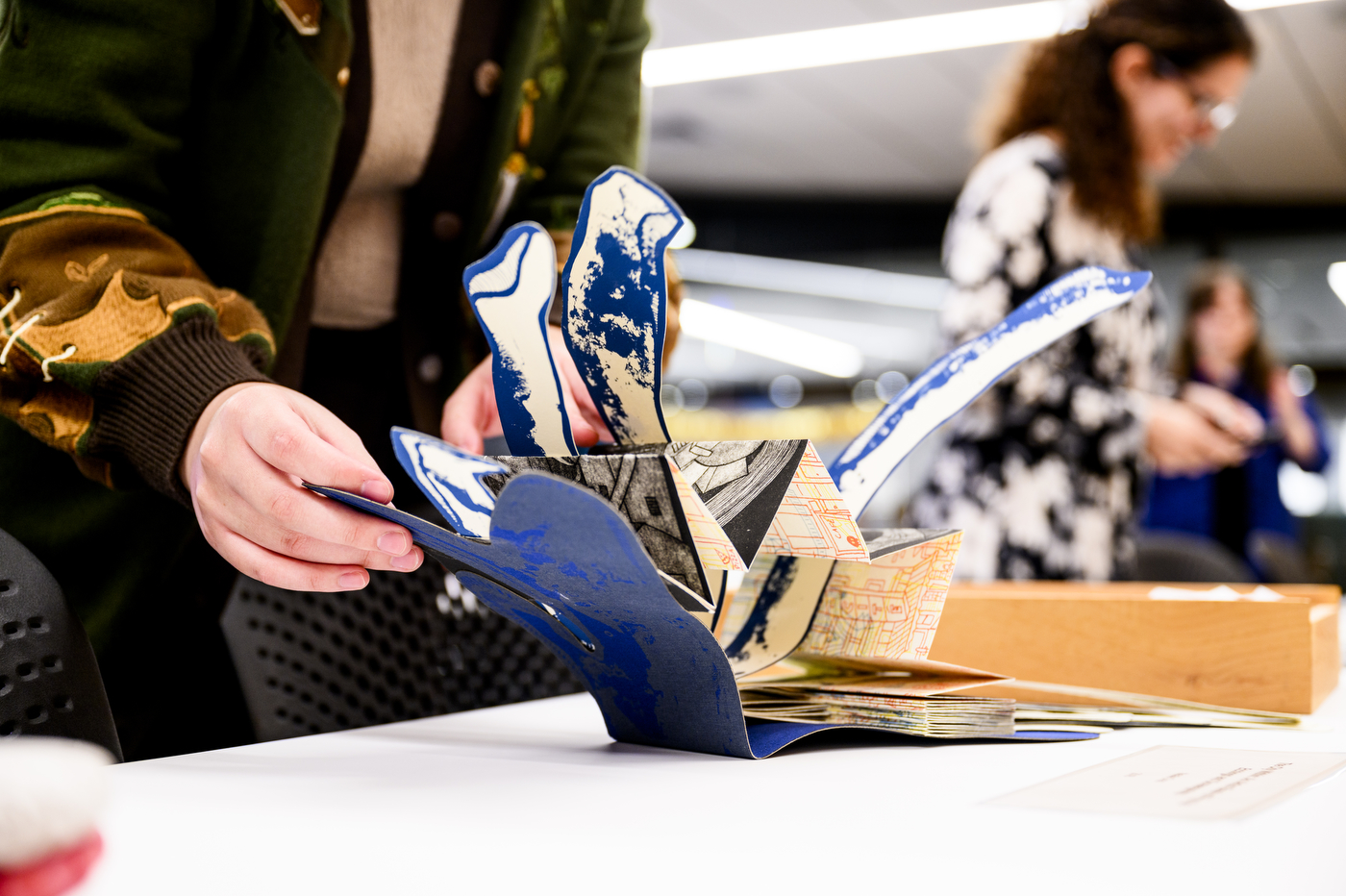
Tucked away in the F.W. Olin Library on the Oakland campus is one such experience, a quiet sanctuary filled with more than 6,500 artists’ books curated by archives and manuscripts librarian Rebecca Leung. These art pieces use the form and function of books as inspiration, but seek to challenge the structure and content of traditional books with experimental designs.
Professors of the arts and sciences alike across Northeastern’s Oakland and Boston campuses are now using these artists’ books to educate students on the value of tactile learning, wild creativity and the slow and silent process of observing a piece of art. Just as Bacon contended in the 1600s, the professors say doing so provides students a scholarly and personal fullness, helping them to tap into their artistic selves and, thus, immunize them from an impersonal, AI-dominated future.
“Physicality and interaction with real objects is the way our brains have been wired for millions of years,” said Yulia Pinkusevich, professor in the College of Arts, Media and Design on the Oakland campus and an award-winning visual artist. “Digital technologies have existed for a number of decades. It doesn’t mean that our brains have caught up.”
What makes artists’ books exciting is how difficult they are to narrowly define, said Regina Pagani, librarian at the Snell Library on the Boston campus, which holds around 70 artists’ books.
Artists’ books can rely on traditional printing and bookbinding techniques, using images, illustrations and text to convey ideas. But these pieces can also be made with fabric and wood, spring outward in complex origami shapes, be stained with river mud and end up the size of a dining table or deck of cards. Picking up and investigating the book is central to the experience, Leung said, just as one would pore over an ancient relic or alien artifact. Artists themselves have treated books as art objects since the mid-20th century, according to the Smithsonian Institution, using their covers, bindings, text and images as inspiration to create interactive experiences that ask readers to explore their pages with curiosity and touch.
Like any art medium, the themes of artists’ books are limitless. Many deal with matters of science, Pagani said, attracting professors who use them as novel teaching tools.
For instance, students in an Advanced Writing in the Technical Professions class – part of the engineering and computer science curricula – visited the Boston collection to explore the ways creative storytelling can be used to communicate scientific research topics, Pagani said. In Oakland, architecture students examined the books’ physical structures to learn about construction and balance, Leung added. Pinkusevich brought her Abstract Drawing class to interact with the Oakland collection’s pop-up artists’ books, many of which spoke to ideas of astronomy, she said. One was made entirely out of sheet metal, and bridged history, art, geometry and science through creative etchings of celestial bodies.
Interactive design professor Larissa Erin Greer, meanwhile, tasked her Interaction Design students with creating their own artists’ books, several of whom went beyond the assignment to create stunning works of art, she said.
One student made “Flower Zine,” a delicate piece of folded, intertwined paper that, when undone, sways like flower petals being blown by the wind. Another made a piece of album art with liner notes to support his grunge music album, which he also produced on the Oakland campus. And a business student designed “Little Black Dress,” a booklet that analyzes the topic of the male gaze in the fashion industry.
Pagani said she offers interested students across Northeastern’s global campus network to act as “their hands” and explore the artists’ book collection at their own pace over video.
Editor’s Picks #
Next month, Leung will debut a small exhibit outside the Oakland special collections wing, displaying four new artists’ book arrivals. These include “Fictionary #2,” a single-edition piece by California artist Lisa Kokin made of thick fabric and complex threading that appears like handwritten text. Also on display will be “Common Rocks and Other Problems” by Ellen Knudson, whose pages cascade downward like a waterfall and include spinning, paper elements that show the effects of seismic faults.
“Everybody is inspired in different ways, somebody studying science might see something that’s not explicitly science and it can still spark that inspiration,” Leung said. “Sometimes we have these happy little accidents where we stumble upon something that brightens their day.”
Greer, who previously worked at Meta in design, content and art roles, said she hoped students understand that coming up with truly creative ideas is a skill that AI does not possess. Irrigating this exclusively human ability, even if they pursue careers in tech or science, is their ticket to a prosperous future, she said.
“The more AI and digital technologies are integrated into our everyday lives, the more I feel that working with analog means is critical,” Pinkusevich added. “It’s vital for our happiness as a species, and it makes me realize how critical something like a drawing practice is to a developing mind.”