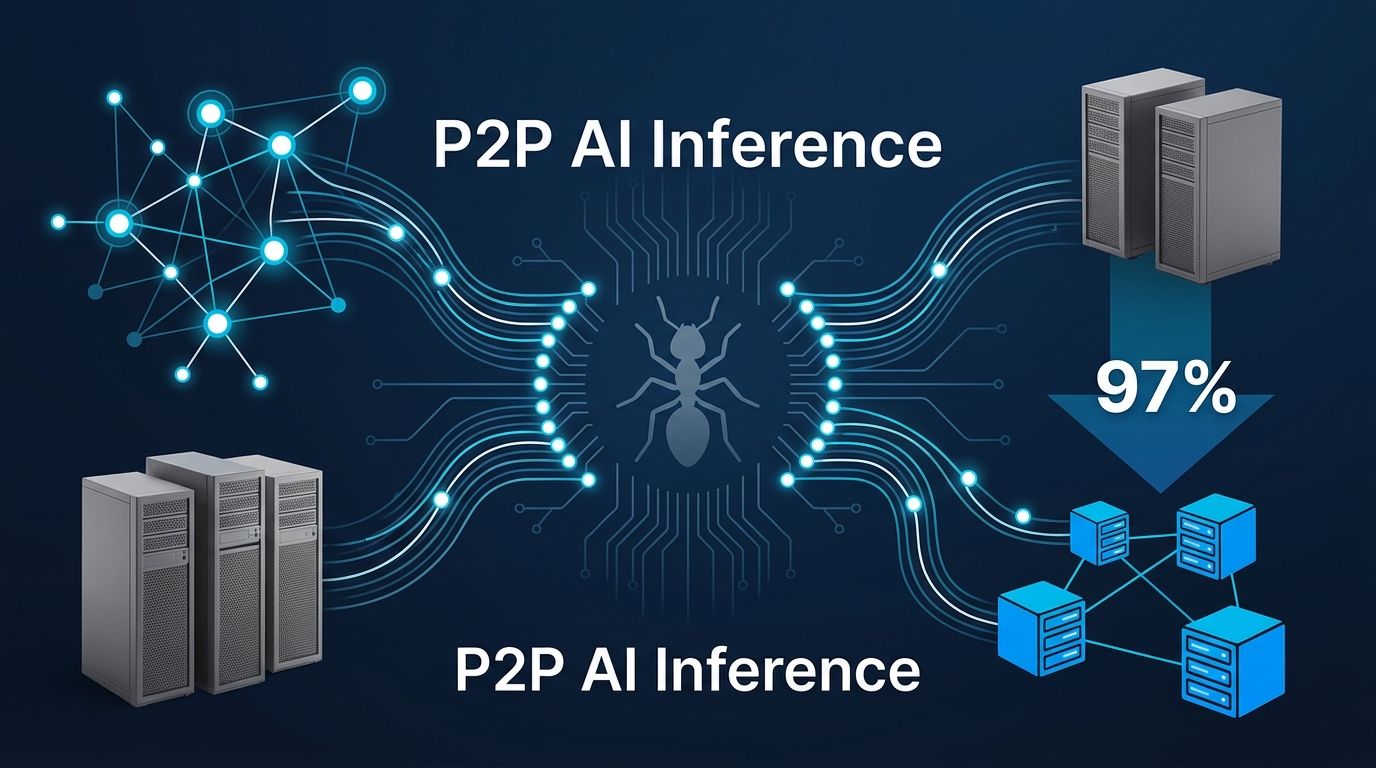
A peer-to-peer protocol called Antseed launched today that routes AI inference requests directly between buyers and providers — no aggregator, no account, and no API key required from any central platform. Developers can access frontier models at prices up to 97% below official rates, with payments settled per request in USDC. The network already has 202 active providers and has processed nearly 150 billion tokens.
How It Works #
Antseed replaces the centralized aggregator model with a peer-to-peer stack: BitTorrent DHT handles provider discovery, WebRTC carries encrypted connections between buyer and provider, and USDC on Base settles payments directly to the provider’s wallet the moment a request completes. Your identity on the network is a cryptographic keypair generated on your machine — no name, no email, no card on file.
When you run the local proxy, it discovers providers, scores them on price, latency, and reputation, then forwards your request through an encrypted peer-to-peer connection. From your application’s perspective, it looks like any other API endpoint.
Three Commands to Get Started #
Setup is deliberately minimal:
npm install -g @antseed/cli
antseed buyer start
curl localhost:8377/v1/models
The proxy runs at localhost:8377 and speaks both OpenAI and Anthropic API formats. Any tool that accepts a custom base URL — Claude Code, Codex, Cursor, or a plain curl call — can point at it without code changes. Deposit USDC using antseed buyer deposit <amount>, pick a model, and you’re sending requests through the P2P network.
The Cost Math #
The 97% figure is aggressive but the network stats support the direction: roughly $285,000 settled across 150 billion tokens works out to about $1.90 per million tokens on average — well below what OpenAI or Anthropic charge for their flagship models. Providers compete directly on price with no intermediary markup. Compare that to OpenRouter, which raised $113M in May 2026 on a model that still charges a 5.5% credit card fee on top of provider rates.
For high-volume dev workloads — eval pipelines, test suites, bulk summarization — the savings compound quickly. For production workloads with sensitive data, the calculus changes, which brings us to the catch.
The Trust Question #
Antseed’s terms of service are unusually blunt: the protocol does not vet providers, does not know what prompts are exchanged, and makes no guarantees that providers aren’t logging requests. Providers are independent, anonymous peers. That’s the trade-off for removing the intermediary.
The mitigation is TEE-secured environments. Antseed’s router scores providers on whether they run in a Trusted Execution Environment, which provides hardware-level encryption that keeps prompts and outputs inaccessible even to the provider running the hardware. For sensitive workloads, filter for TEE providers. For dev, eval, and non-sensitive inference, the risk profile is comparable to any third-party API.
New Category, Not Just a Cheaper OpenRouter #
Antseed is not Akash Network or io.net — those are GPU marketplaces for renting raw compute. Antseed operates at the inference API layer: you send model requests, you get responses, you pay per token. The P2P architecture means providers can join without a listing review and models can’t be de-listed by a platform decision. For developers who’ve watched aggregators change terms mid-sprint or quietly drop a model they depended on, that’s the real value proposition.
The open-source protocol is backed by a $2.4M token raise from Spark Capital — the same fund that backed Anthropic early — with participation from Venice.ai. The foundation structure signals long-term protocol ambition rather than a typical SaaS exit path.
The network is live. With 202 active sellers, a three-command setup, and no account friction, it’s worth running antseed buyer start today and checking what the P2P market is actually offering on the models you’re already using.