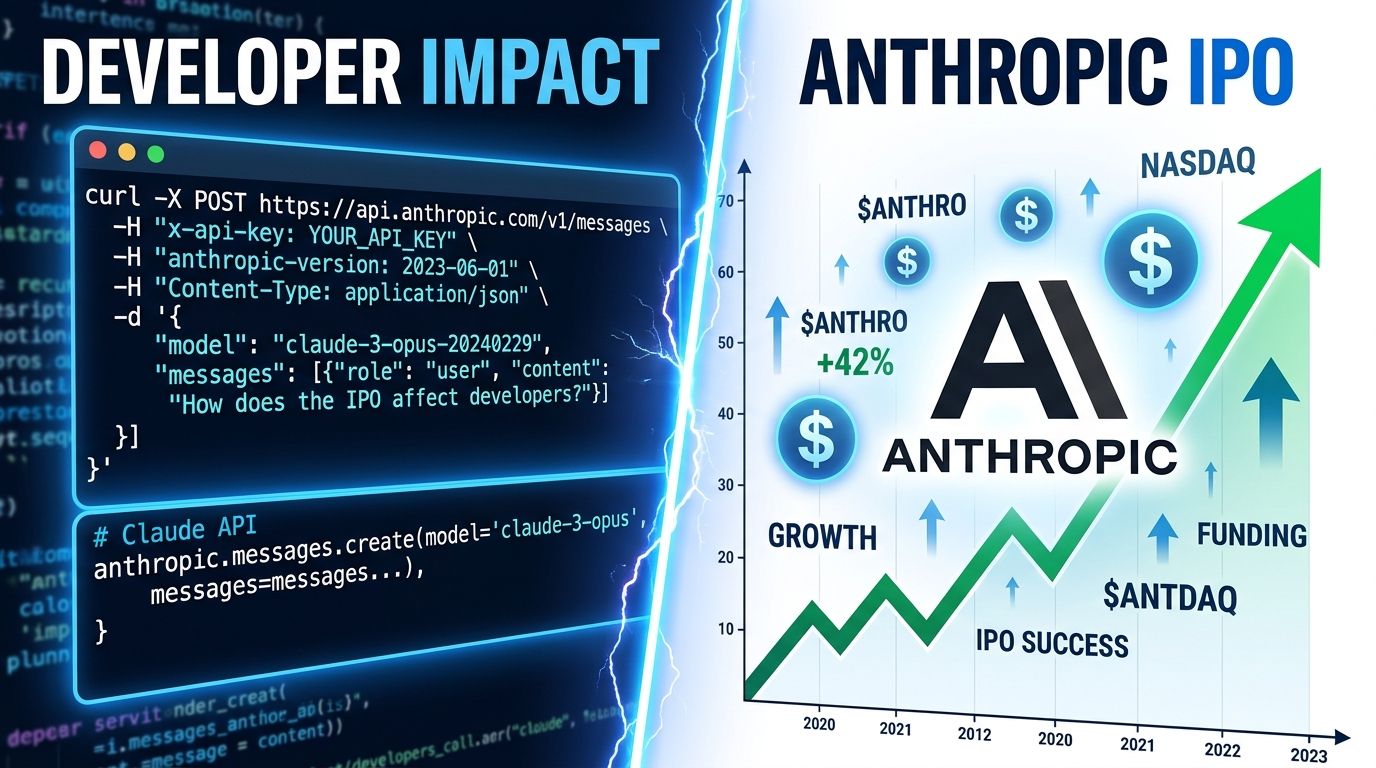
Anthropic is expected to publicly file its S-1 prospectus with the SEC this week, placing an October Nasdaq debut on track that would become the largest IPO in history. The company has hit $65 billion in annualized revenue and is growing at 800% year-over-year, targeting a $2 trillion valuation. For developers building on the Claude API, Claude Code, or any Anthropic-backed toolchain, this is not financial news. It is a structural change to the platform you may have quietly built a dependency on.
Anthropic’s Revealed Behavior #
Before debating what Anthropic might do post-IPO, consider what it has already done. In June 2025, Anthropic cut Claude access to Windsurf users when rumors surfaced that OpenAI was acquiring the startup. Co-founder Jared Kaplan explained it plainly: “I think it would be odd for us to be selling Claude to OpenAI.” The acquisition fell through, access was restored weeks later — but the precedent was set. Your Claude dependency can be revoked for a deal you had no part in.
Two months later, Anthropic revoked OpenAI’s API access entirely, citing a terms of service violation: OpenAI engineers had been using Claude Code to benchmark GPT-5. In April 2026, Anthropic cut Pro and Max subscription access for third-party frameworks like OpenClaw, pushing those users to pay-as-you-go billing. Then in June 2026 — as IPO preparation was underway — Claude Agent SDK usage was carved out of standard subscription limits into a separate credits layer. These are not random policy tweaks. They are a consistent pattern of moving developer access toward metered billing.
The Pricing Math Is About to Change #
Anthropic’s current API pricing is a land-grab. Haiku 4.5 runs at $1 per million input tokens and $5 per million output. Sonnet 5 is at $2/$10 — but that promotional rate expires August 31. Fable 5 debuted at $10/$50, double the Opus 5 rate. A private company at $65 billion ARR can absorb pricing designed to win market share. A public company reporting to shareholders quarterly cannot, at least not indefinitely.
The critical exposure for most developers is structural: annual enterprise agreements lock rates for a contract term. Pay-as-you-go monthly API users have no contractual protection against repricing. As one analysis put it, “a public company defending roughly 40% gross margins has more pressure to reprice usage-based tiers than a private one.” The lock-in window — the period when early investors and insiders watch the share price most closely — is precisely when the incentive to reprice is highest.
What the S-1 Will Confirm #
Anthropic’s public filing will formalize risks that developers currently treat as vague concerns. According to CNBC reporting from August 21, “AI backlash” will appear as an explicit risk factor in the prospectus. Anthropic runs exclusively on Google TPU infrastructure — single-vendor compute that is a disclosed API reliability risk. Open-source models (Qwen, Gemma, Llama) are named as margin-pressure competitors. These are not speculative concerns. They will be legally disclosed material risks.
For developers, the S-1 is worth reading when it drops. Not for the valuation spectacle — but for what Anthropic itself says about platform durability, API access continuity, and the competitive dynamics it finds threatening. Public filings have a legal obligation to be honest about risks in ways that corporate blog posts do not.
Four Actions to Take Before October #
None of these require abandoning Claude. They require not being caught by surprise.
Abstract the provider layer. Route Claude calls through a config-based adapter so any provider swap is a toggle, not a rebuild. OpenRouter (now Stripe-owned), AWS Bedrock, and Google Vertex AI all offer Claude model access with better contractual terms than direct API usage.Pin to capability tiers, not model SKUs. Build your application logic against “cheap/mechanical,” “judgment,” and “frontier” capability categories. Hardcoding “Sonnet 5” means you inherit Anthropic’s deprecation schedule as an engineering emergency.Benchmark a fallback model now. Run production-representative workloads against GPT-5.6, Gemini 3.7 Flash, or an open-weight model while your quality baseline is fresh. Don’t do this for the first time after a pricing shock.Negotiate annual pricing before October. If your usage volume justifies it, an annual enterprise agreement negotiated before the IPO locks pre-public-market rates for 12 months. That window is closing.
The platform risk is not hypothetical — it is the same risk that Windsurf users experienced in June 2025, that OpenClaw users hit in April 2026, and that anyone on a monthly API plan faces every time Anthropic reprices a tier. An IPO adds shareholders to the audience for those decisions. That changes the frequency and magnitude of the decisions, not the underlying dynamic.
Key Takeaways #
- Anthropic’s public S-1 filing is expected this week; an October Nasdaq listing puts pricing and access decisions under quarterly shareholder scrutiny for the first time.
- The access restriction track record — Windsurf (June 2025), OpenAI (August 2025), third-party frameworks (April 2026) — is Anthropic’s revealed behavior, not hypothetical risk.
- Pay-as-you-go API users have zero contractual pricing protection; the Sonnet 5 promotional rate ends August 31 — this Sunday.
- Abstract your provider dependency, benchmark a fallback, and evaluate annual agreements before the October lock-in window closes.
- Read the S-1 when it files — legally disclosed risk factors are more honest than any corporate blog post.