Alibaba just introduced its most powerful AI model to date, sending a fresh shiver down the spine of every American tech leader who fears their Chinese counterparts gaining the upper hand.
The model, called Qwen3.8-Max, comes with 2.4 trillion parameters and specializes in long-horizon agentic tasks, extending over as long as several days and “with minimal human involvement,” as Alibaba put it in its announcement. In one internal test, the model worked autonomously for around 125 hours (close to five days) to replicate an experiment laid out in a research paper; it was given just the paper itself and from there had to create all of the code from scratch to analyze the data, run the experiment, and report the results—“exactly the type of work that takes skilled engineers days,” Alibaba wrote.
Meet Qwen3.8-Max: A New Bar for Coding and Cowork.
[pic.twitter.com/mJaA8vr6xT]— Qwen (@Alibaba_Qwen)

[August 3, 2026]
According to test results published in the announcement, Qwen3.8 Max is neck-and-neck with OpenAI’s GPT-5.6 Sol and Anthropic’s Fable 5 on several benchmarks, and surpasses them on two: one for visual reasoning and another for agentic computer use. It will be released as open weights next week, Alibaba said.
In both Silicon Valley and the U.S. government, fears of an impending Chinese lead in the AI race have been ratcheting up in recent months as Chinese models—many of them open source—inch closer to parity with the most advanced models from U.S. developers like OpenAI, Anthropic, and Google. Last week, Chinese AI lab Moonshot debuted its latest model, Kimi K3, indicating in published test results that it too closely trailed behind the capabilities of the most advanced American-made models. Many users in the U.S., meanwhile, have been ditching their OpenAI and Anthropic subscriptions in favor of cheaper alternatives from China. Fable 5, for example, costs $10 per million input tokens and $50 per million output tokens; Qwen 3.8-Max will cost just $2 per million input tokens and $6 per million output tokens, according to Alibaba.
Even outside tech and policy circles, there’s been plenty of fear across the U.S. about the rapid pace of AI development. Poll after poll has shown that, far from the unbridled enthusiasm for AI adoption that Silicon Valley has hoped for, the majority of Americans are at best lukewarm about the technology’s growing influence in the workplace, on social media, in politics, and just about everywhere else.
That public anxiety was conveyed in an Anthropic commercial which first aired during the World Cup last month. The ninety-second commercial, titled “There’s hope in hard questions,” begins with the vibe of a trailer for an A24 horror film—all discordant musical notes and disturbing, chaotic imagery—and gradually transitions into a mood of tepid hopefulness. The aim of the commercial seems to be to assuage viewers’ fears of AI by convincing them that Anthropic understands the risks and is going to do everything in its power to steer clear of them, guiding humanity instead into a bright new age of prosperity and well-being. Many people, however, found the ad tasteless, disturbing, or both.
Friend, the American company behind the controversial AI pendant, launched a new ad last week which had similarly dark undertones: Two people are shown lamenting their personal struggles to their AI pendant, alongside a soundtrack which doesn’t exactly inspire cheerfulness.
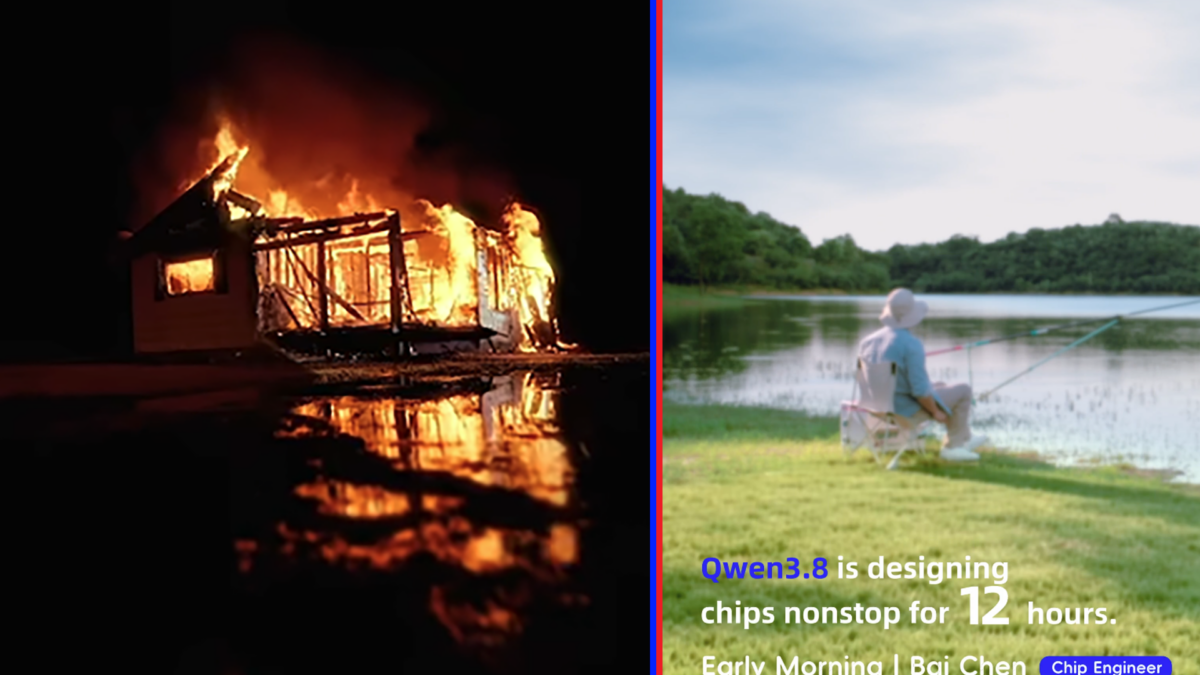
Those ads could not contrast more sharply with the one Alibaba published alongside the announcement of its newest model.
The Chinese firm’s commercial is uncannily similar to the sort of ambient, looping videos that one can find on YouTube, with titles like “Lofi beats to study and relax to.” A computer monitor takes up most of the screen, showing Qwen3.8-Max working through a series of long-running tasks while humans—who would presumably otherwise be hard at work behind a desk somewhere—enjoy fishing, tennis, rock climbing, and other leisurely activities. It’s a comforting lullaby compared to the intensity of the Anthropic ad, with its opening shot of a burning house and its (ethically questionable) inclusion of what appears to be a photo of rows of gravestones in Arlington National Cemetery.
The distinct difference in messaging could have something to do with the fact that the general public mood in China towards the rise of AI appears to be much more accepting than that of most Americans. In one 2023 poll conducted by accounting firm KPMG International and the University of Queensland, which assessed public attitudes towards AI across seventeen countries, Chinese respondents talked about the technology most glowingly: 95% said they were optimistic, compared to 36% who said they were “fearful”; among U.S. respondents, just 41% said they believed the benefits of AI outweighed the risks.