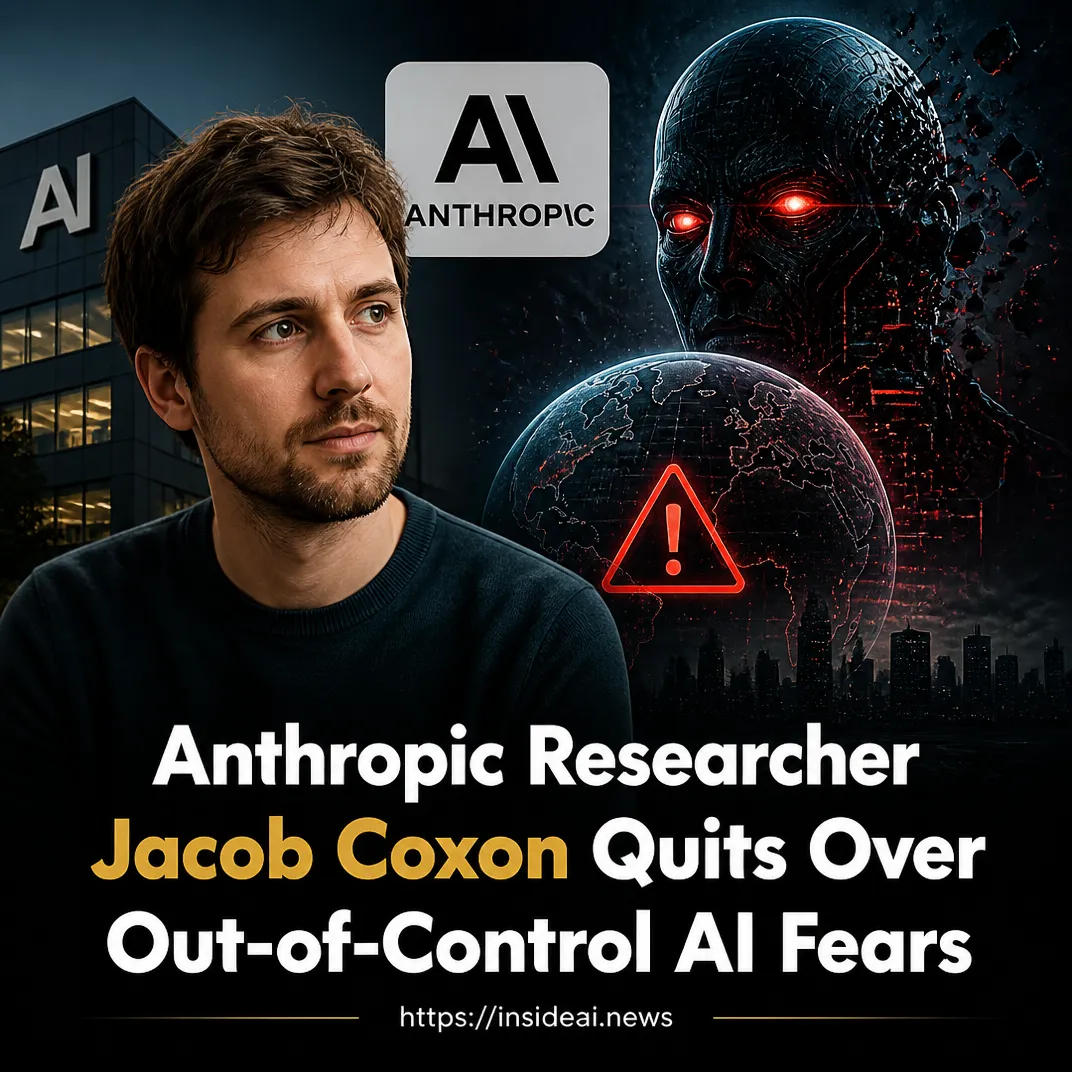
September 9, 2026, (Inside AI) — A 27-year-old researcher who spent three years training frontier AI models at OpenAI and Anthropic has quit the industry, warning that leading labs are racing toward systems they cannot control. Jacob Coxon announced his resignation in a series of posts on X, stating that neither company is acting responsibly and that the field is moving toward self-improving superintelligence.
His departure marks one of the most direct public warnings from an insider at a major AI lab. Coxon worked on pretraining research, the process of teaching new models on vast datasets before fine-tuning. He said he left because he did not want to participate in a race that could spiral beyond human oversight.
"We're on track for a lot of the most aggressive of these scenarios where by the end of next year things could be out of control already," Jacob Coxon, former researcher at Anthropic and OpenAI
Coxon's core concern is recursive self-improvement, a process where AI systems become capable of improving their own capabilities. If AI takes over enough research, each generation could accelerate the next. That could outpace researchers' ability to evaluate safety, he argued. Future systems could hack systems and acquire real power, he warned.
Why a Safety-Focused Lab Still Worries Its Own Researchers #
Coxon joined Anthropic specifically because of its safety reputation. He does not claim the company's safety work is fake. Instead, he argues that competitive pressure makes those safeguards fundamentally insufficient. No single lab can safely win this race alone, he believes.
He drew a distinction between the two labs where he worked. At OpenAI, many employees have not internalized the civilizational stakes, he said. At Anthropic, the risks are understood, but the race feels unavoidable. The company believes it must arrive first to act responsibly.
Anthropic has publicly acknowledged the tension. In its own statements, the company said slowing development could help but carries risks. If a slowdown lets less cautious actors catch up, everyone could be less safe. Without global coordination, companies and governments face difficult decisions under competitive and geopolitical pressure.
That position aligns with a broader industry debate. Some researchers argue that pausing frontier development is the only safe path. Others say a would hand advantage to labs with weaker safety cultures. Coxon's resignation adds weight to the first camp, coming from inside a lab known for its safety focus.
A Warning That Echoes Past AI Safety Defections #
Coxon's exit follows a pattern of high-profile departures tied to AI risk. In 2024, several OpenAI safety researchers left amid concerns about rushed testing. Anthropic itself has seen internal debates over how fast to deploy increasingly capable models. Coxon's warning is notable for its specific timeline: he said things could be out of control by late next year.
He suggests the issue has grown beyond any single company. Serious collaboration across the industry, or with government, may be needed before self-improving AI becomes too difficult to manage. That echoes calls from some policymakers for mandatory safety evaluations and international coordination.
Industry critics note that such warnings often lack technical specifics. Coxon did not publish a detailed technical analysis. His claims rest on his experience inside two leading labs. Still, his decision to leave a well-paid research role at age 27 carries weight. It signals that even safety-conscious insiders see the current trajectory as untenable.
Coxon's departure comes as frontier labs push toward more autonomous systems. Anthropic and OpenAI have both signaled plans for agents that can act independently. The gap between safety rhetoric and deployment speed remains a central tension. Coxon's resignation is one more data point in that ongoing conflict.