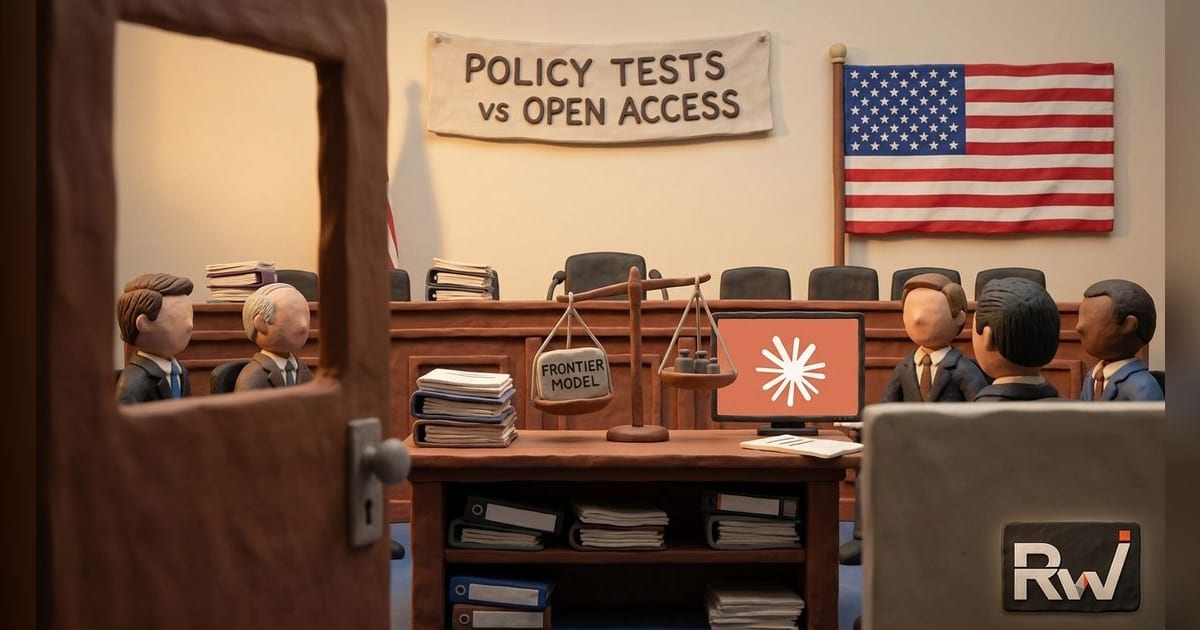
Dario Amodei used a July 27 Anthropic policy post to reject calls for a categorical ban on open-weight AI models while defending tighter controls on the chips, training methods and high-risk capabilities that shape the frontier.
Anthropic on X "Anthropic has never advocated for a ban on open-weights models," Amodei wrote. He called models without dangerous capabilities "a public good" for developers, researchers and businesses, and said restrictions on their use by American companies would fail to address the national security threats that concern him.
The statement puts Amodei himself at the center of a policy fight that had begun to cast Anthropic's safety agenda as a commercial defense strategy. A physicist and biophysicist who worked at Google Brain and became OpenAI's vice president of research before co-founding Anthropic, Amodei has built Anthropic around the premise that safety controls must advance alongside model capabilities. His July 27th post draws a harder boundary around that premise: distribution format alone should not decide which models face restrictions.
"It would protect US AI companies from competition, but that has never been my goal," Amodei wrote of a ban targeting use by American businesses. The concession matters because Anthropic sells access to closed frontier models and has a direct financial interest in how policymakers treat downloadable competitors.
A protectionism charge forces a clearer answer
The statement followed a week of pressure from Washington and the technology industry. Axios reported on July 20th that US officials had considered measures that could discourage or block American companies from using Chinese open-weight models. White House AI adviser David Sacks accused leading closed-model developers of seeking government protection from cheaper competitors.
On July 24th, many tech companies published an industry letter supporting open weights. The signatories argued that downloadable models expand access, reduce dependence on a small group of providers and let customers run AI on their own infrastructure. They also warned policymakers against treating legitimate model distillation as misappropriation.
Anthropic issued its own answer instead. Amodei agreed that open weights can widen access, improve customer control and strengthen competition in some markets. He rejected the letter's broader claim that openness necessarily improves safety by giving more defenders and researchers access to a model.
That disagreement reaches the most difficult part of the open-weights debate. A model owner can update safeguards, monitor usage or revoke access to a hosted system. Once weights are released, modified copies can circulate beyond the original developer's control. Amodei argues that the risks should be measured through capability testing rather than inferred from an open or closed label.
Amodei wants policy aimed at capability and compute
Amodei laid out three priorities. The United States should restrict exports and smuggling of advanced chips and chipmaking equipment to China, deter industrial-scale extraction of capabilities from American models, and require sufficiently capable models to pass safety tests before release, whether their weights are open or closed.
The anti-distillation plank follows Anthropic's report on detecting and preventing distillation attacks. Amodei distinguishes industrial campaigns from ordinary distillation, a common method for training smaller models with outputs from stronger systems. His concern is scale, unauthorized access and the transfer of frontier capabilities to labs operating beyond US controls. The policy target, in his formulation, is capability extraction rather than the later decision to publish weights.
He also endorsed mandatory testing for cyber, biological and alignment risks once a model crosses a capability threshold. Amodei pointed to a proposal from Demis Hassabis as one possible industry model for applying testing to the most capable systems regardless of country of origin or release format, while exempting less capable models.
The threshold will determine whether that system restrains only the largest labs or becomes a costly barrier for emerging competitors. That makes threshold-setting the core fight: narrow enough to avoid trapping startups and academics, but broad enough to cover models that present serious cyber, biological or alignment risks.
Anthropic's commercial position raises the stakes
Anthropic's policy influence has grown alongside its balance sheet. On May 28th, Anthropic said it raised a $65 billion Series H at a $965 billion post-money valuation, led by Altimeter Capital, Dragoneer, Greenoaks and Sequoia Capital. Anthropic also said run-rate revenue had crossed $47 billion earlier that month. RuntimeWire previously examined how Amodei's round concentrated the 2026 startup funding market.
Those numbers make the protectionism criticism unavoidable. Anthropic has the capital, compute commitments and customer base to absorb compliance costs that would strain smaller developers. Closed access also lets Anthropic charge for usage and enforce its policies at the account level.
Amodei addressed that tension directly instead of claiming Anthropic has no stake in the outcome. His position leaves room for open-weight models across most commercial and research uses while seeking controls around models capable of serious cyber or biological harm. It also preserves Anthropic's longstanding argument that frontier development requires oversight, even when the developer plans to release weights publicly.
Anthropic still keeps Claude's frontier weights closed, and the July 27th statement does not commit Anthropic to an open release. It does narrow the policy argument. Amodei is asking Washington to regulate measurable capability, compute access and abusive extraction rather than treating every downloadable model as the same security problem.