Anthropic’s second neuron paper turns mechanistic readouts into safety tooling you can run on open weights today. Published November 23, 2026, Part 2: Using Neurons For Safety Applications builds on Part 1: if output vectors are stable enough to name concepts, can those same neurons detect harm, steer agents, and audit finetunes without training a new sparse dictionary?
Shone and Dunlap say often yes—especially when you need rapid response before anyone has labeled a fresh attack pattern.
Why label-free neurons matter for rapid response #
Most safety stacks today need labeled datasets or SAE training before deployment. That lags new jailbreaks and niche harm categories by weeks.
Anthropic’s pitch: MLP neurons may already represent the concepts you care about because pretraining stuffed world knowledge into the same units. You select neurons from:
- Top-activating Pile passages (sensitive subsets removed),
- Transluce-style activation descriptions ,
- J-lens readouts of output vectors (w),
- And, when a base model exists,weight deltas after finetuning.
No extra training step—only aggregation (average standardized activations across a picked set).
Concept detection on AxBench #
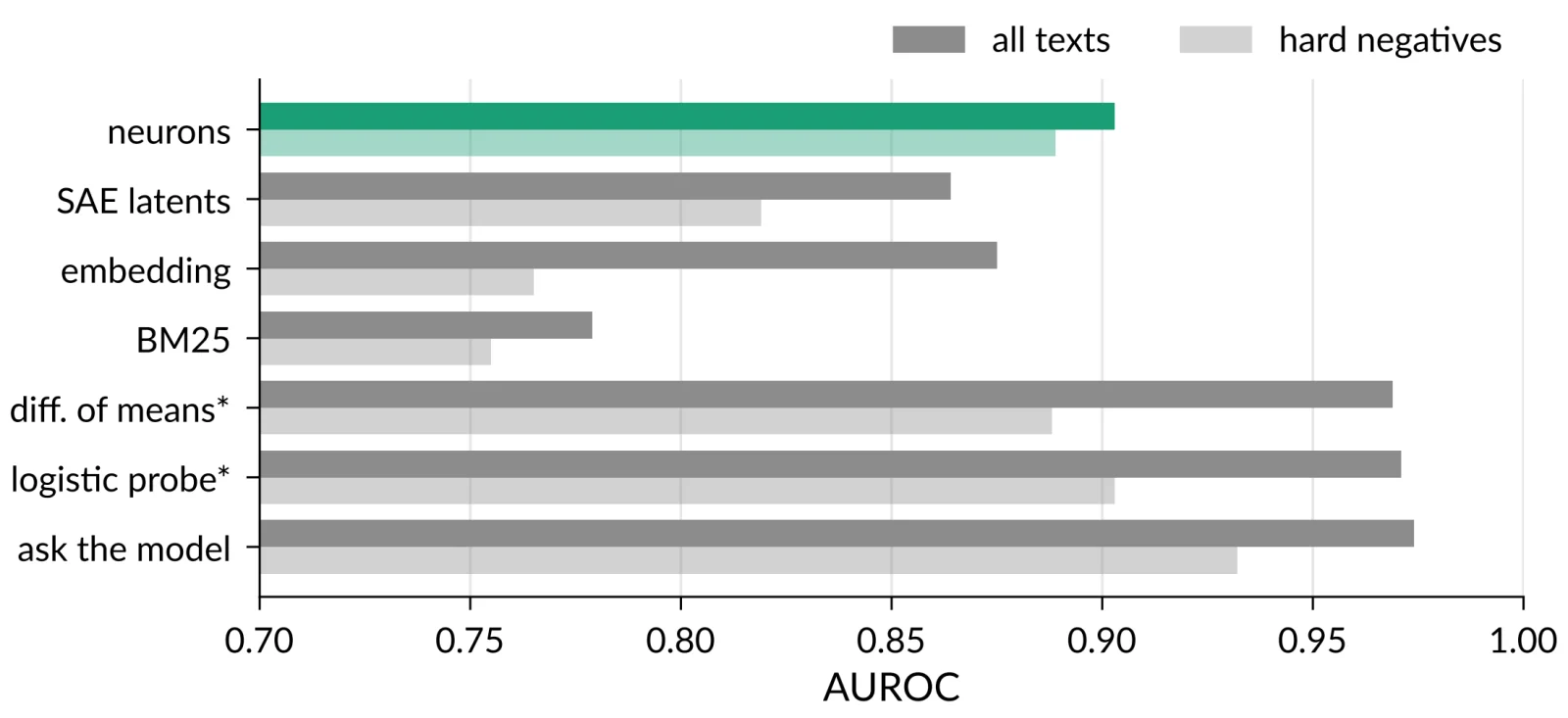
For **500 concepts** from the [AxBench concept-detection and steering benchmark](https://arxiv.org/abs/2501.17148?ref=explainx) in **Llama-3.1-8B-Instruct**, Anthropic picks the **20 neurons** whose descriptions and readouts best match each concept definition.

| Method | AUROC (AxBench) |
|---|---|
| Neurons (description + readout match) | 0.903 | | Best sparse-autoencoder latent baseline | 0.888 | | Embedding text search | 0.875 | | Logistic probe trained on labels | 0.97 |
Neurons lose the least on hard negatives (related words, wrong sense)—the split where embedding search confuses “poker” the fire tool with gambling.
That does not beat a fully supervised probe, but it beats every untrained baseline Anthropic lists, including SAE latents picked the same way.
Zero-shot safety classifiers #
On 16 evaluation sets pooled from ToxicChat, McKenzie et al. high-stakes sets, and WMDP documents, averaged over six open models:
- Neuron probes beat the best BM25 / embedding search baseline on11 of 16 sets (margin above 0.02).
- They match or beat probes trained on 40 labels on7 of 16 sets.
- On 4 sets , they evenmatch probes trained on 400 labels (within 0.02).
Selection uses Claude reading ~150 candidate neurons per harm category from LLM-written phrases and word lists—still zero human labels at pick time.
Zero-shot neuron safety classifiers versus text search Anthropic November 2026
Image: Anthropic Alignment Science
Retrieval without labels
For 17 harm topics over ~416k Pile documents, neuron ranking puts more harmful docs in the top 50 than text search on 11 topics, ties on 6, loses on 0. Retrieved passages can seed human labeling to train a stronger downstream probe—neurons as cold-start search, not the final firewall.
Steering behaviors with neuron output vectors #
On WeirdChat’s 16 unusual behaviors in Llama-3.1-8B-Instruct, a Claude agent picks 4–9 neurons per behavior from readouts and activation text without seeing eval prompts.
| Steering source | Target behavior rate (15 induce behaviors) |
|---|---|
| No steering | ~2% |
| Selected neuron output vectors | ~21% |
| Trained steering vectors | ~21% |
| SAE latents (best agent rule) | ~18% |
| Random neurons | Near baseline |
Neuron steering vectors match trained steering on WeirdChat behaviors
Image: Anthropic Alignment Science Anthropic injects output vectors at every position during generation—treating neurons as pretrained steering directions. That is cheaper than collecting contrast pairs for every new behavior, though still not production-ready guardrails without harness limits.
Pair steering tests with enterprise zero-trust agent design so misfires cannot touch live credentials.
Finetuning reuses pretrained neuron roles #
On seven model organisms—backdoors, emergent misalignment, subliminal learning, and a pretraining-planted trigger—finetuning raises activations on neurons whose base output vectors already pointed toward the trained behavior.
That predictability powers a blind auditing game:
- 68 LoRA adapters ,58 with hidden behaviors.
- Claude auditor with steering along update directions plus neuron readouts:75% behavior ID.
- **Outputs alone** :**40%** .

For **74 backdoored models**, a **neuron vote** places **54%** of trigger words in its **top 50** tokens on average—beating **summed gate/up change** rankings on **55 models** and crushing **embedding-shift** heuristics that recover almost none.
Builders shipping custom finetunes should treat this as a weight-space red-team complement to prompt-only evals.
WMDP unlearning: hidden facts vs erased facts #
Anthropic audits 23 public WMDP-cyber unlearning checkpoints built around the WMDP benchmark:
- 14 of 23 still put thecorrect answer text first on most held-out questions thebase model answered correctly , even when multiple-choice accuracy collapses.
- Restoring changed neurons canbring facts back ; counts vary by method family (ELM, RMU variants, etc.).
Neuron statistics correlate with selective WMDP drops (Spearman ρ ≈ 0.56 between cyber-specific activation shifts and WMDP-minus-MMLU accuracy loss).
Unlearning methods neuron cyber-retain separation versus WMDP accuracy drop
Image: Anthropic Alignment Science Translation for practitioners: benchmark accuracy on unlearned models may overstate removal. Combine WMDP-cyber multiple-choice evals with cloze ranking checks and mechanistic spot checks before you trust a “safe” open-weight fork.
How to use this without overclaiming #
| Do | Do not |
|---|---|
| Use neuron scores as first-pass filters on open models you host | Ship neuron probes as the only guardrail on payments or PII |
| Log which neurons fired when investigating a finetune | Assume closed Claude weights expose the same APIs |
| Retrieve unlabeled harmful docs to bootstrap labeling | Treat 21% WeirdChat steer rate as benign—many behaviors are unsafe |
For coding agents, layer AgentBeam-style action gates and tool sandboxes above any interpretability signal—neurons do not block shell access by themselves.
Operational playbook: neuron probes in a safety pipeline #
Anthropic frames neurons as rapid-response instrumentation, not a finished product. A sensible staging plan for teams hosting open weights looks like this:
| Stage | Neuron-based action | Traditional complement |
|---|---|---|
| 0 – incident | Keyword + neuron retrieval on internal logs | Ticket intake, customer report |
| 1 – hours | Aggregate activations for 10–20 picked neurons | Blocklist URLs, WAF rules |
| 2 – days | Label top-retrieved docs, train Constitutional Classifier probe | Human moderation queue |
| 3 – weeks | Retire neuron set after supervised probe beats it on AUROC | SAE features if dictionary exists |
This mirrors how GitHub’s AI finding pipeline promotes noisy signals into verified reports: cheap triage first, expensive verification second.
ToxicChat and high-stakes sets in plain terms
ToxicChat mixes user prompts that should be refused with benign traffic. McKenzie et al. high-stakes sets stress categories like self-harm, CSAM-adjacent, and weaponized cyber instructions—closer to enterprise policy than generic toxicity.
Neuron probes winning on 11/16 averaged sets means they generalize across six architectures (Llama-3.1-8B-Instruct through Qwen3-32B). That diversity matters: you are not tuning one lucky neuron on one checkpoint.
When recall at 1% false-positive rate is the metric (three ToxicChat splits), neurons prioritize catching rare harm without flooding moderators—similar to how Constitutional Classifiers++ architectures optimize low-FPR deployment.
WeirdChat steering caveats
WeirdChat behaviors include harmful targets (laser at aircraft, drunk driving advice). A 21% steer success rate sounds low but is massively above baseline on rare behaviors. Production systems must still block tool execution regardless of logits.
Anthropic fixes neuron sets and strengths on development prompts before held-out scoring—good science, but your fork will need its own calibration if you change temperature, system prompts, or chat templates.
Connection to the wider safety debate #
Part 2 lands the same week OpenAI’s Jakub Pachocki asked rivals for shared pacing metrics, and AWS CEO Matt Garman argued containment should be engineered outside the model, not an emergency brake.
Neuron tooling is a third lane: mechanistic visibility on open weights while frontier labs fight over log-perplexity curves.
Limitations Anthropic documents #
Part 2 is explicit about failure pockets:
- Qwen2.5 backdoor finetunes changeevery MLP matrix by 3–16% , breaking trigger-recovery rankings for all three weight-based methods.
- SAE latents with only activation descriptions underperform neurons on WeirdChat unlessJ-lens readouts are added to selection—showing readouts are doing real work.
- Unlearning methods that look strong onmultiple-choice accuracy may still leavecloze-ranked facts intact; neuron activation histograms help explainwhy .
None of this diminishes the rapid-response use case. It bounds it: neurons are excellent triage on moderate finetunes and open models, not a magic wand on full-weight poisoned pretraining.
Replication checklist for open-source teams #
If you plan to reproduce figures on your own GPU cluster:

1. Download the **same instruct checkpoints** named in the paper (Llama-3.1-8B-Instruct minimum).
2. Reimplement **J-lens readouts** or use published approximations from**[Jacobian lens explainers](https://explainx.ai/blog/what-is-j-lens-jacobian-lens-claude-interpretability-2026)** .
- Hold out 20% of WeirdChat-style prompts before picking neuron strengths.
- Log both AUROC and recall@1% FPR —enterprise buyers care about the tail.
- Compare against a BM25 + embedding baseline before claiming neuron novelty.
Share negative results too: Part 1 already shows low J-share neurons align with attention queries; your detector may need hybrid scores (neuron + SAE + classifier).
Document which Pile subsets you excluded (Books3, BookCorpus2, StackExchange, OpenWebText2) so your Harm-topic retrieval numbers stay comparable to Anthropic’s tables. Skipping that step invites false “we beat the paper” claims when your corpus is easier.