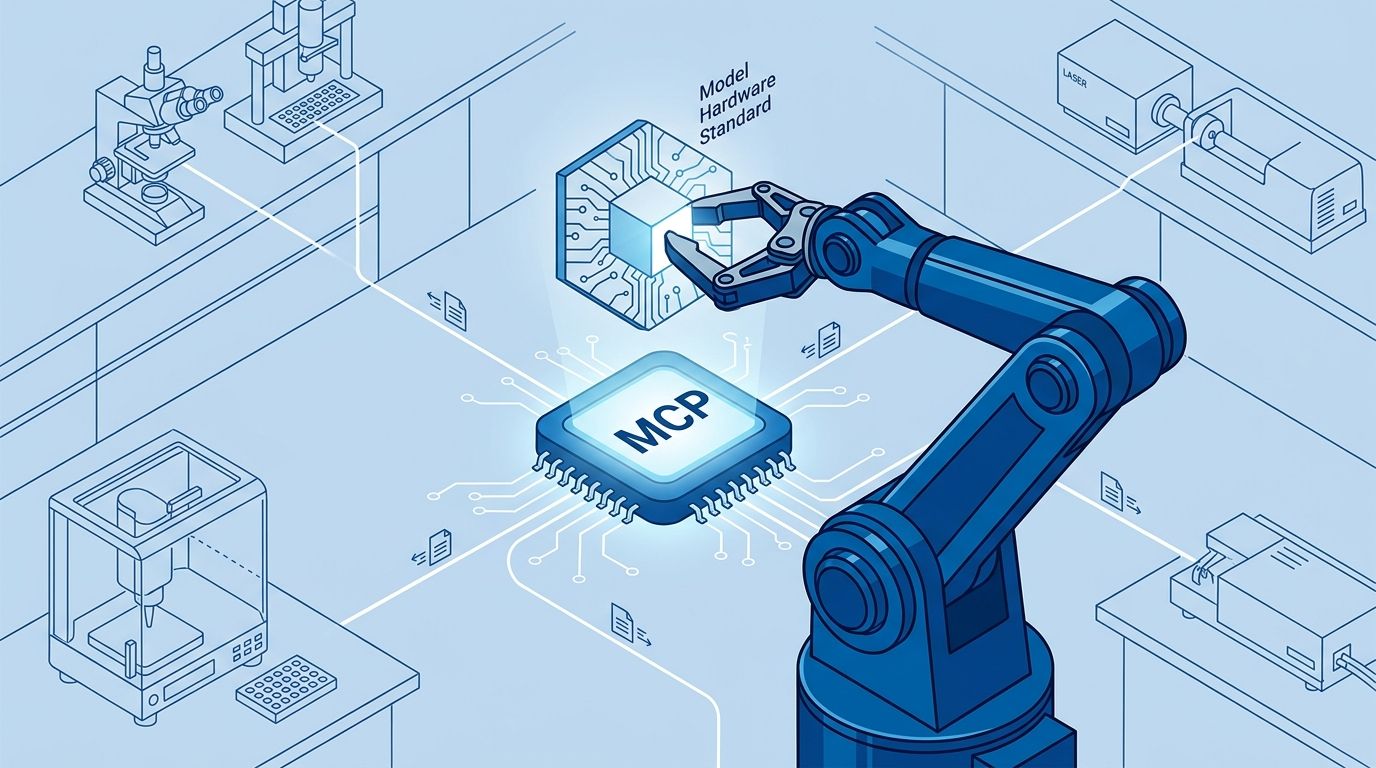
Anthropic shipped a research preview of the Model Hardware Standard (MHS) today, and for the first time, an AI agent can drive a robotic arm, calibrate a laser, or run a protein assay without a team of specialists writing device-specific code for each machine. The company is calling it the “USB moment” for physical AI — and the early partner results make that claim harder to dismiss than most AI lab marketing.
MHS Is MCP for Hardware #
If you already use the Model Context Protocol to connect LLMs to software tools, MHS is the same interface extended to physical devices. The transport layer is identical: MCP handles agent-to-device communication, while MHS adds physical-world primitives — read sensor values, write actuator commands — and safety metadata baked into each device driver: speed limits, weight constraints, emergency-stop conditions. Anthropic’s Alek Kemeny put it plainly: “What MCP did for software, MHS will do for the hardware world.” Three control pathways are available — MCP for agent tool calls, a CLI for direct human control, and code files for deterministic long-running tasks. The promise: go from a device datasheet to a working integration in hours rather than weeks of custom automation work.
The Numbers From Early Partners #
Six research institutions and manufacturers ran actual experiments, and the results hold up under scrutiny:
Carnegie Mellon integrated three incompatible lab instruments in 8 hours versus several weeks for vendor solutions, cut experimental cycle time by roughly 3x, and the system correctly blocked all six induced failure conditions during safety testing.QuEra Computing automated laser frequency recovery on a quantum system: time dropped from 150 seconds to roughly 6 seconds, success rate from 58% to 99.3% across 695 out of 700 blind tests.HHMI Janelia unified seven vendor programs into a single interface; new hardware integration time dropped from multiple days to minutes.University of Washington connected six lab instruments in under a week — replacing months of traditional automation work — and eliminated manual plate swapping every 90 minutes during qPCR runs.
These are institutional research partners — Genentech, Carnegie Mellon, a quantum computing firm — not curated demos. The results are credible.
Anthropic’s Actual Strategic Play #
MHS is explicitly model-agnostic: OpenAI models, open-source LLMs, anything with an MCP client can use it. That is unusual for Anthropic, which typically ships Claude-specific tooling. The company is not framing this as a Claude feature — it is framing it as infrastructure.
The logic is straightforward. If MHS becomes the standard interface for physical devices — the way USB became the standard interface for peripherals — then Anthropic designed the layer that all physical AI runs through, regardless of which model powers it. Developers on Hacker News are not fully convinced: the criticism that landed hardest is that MCP itself ignored years of existing protocol design, and MHS may repeat that pattern by sidestepping ROS 2, the established robot operating system already used in academic and industrial robotics.
Two Complications Worth Watching #
The first is regulatory. Europe’s Machinery Regulation 2023/1230 takes effect January 20, 2027 — the first regulation to govern AI-based safety functions in physical machinery. A specification that constrains a robot arm’s speed and angle is performing a safety function. When Anthropic open-sources MHS, whoever publishes that spec may find they have authored a regulated safety component in EU jurisdictions. The Next Web’s analysis of this angle is worth reading before you build anything MHS-dependent for European deployment.
The second is physical reasoning. Genentech noted that Claude required domain expert guidance for bubble formation physics during fluid pipetting — a phenomenon any experienced lab technician recognizes on sight. MHS reduces integration overhead significantly. It does not replace domain expertise. It is a coordination layer, not a substitute for knowing your instruments.
What This Means If You Build With MCP #
For developers already on MCP, MHS is the obvious next extension. The interface is familiar, the primitives are simple, and the hardware partner list — Universal Robots, Tecan, QIAGEN, Danaher, Raspberry Pi, Hugging Face’s LeRobot — covers the instruments most research labs actually use. A public waitlist is open at [Anthropic’s MHS announcement page](https://www.anthropic.com/news/model-hardware-standard-research-preview) for researchers and manufacturers who want early access before the open-source release.

For everyone else, the core question is whether Anthropic can build a genuinely neutral infrastructure standard — one that benefits from Anthropic’s investment but does not become a Claude-shaped moat. The model-agnostic claim needs to hold through open-sourcing and governance decisions that have not happened yet. Watch the spec, not the press release.