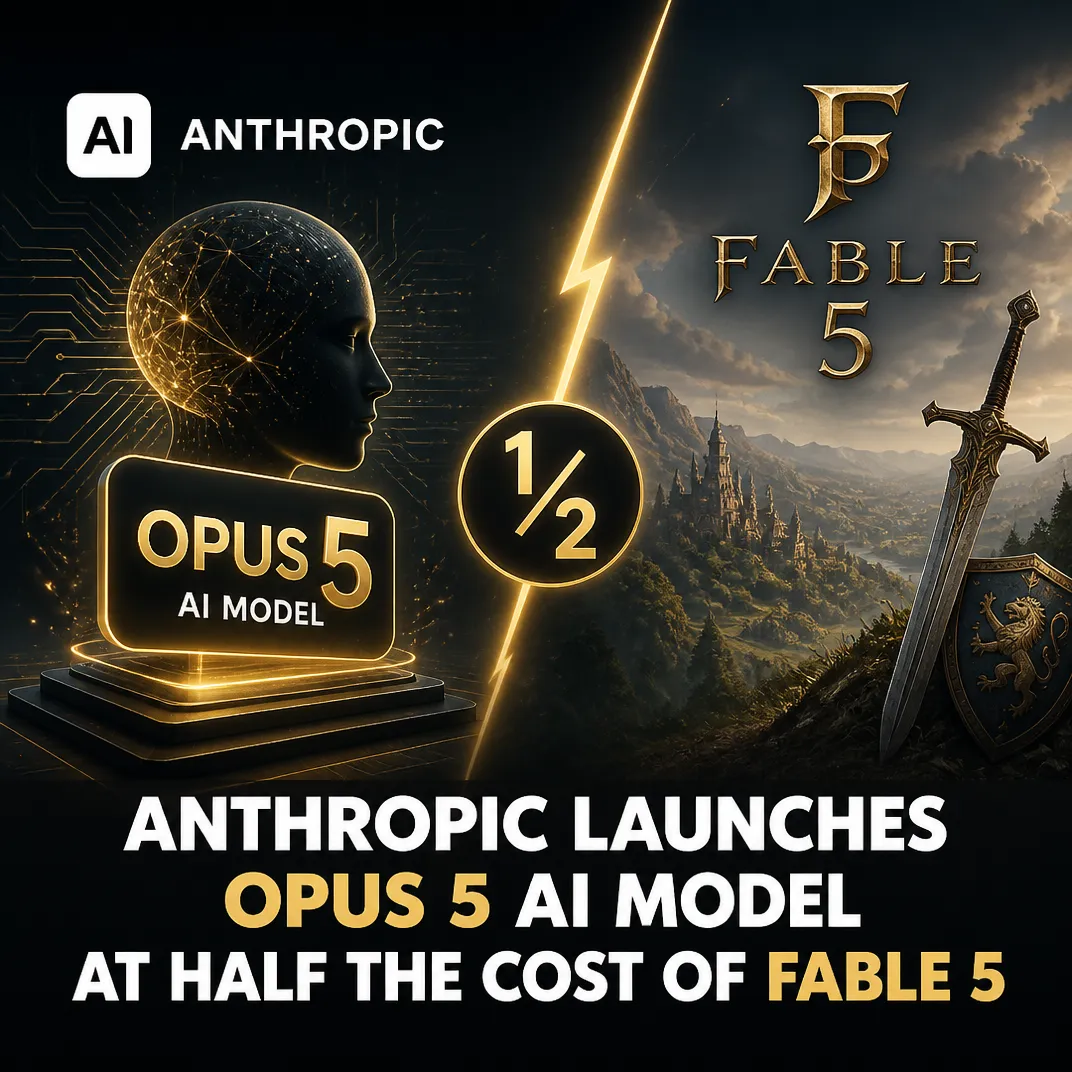
July 25, 2026, (Inside AI) — Anthropic has launched Opus 5, a new AI model that delivers near-Fable 5 performance at half the cost. The release, announced Friday, targets everyday office work and coding tasks with improved efficiency over its predecessor, Opus 4.8, which debuted in May.
The San Francisco-based startup positions Opus 5 as a value-driven alternative to its top-tier Fable 5 model, which was temporarily pulled in June after U.S. officials raised concerns about potential foreign military intelligence diversion. Opus 5 arrives with less restrictive safeguards, partly because it proved less capable of exploiting cyber vulnerabilities in testing.
"We're building and continue to consistently deliver frontier intelligence and bring that as accessibly as possible with every model generation," Dianne Penn, Anthropic product leader, told Reuters.
Benchmark results show Opus 5 trails Fable 5 in raw capability but excels in safety and cost-effectiveness. Anthropic reports the model was less susceptible to being tricked into misuse than its other current models, a trade-off that allowed engineers to relax certain guardrails without increasing risk. This makes it particularly suitable for enterprise deployments where budget and security are paramount.
The pricing structure underscores a strategic shift. While Fable 5 targets "days-long, very autonomous projects," according to Penn, Opus 5 handles routine coding and document analysis at 50% lower cost. This bifurcation mirrors industry trends where providers offer tiered models—one for peak performance, another for scalable efficiency—as seen with OpenAI's GPT-4o and GPT-4o mini.
Safeguards and Security Trade-offs #
Opus 5's reduced cyber exploitation capabilities directly informed its lighter restrictions. Anthropic's safety evaluations, detailed in a company research paper, show that models with lower offensive potential require fewer constraints to prevent misuse. This design philosophy allows Opus 5 to operate more flexibly in controlled environments without compromising Anthropic's responsible scaling policy.
The timing is notable. Fable 5's June availability hiccup—sparked by U.S. government intervention—highlighted the geopolitical tightrope AI developers walk. Opus 5 avoids such scrutiny by design, offering a domestically safer profile while still advancing frontier capabilities. It also sidesteps the open-weight model debate, which Penn addressed when asked about China-based Moonshot's Kimi K3.
"It remains to be seen" how open-weight models perform on complex real-world projects, Penn said, referencing U.S. accusations that Moonshot "freeloaded" off Anthropic's technology. Open-weight models let users download and customize AI systems, unlike proprietary ones like Claude—a distinction that fuels ongoing disputes over intellectual property and national security.
Open-Weight Rivalry Intensifies #
The Moonshot controversy underscores a broader industry clash. Open-weight models, such as Meta's Llama series, promise transparency but raise concerns about uncontrollable proliferation. Anthropic's closed approach, reinforced by Opus 5, bets that enterprise customers will pay for integrated safety and reliability over raw customizability. A recent academic analysis suggests closed models maintain an edge in safety benchmarks, though the gap narrows with each open-source iteration.
Opus 5's launch also reflects Anthropic's accelerated release cadence. Moving from Opus 4.8 in May to Opus 5 in July signals a maturation of its training infrastructure, likely leveraging advances in constitutional AI and compute scaling. The model is available immediately via Anthropic's API and consumer chat interface, with enterprise-tier support for on-premises deployment.
For users, the choice is clear: Opus 5 for daily productivity, Fable 5 for moonshot projects. Both models will coexist, Penn confirmed, with future updates expected to further narrow the capability gap while preserving distinct safety profiles.